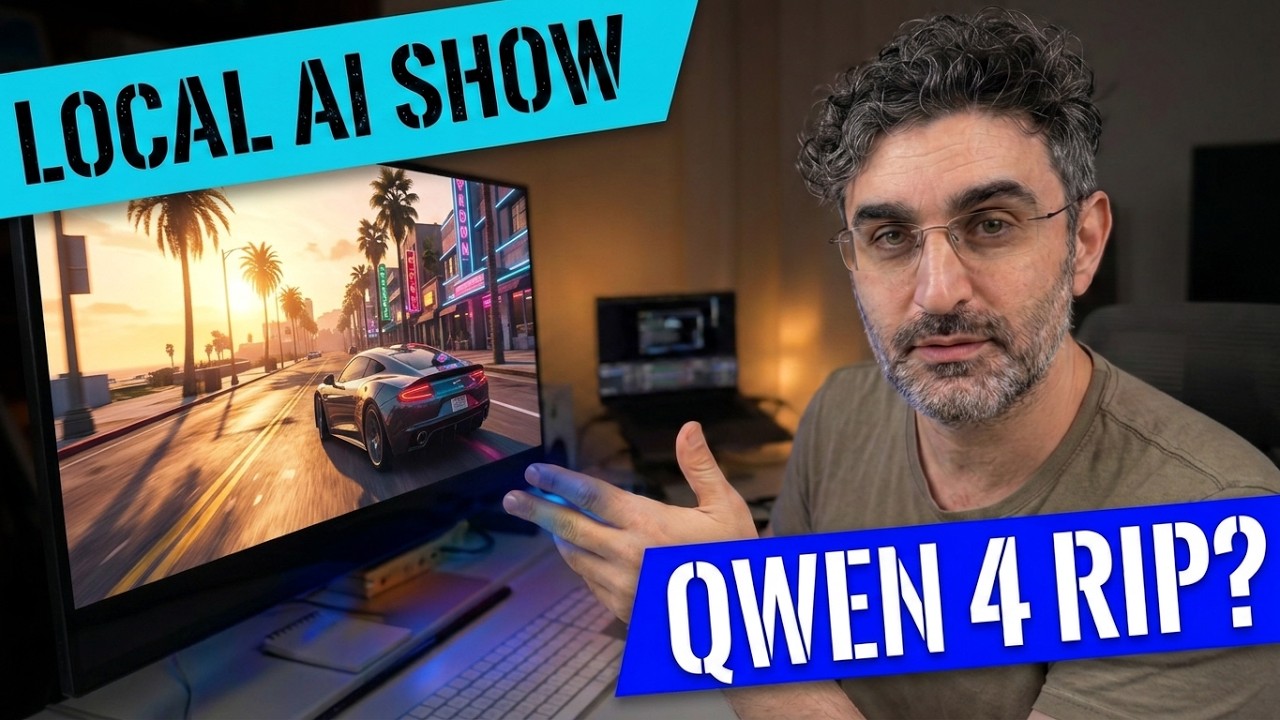
I Tested Inkling 2 Mini for 24 Hours... Better than Qwen 4? 🤯
Keywords
Summary
116 words
Critical Evaluation
Value of the Information & Strength of the Argument
The video provides valuable empirical data on the capabilities of a newly released small LLM. The creator demonstrates many real-world use cases, including 3D graphics generation, website creation, and complex game simulations. The argumentation is supported by visual evidence and token counts, but it is largely anecdotal and lacks statistical rigor. The comparison with other models is informal, relying on personal impressions rather than standardized benchmarks. Nonetheless, the information is useful for practitioners considering local deployment of this model.
Scientific Rigor, Source Quality, Title Accuracy
The video cites the model’s Hugging Face page and an inference tool, which are relevant. However, the channel appears to be affiliated with the model developers, since the model is hosted under ‘inferencerlabs’ and the link to inferencer.com is provided. This poses a conflict of interest. The title is designed to attract clicks with ‘24 Hours’ and ‘Better than Qwen 4?’ which is not fully substantiated in the content. The actual testing is extensive but not systematic, lacking controlled conditions and reproducibility. No external benchmarks are provided beyond the creator’s own tests.
186 words
Title / Content Match
The title suggests a 24-hour continuous test and direct comparison with Qwen 4, whereas the video actually shows a series of prompt-based evaluations over an unspecified period. The comparison is mostly with Qwen 3.8 and includes a few references to Qwen 4. Somewhat clickbait.
Quality & Reliability
6/10
The video provides extensive hands-on testing of the Inkling 2 Mini model, but the evaluation is subjective, lacks controlled methodology, and the channel has commercial ties to the model (affiliate links and same organization).
Chapters
- Intro & Inkling 2 Mini Architecture
- Benchmarks vs Qwen 3.8 & Qwen 4
- Local Speed & Tokens Per Second Tests
- 3D Solar System & Thinking Modes Comparison
- Python 3D Graphics & Thinking Loops
- Nuclear & Volcano Explosions (Safety & Token Limits)
- Photorealistic 3D Human Face Generation
- Temperature 0 vs Temperature 1 Tests
- 3D Human Anatomy & Expanded Thinking Detection
- Exploding 3D Helicopter Demo
- Modern Website UI Generation
- Animated Infographic Test
- Interactive Animated Weather Widgets
- 2D Canvas Parallax Driving Simulation
- Logic Pro Style Music App UI
- 3D Fat Cat Game in Three.js
- GTA in a Single HTML File (Base vs Q9)
- GTA Multi-File Agentic Generation
- Red Dead Redemption
- 3D Go-Kart Racing Game
- Common Sense, Riddle & Logic Tests
- Coding & Math Problem Solving
- Final Verdict
Cited Sources
- Inkling 2 Mini MLX — Model page for the base pre-quantized version.
- Inkling 2 Mini Q9 — Model page for the 9-bit quantized version.
- Inferencer — Inference tool used for testing.
- DeepSeek 4.1 Streaming — Companion video comparing other models.
- Kimi K3.1 — Companion video comparing other models.
- GLM 5.3 — Companion video comparing other models.
Contribution & Novelties
This video offers one of the first detailed, practical evaluations of the Inkling 2 Mini model, emphasizing its strengths in generating interactive 3D and web content. It highlights the model’s unique looped architecture and the impact of thinking modes on output quality. The demonstration of the Q9 quantized version’s performance is particularly useful for users with limited resources. However, the content is primarily a product showcase rather than a rigorous academic study.
Pour aller plus loin :
- Mixture of experts — Hierarchical expert routing, a key technique in modern LLMs like Inkling.
- QLoRA: Efficient Finetuning of Quantized LLMs — A method for quantizing models while preserving performance, relevant to the Q9 quantized version.
- llama.cpp — A popular framework for running quantized LLMs locally, enabling inference on consumer hardware.
128 words
Radar Profile
The radar profile shows a strong quantity of information (9) but moderate quality (6) and reliability (5). High technical level (8) indicates the content is suitable for an audience familiar with AI/ML concepts. The main weaknesses are the lack of rigorous methodology and potential bias, lowering the overall trustworthiness.