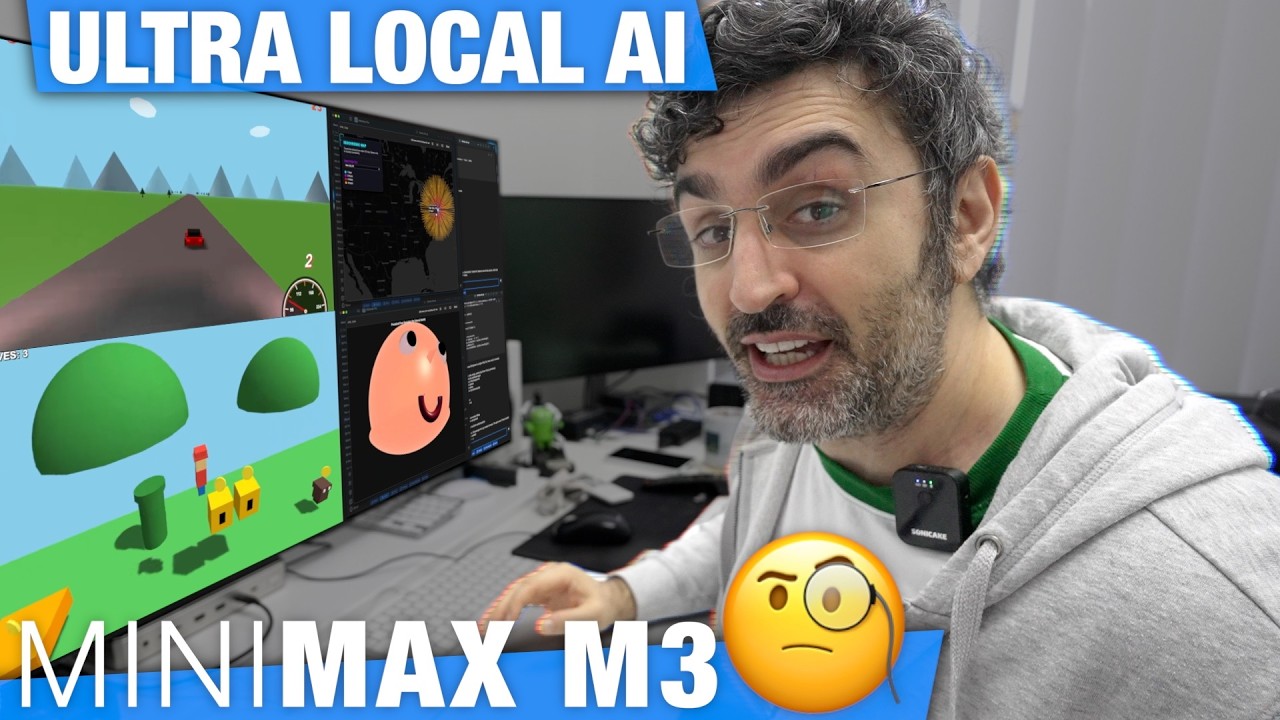
MiniMax M3 - Better than Qwen, GLM & Opus? 🧐 Open Source AI TESTED
Keywords
Summary
160 words
Critical Evaluation
Value of the Information & Strength of the Argument
The video offers valuable empirical data on MiniMax M3’s capabilities, directly comparing it with M2.7 and other models in a consistent test set. The argumentation is based on practical demonstrations rather than theoretical claims, showing actual outputs and discussing trade-offs such as speed vs intelligence. The presenter is candid about failures and limitations, which strengthens the credibility. However, the evaluation is subjective and lacks rigorous benchmark controls, and the comparison with Opus is notably absent despite being in the title.
Scientific Rigor, Source Quality, Title Accuracy
The video references its own test methodology and uses the HuggingFace model page as a primary source for model details. It also links to companion videos for other model evaluations, which adds context. The title is catchy but slightly misleading as it mentions Opus without direct testing. The content is scientifically presented in a practical manner, but the lack of statistical rigor and potential biases from the presenter’s preferences (e.g., speed vs intelligence) affect the overall reliability.
172 words
Title / Content Match
The title promises comparison with Qwen, GLM and Opus, but the video mainly compares with GLM and Kimi, and Opus is not directly tested. Partially adequate, but the core focus on MiniMax M3 is clear.
Quality & Reliability
8/10
The video provides extensive hands-on testing with quantitative metrics (tokens, speed, memory) and clear comparisons, though subjective in evaluation. The presenter demonstrates real outputs and acknowledges limitations, lending credibility to the assessment.
Key Moments
Markers derived by PSI from the transcript: the creator did not define chapters.
- Introduction to MiniMax M3, its size, and license overview.
- Voxel generation test comparing M2.7 and M3 with an image of a cat.
- Piano test showing M3's improved performance with lyrics and notes.
- Photo-realistic face generation test; M3 produces a 'potato' face.
- Minecraft generation test; M3 with thinking enabled yields a good world.
- Procedural planet generator test; M3 produces a decent planet with asteroid impact.
- Outrun game clone test; adaptive thinking mode creates a playable version.
- Super Mario 3D game test; M3 with thinking enabled makes a functional game.
- Math Olympiad problem test; M3 with adaptive thinking solves correctly.
Cited Sources
- HuggingFace Models - inferencerlabs/minimax-m3 — Official HuggingFace directory for MiniMax M3 model files and documentation.
- Inferencer App — Third-party inference application used to run the model locally.
- GLM 5.2 Companion Video — Video comparing GLM 5.2, providing context for M3's performance.
- Kimi K2.7 Companion Video — Video evaluating Kimi K2.7, another model in the comparison.
- MTP AI Harness Companion Video — Video about AI harness, possibly related to testing methodology.
External References
Contribution & Novelties
This video provides a practical, side-by-side comparison of MiniMax M3 against its predecessor M2.7 and other open-source models, focusing on real-world creative coding tasks rather than standard benchmarks. It highlights M3’s enhanced vision capabilities and improved performance when using thinking modes, while also exposing the trade-offs in speed and memory usage. The licensing discussion adds important context for potential adopters.
Pour aller plus loin :
- Large language model — Overview of LLMs, relevant context for understanding MiniMax M3.
- Voxel — Explains the voxel representation used in generation tests.
- Speculative decoding — Technique to speed up inference, mentioned as a possible optimization.
- Procedural generation — Concept underlying the planet and map generation tests.
112 words
Radar Profile
The radar profile shows high scores in quantity of information (9) and technical level (8), indicating a comprehensive and detailed review. Quality of information (7) and reliability (7) are slightly lower, reflecting the subjective nature and lack of rigorous benchmarking. This suggests the video is informative but should be complemented with more formal evaluations.