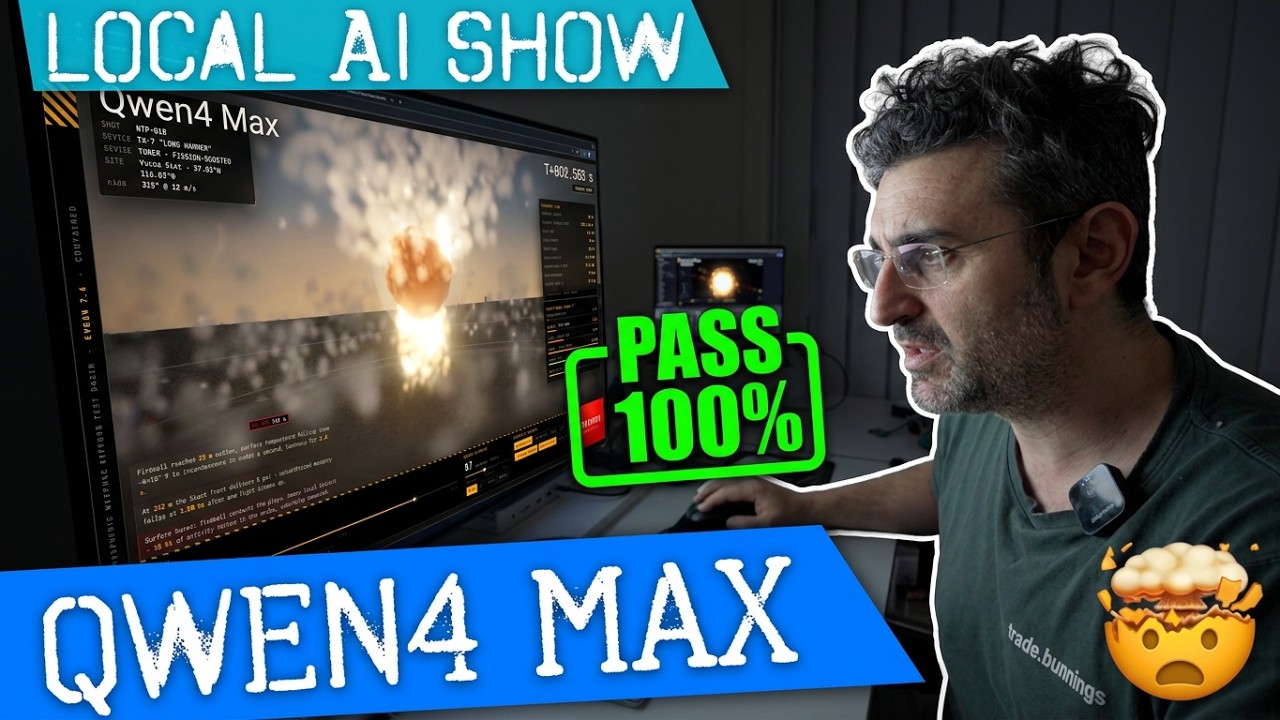
I Tested Qwen4 Max vs Local FN... The Gap Is INSANE 🤯
Title history
- I Tested Qwen4 Max vs Local FN... The Gap Is INSANE 🤯 — observed on 20261116-1132 UTC (YouTube)
Keywords
Summary
178 words
Critical Evaluation
Value of the Information & Strength of the Argument
The value of the information lies in the practical demonstrations and the direct comparison between cloud-based frontier AI and local open-weights models. The argumentation is persuasive through concrete examples, though it is primarily anecdotal and lacks controls (e.g., fixed prompts, repeat runs, or systematic scoring). The creator does acknowledge limitations such as prompt dependence and occasional errors, but the overall assessment is subjective and influenced by personal experience and potential affiliate marketing. The evidence is enough to illustrate the gap but not to provide a statistically robust comparison.
Scientific Rigor, Source Quality, Title Accuracy
The video cites specific model versions and provides links to the employed software and model files in the description, which aids reproducibility. However, no external verification or independent benchmarks are included, and the quality of sources is limited to the creator’s own tests and the provided HuggingFace pages. The title fairly represents the content, and there is no major discrepancy between advertised and delivered material. The presence of affiliate links in the description could introduce bias, but this is not reflected in the core testing methodology. Overall, scientific rigor is moderate: the demonstrations are reproducible but not exhaustive, and the lack of standardized evaluation prevents broader generalization.
210 words
Title / Content Match
The title accurately reflects the content: a practical head-to-head test between Qwen4 Max and a local Qwen 3.8 Flash-Next, emphasizing the remarkable performance gap.
Quality & Reliability
7/10
The video provides hands-on demonstrations and transparent comparison of two AI models, but relies on subjective testing, affiliate links, and lacks rigorous benchmarking methodology or independent verification.
Chapters
- Benchmarks Overview
- Cloud vs Local
- Nuclear Explosion Simulation
- Volcano Eruption Simulation
- Context Attention Feature Breakdown
- Nuclear Detonation Demo
- Interactive Volcano Demo
- Procedural 3D Human Face
- Generating GTA 5 in WebGL
- Modern Interactive 3D Website
- HTML Infographic Test
- Interactive Music DAW App
- Hard Coding Test
- Fixing Issues
- Testing Music Gen & GTA
- Final Verdict & Summary
Cited Sources
- Alibaba Cloud Token Plan — Link to the cloud service plan used to run Qwen4 Max online.
- Inferencer v2.5.3 — Tool used for testing and managing AI model generations.
- Qwen3.8 Flash-Next MLX Q9s — HuggingFace page for the local Qwen 3.8 Flash-Next model used in the comparison.
- Qwen3.8 Flash-Next MTP MLX — HuggingFace page for the local model with multi-token prediction capabilities.
Concurring Sources
- Qwen3.8 Flash-Next MLX Q9s — Model page confirming the existence and specifications of the local model.
- Qwen3.8 Flash-Next MTP MLX — Model page confirming MTP implementation for local inference.
External References
Contribution & Novelties
The video offers a hands-on, visual comparison of a newly released frontier model (Qwen4 Max) against a state-of-the-art local open-weights model, emphasizing practical implications for developers and creators. It showcases the ability of cloud models to handle complex, long-context generation tasks with high speed and minimal errors, while highlighting the trade-offs of local deployment. The demonstration of a correct WinRT subscription handling in fast mode is a notable unique finding.
Pour aller plus loin :
- Large language model (Wikipedia) — Context on LLM capabilities and sizes.
- Transformer architecture (Wikipedia) — Foundational architecture for these models.
- Qwen3.8 Flash-Next MTP MLX (HuggingFace) — Explanation of multi-token prediction technique used in local models.
110 words
Radar Profile
The radar profile shows a balanced but moderate performance across all dimensions, with higher scores on quantity of information and technical level, but lower on global reliability. This indicates a knowledgeable content creator providing extensive demonstrations, yet lacking rigorous scientific methodology and external validation.