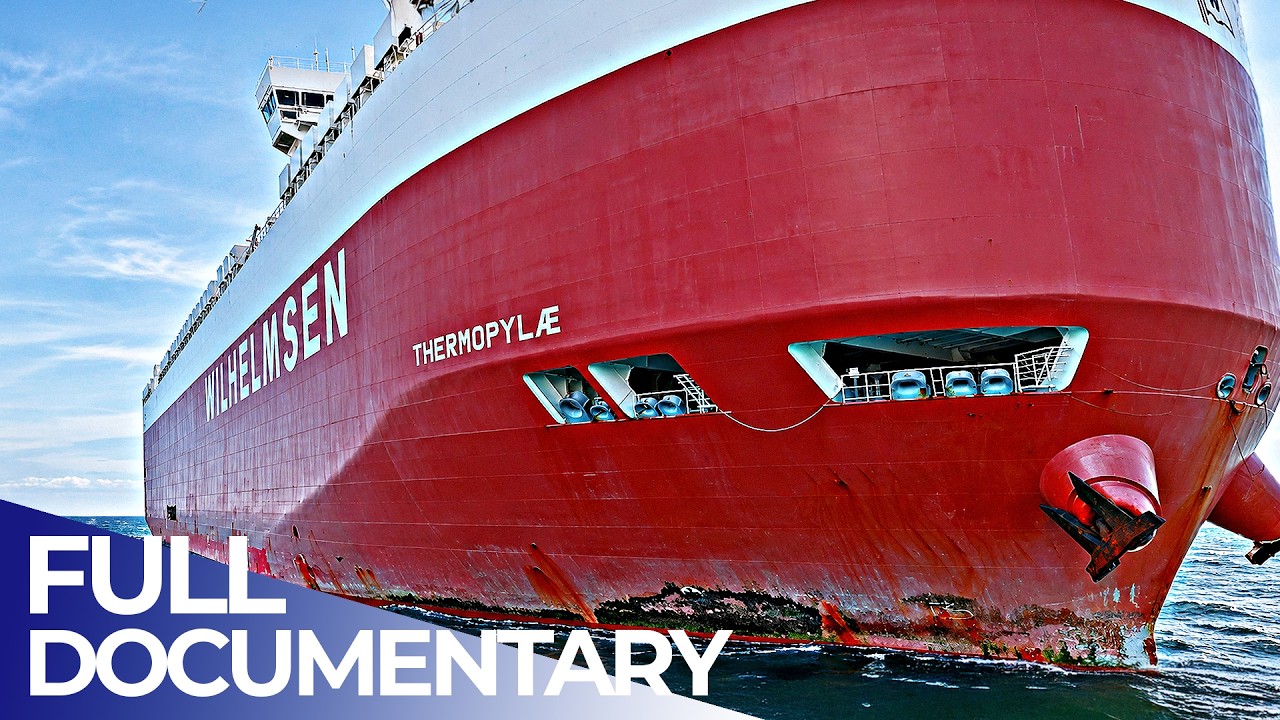
8,000 Cars, 13 Decks | MV Thermopylae: Inside a Monster Cargo Ship | FD Engineering
Keywords
Summary
194 words
Critical Evaluation
Value of the Information & Strength of the Argument
The value of the film lies mainly in its access: it shows concrete operational sequences that are rarely visible to outsiders, including pilot boarding in heavy weather, lock transit, ramp deployment, vehicle lashing, survey inspection, mooring-line handling and a large marine-engine overhaul. These sequences give a practical sense of the coordination, timing and safety margins involved in ro-ro shipping. Its argumentation, however, is narrative and observational rather than analytical. The film explains what is happening and why it matters operationally, but it does not test claims, compare competing figures, discuss uncertainty or situate the ship within broader fleet and market data. Technical details are often delivered through voice-over and crew testimony without supporting calculations, diagrams or independent verification. The result is informative as a documentary account of operations, but it should not be treated as a technical reference for ship specifications or industry-wide performance.
Scientific Rigor, Source Quality, Title Accuracy
Scientific rigor is limited: the film does not cite studies, classification-society rules, port authority documents or independent naval-architecture sources, and its numerical claims are mostly presented without units, definitions or provenance. Source quality rests on direct observation and crew testimony, which is valuable for operational texture but weak for verifying specifications or generalizing about the fleet. The title/content match is strong: the film really is about the MV Thermopylae, its 13 decks, its vehicle capacity and the engineering and logistics of operating it.
242 words
Title / Content Match
The title accurately reflects the content: the film focuses on the MV Thermopylae, its 13 decks, vehicle capacity, and the engineering and logistics of its port operations.
Quality & Reliability
6/10
The film offers privileged onboard access and consistent operational detail, but it is a narrated observational documentary rather than a sourced technical report; most figures are not independently referenced within the video, and several broad claims are presented without qualification.
Key Moments
Markers derived by PSI from the transcript: the creator did not define chapters.
- Introduction to the MV Thermopylae and its headline specifications: 75,000 tons, 13 decks, 8,000-car capacity and a 390-ton ramp.
- A maritime pilot attempts to board the ship in rough North Sea conditions, requiring an emergency tugboat to create shelter.
- The pilot guides the vessel through a narrow lock into Bremerhaven, coordinating tugs, rudder, main engine and bow thruster.
- The stern ramp is deployed and the crew begins loading more than 700 vehicles within a tight schedule.
- An annual survey inspection tests generators and emergency equipment, with a false alarm briefly disrupting the process.
- High winds prevent the pilot from leaving by boat, forcing a helicopter airlift and putting the schedule behind.
- A Belgian national strike threatens to delay the ship in Zeebrugge, while port operations managers redistribute work gangs.
- The chief engineer oversees a main-engine overhaul, including removal of a 1.5-ton piston under time and safety pressure.
- Prestige cars, including Lamborghinis, are loaded with specialist drivers and strict clearance and handling rules.
- The ship heads across the English Channel toward Southampton, closing with a glimpse of daily crew life in the galley.
Cited Sources
- World's Largest Cargo Ships - Titans of the High Seas — Related documentary linked in the video description; it is not an independent scientific source used in the film.
Concurring Sources
- General naval-architecture descriptions of ro-ro vehicle carriers — Specialized vehicle carriers are generally described as using internal ramps and multiple decks, consistent with the film's account.
- Standard maritime pilotage and tug-assisted docking practice — The use of pilots, tugs and coordinated engine/thruster control in restricted ports is standard for large vessels.
- IMO and port-state inspection frameworks for ship surveys — Annual or periodic surveys of safety and technical systems are routine in commercial shipping, matching the inspection sequence.
Dissenting Sources
- Panama Canal expansion chronology — The narration says new locks were built in 2007; the expansion project began in 2007, but the new locks opened in 2016. This is a chronological simplification rather than a central error.
- Ship tonnage terminology — The film says the ship 'weighs 75,000 tons' without specifying gross tonnage, deadweight or displacement; these are distinct measures and the ambiguity matters for technical comparison.
Contribution & Novelties
The film’s original contribution is observational rather than scientific: it provides a close operational portrait of a large vehicle carrier, from pilotage and lock transit to ramp operations, inspection, mooring, engine overhaul and prestige-car loading. It does not introduce new data or a new analytical framework, but it makes visible the coordination and safety culture behind ro-ro shipping.
Further reading:
- Roll-on/roll-off — Background on the ro-ro shipping method central to the film.
- Car carrier — Context for the specialized vessel type and its deck arrangements.
- Maritime pilot — Explains the role of the pilot shown boarding and guiding the ship.
- Panama Canal expansion — Relevant to the film’s discussion of wider locks and larger vessel dimensions.
- Two-stroke diesel engine — Technical background for the main-engine overhaul sequence.
127 words
Radar Profile
The profile is strongest in information quantity and moderate in technical depth, reflecting a detailed operational documentary rather than an engineering analysis. Reliability and source rigor are lower because claims are presented without citations or independent verification. Overall, the film is informative and visually concrete but should be used as an introduction, not as a technical authority.