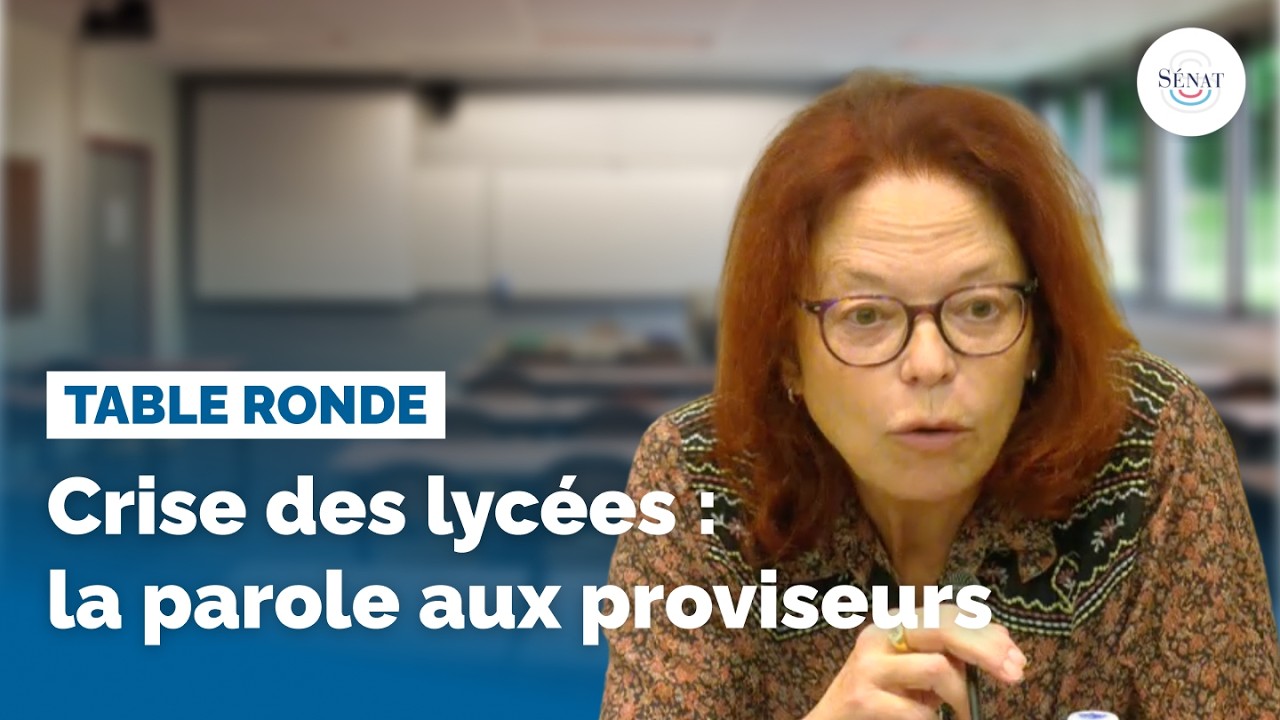
Crise des lycées : la parole aux proviseurs
High school crisis: giving the floor to principals
Keywords
Summary
151 words
Critical Evaluation
Value of the Information & Strength of the Argument
The value of the information lies in its direct, firsthand perspective from school principals who are on the ground and have experienced the crisis. The representatives provide concrete figures (e.g., 65% of schools without complete staff at the start of the school year, 550 establishments closed) and share personal anecdotes, such as a principal who was beaten for trying to extinguish a fire. Their argumentation is structured around five key student demands (building conditions, means, teacher replacements, schedules, and Parcoursup), and they consistently link these to broader governance criticisms. However, the discussion is largely testimonial and union-oriented, lacking external data or independent studies, which limits its analytical depth. The principles of argumentation are sound, but the lack of counterpoints and solely institutional perspective reduces the overall scientific rigor.
Scientific Rigor, Source Quality, Title Accuracy
The rigor is moderate: the hearing is an official parliamentary commission, ensuring a formal framework and credibility of the speakers as union leaders. However, the sources are exclusively testimonial, and no written documents or studies are cited during the session. The title matches the content precisely, as the session indeed gives voice to principals. The discussion is coherent and stays on topic, but it does not engage with opposing views or provide a balanced analysis. The lack of external references, beyond the unions’ own surveys, limits the scientific rigor. No comments were provided, so public reception could not be assessed.
243 words
Title / Content Match
The title accurately reflects the content: the session focuses on the crisis in French high schools, giving the floor to principals and their unions.
Quality & Reliability
7/10
The hearing features official representatives of principal unions, provides concrete data and situational reports, but remains an institutional discussion with partisan perspectives and no independent verification.
Key Moments
Markers derived by PSI from the transcript: the creator did not define chapters.
- Opening remarks: President expresses outrage over violence and supports the hearing.
- Bruno Bobkiewicz begins his speech, detailing attacks on principals and lack of staff.
- Bobkiewicz discusses Parcoursup, defending the tool and blaming lack of university places.
- Agnès Andersen speaks about the invisibility of principals and criticizes governance.
- Andersen condemns the pressure on principals to maintain classes and highlights the role of unions.
- Laurent Kaufmann takes the floor (likely topics: building conditions and staff replacement).
- Questions from senators begin, addressing specific issues like cyberattacks and climate adaptation.
Contribution & Novelties
This hearing provides a rare direct platform for school principals to express their views on the ongoing crisis, offering insights into the operational challenges and psychological impact on educational leaders. It adds to the public discourse by highlighting the often-overlooked role of principals and non-teaching staff.
Pour aller plus loin :
- Parcoursup (Wikipedia) — The higher education admission platform discussed at length; the principals defend it but criticize the lack of places.
- SNPDEN (Wikipedia) — The main union for school principals, whose representative Bobkiewicz speaks.
- ID-FO (Wikipedia) — Another union representing principals, led by Agnès Andersen.
- Rythmes scolaires (Wikipedia) — Mentioned as a necessary but complex topic for addressing student schedules.
111 words
Radar Profile
The radar profile shows a balanced score across information quality and reliability, with a slightly lower technical level, reflecting the testimonial and policy-oriented nature of the hearing rather than a deep technical analysis.