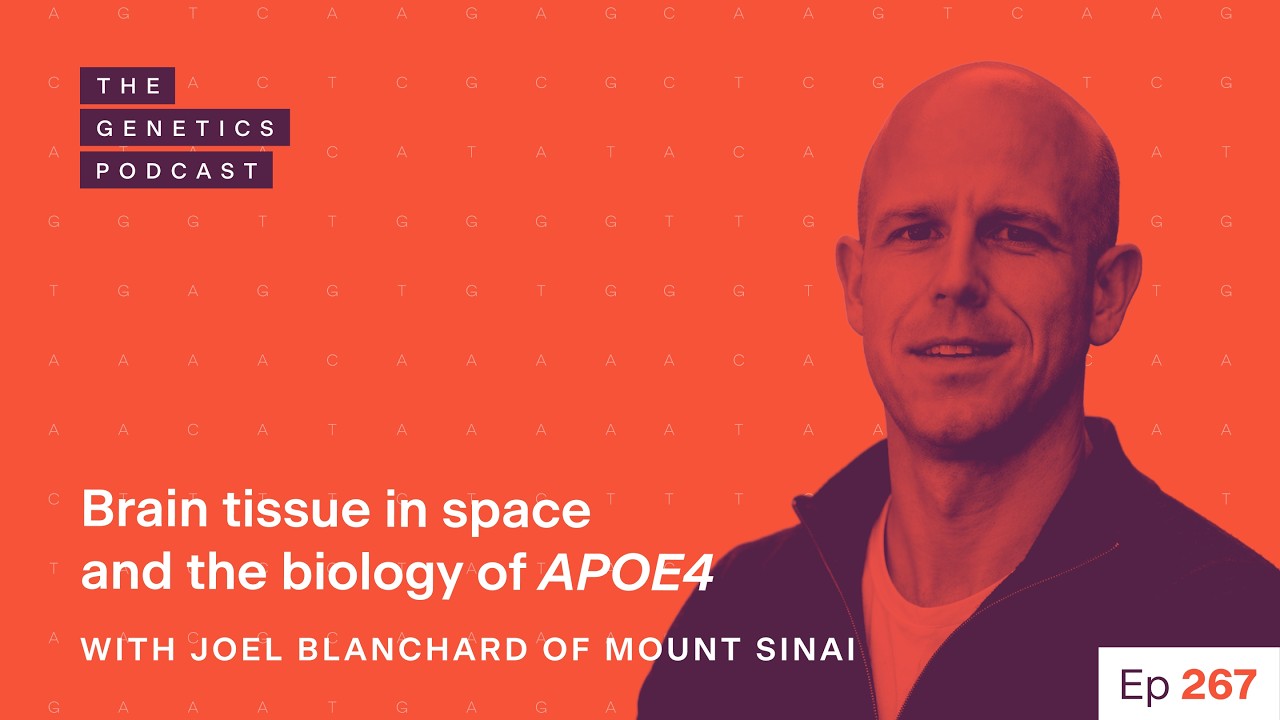
EP 267: Brain tissue in space and the biology of APOE4 with Joel Blanchard of Mount Sinai
Keywords
Summary
265 words
Critical Evaluation
Value of the Information & Strength of the Argument
The informational value lies in the density of mechanistic detail about how a complex human tissue model is actually built and validated, a level of procedural specificity rarely offered in general science coverage. Blanchard names the cell types used, describes the self-assembly matrix, explains the benchmarking strategy against matched post-mortem tissue, and outlines the logistics of the spaceflight experiment from launch to splashdown and sample handover. The argumentative structure is consistently causal: human single-cell transcriptomic data generate a hypothesis, the in vitro model provides longitudinal and mechanistic resolution, and mouse work tests whether the pathway can be manipulated in vivo. This three-step chain is presented as a template for functional validation of correlative genetic data, and it is a coherent one. The speaker is also careful about epistemic status: he explicitly labels parts of his spaceflight reasoning as speculative, concedes that a hundred-donor benchmarking study is unfinished and that its outcome is unknown, and lists concrete deficiencies of the model. The main weakness is that claims are made at a level of generality that resists verification within the episode: figures such as the scale of collective genome sequencing are rounded and unattributed, and no effect sizes, sample sizes or statistical results are given for the Cell paper. The therapeutic discussion is framed as a survey of competing hypotheses rather than an argued position, which is honest but leaves the listener without a way to weigh the alternatives.
Scientific Rigor, Source Quality, Title Accuracy
Rigour is good for the format. The guest distinguishes what is known from what is hypothesised, flags uncertainty explicitly, and volunteers the limitations of his own system, including the restricted neuronal diversity, the absence of a gut-brain axis and the lack of circadian organisation, and the practical difficulty of running multi-year experiments with trainees on five-year horizons. The discussion of the anti-amyloid antibodies is broadly accurate in outline, noting that they slow rather than reverse progression and that APOE4 homozygotes face elevated ARIA risk, although the statement that anti-amyloid agents are the only approved Alzheimer’s drugs overstates the position in most jurisdictions. No references, DOIs or direct citations are given in the episode or in the show notes, which contain only a timestamped agenda; the sources below are therefore the studies named in speech rather than linked documents. The title-to-content match is strong: both the spaceflight work and the APOE4 biology announced in the title occupy substantial portions of the runtime.
413 words
Title / Content Match
The title is fully consistent with the content: the episode covers the MiBrain tissue sent to the International Space Station and the APOE4 biology work in roughly equal measure.
Quality & Reliability
8/10
Interview with a practising academic neuroscientist who describes his own laboratory's methods and results in detail, distinguishes established findings from speculation, and states the limitations of his model system openly. Reliability is limited by the absence of any explicit bibliographic reference, numerical effect sizes or external corroboration within the episode, and by the fact that the work discussed is partly unpublished or still in progress.
Chapters
- Intro to The Genetics Podcast
- Welcome to Joel
- How the MiBrains developed in Joel's lab ended up in space and the aims of the NASA research
- How MiBrains are built from stem cells and benchmarked against real human biology
- Using MiBrains to functionally validate genetic data, including APOE4 and vascular degeneration
- Whether APOE4 carriers have a distinct form of Alzheimer's or APOE4 is a prototype for lipid dysregulation more broadly
- Modeling single variants and whole patient genetic backgrounds
- Hypotheses for how spaceflight stress affects APOE3 and APOE4 MiBrains
- Current Alzheimer's therapies and competing approaches for APOE4
- Other brain diseases MiBrains can model and the limits of the system
- Modeling aging and long-term disease progression in MiBrains
- Using MiBrains for neurotoxicity testing across the drug development process
- Whether a diverse MiBrain bank could represent the population and why oligodendrocytes are hard to make
- Joel's family history of Alzheimer's and subsequent path into stem cell research
- How AI is changing the work and training of PhD students and postdocs
- Early-life myelin differences in APOE4 carriers and what they mean for treating Alzheimer's
- Closing remarks
Cited Sources
- Cell paper from the Blanchard lab on APOE4 and cerebral vascular degeneration — Cited as the study using single-cell transcriptomics to define a cohort, identifying pericyte proportion changes and a myofibroblast-like population in APOE4 brain vasculature, with reversal via TGF-beta pathway modulation in MiBrain culture and in mice.
- U54 benchmarking study comparing MiBrains with matched post-mortem human brain — Described as an in-progress consortium-scale effort across approximately one hundred individuals, testing whether donor-specific transcriptomic signatures and pathology are recapitulated in the tissue model.
- NASA tissue-chip funding opportunity for long-term culture maintenance — Presented as the origin of the collaboration, initially supporting maintenance of tissue chips for roughly six months before extension to spaceflight experiments.
- Upcoming December 2027 spaceflight with astronaut-derived MiBrains — Future mission in which tissue made from astronauts' cells would fly alongside them for around nine months, with paired peripheral blood biomarker sampling.
- Paola Arlotta (Harvard) long-term cortical organoid study — Invoked as the closest analogue for modelling aging in culture, with organoids maintained for five years and methylation clocks showing maturation over that period.
Concurring Sources
- Long-term maturation of human cortical organoids over multi-year culture, showing methylation-clock progression — Consistent with the claim that organoid systems can partially recapitulate aspects of developmental and aging trajectories in vitro.
- Clinical literature on amyloid-related imaging abnormalities (ARIA) with anti-amyloid antibodies and elevated risk in APOE4 homozygotes — Corroborates the account of why some centres are reluctant to treat APOE4 homozygotes with anti-amyloid therapies.
Contribution & Novelties
The episode’s distinctive contribution is procedural rather than conceptual: it documents how a multi-cell-type human brain tissue model is engineered, benchmarked and physically transported to orbit, including the hardware and logistics required to feed and image living tissue on the International Space Station and the paired-ground-control design that makes the comparison interpretable. It also gives an unusually candid account of where such models fall short, and it situates the APOE4 vascular work inside a broader argument that late-onset Alzheimer’s may be substantially a lipid-handling disorder whose vascular component precedes rather than follows amyloid accumulation.
Pour aller plus loin :
- Apolipoprotein E — Background on the isoform biology and population frequencies underpinning the APOE3/APOE4 comparisons discussed.
- Organoid — Context for the distinction drawn between conventional cortical organoids and the vascularised, multi-lineage MiBrain assembly.
- Induced pluripotent stem cell — Explains the reprogramming step that allows donor-specific and isogenic tissue sets to be generated.
- Effect of spaceflight on the human body — Reference frame for the microgravity and cosmic radiation stressors hypothesised to drive the differential APOE3/APOE4 response.
- Alzheimer’s disease — Overview in which the anti-amyloid, ARIA and lipid-dysregulation strands of the discussion can be situated.
193 words
Radar Profile
The profile is dominated by technical depth and information quality, with high scores on both, reflecting a genuinely mechanistic discussion rather than a summary of headlines. Information quantity is slightly lower because the conversation is discursive and some segments, such as career history and AI in training, sit outside the core scientific argument. Overall reliability sits just below the technical scores, reflecting the absence of citable references and effect sizes within the episode.