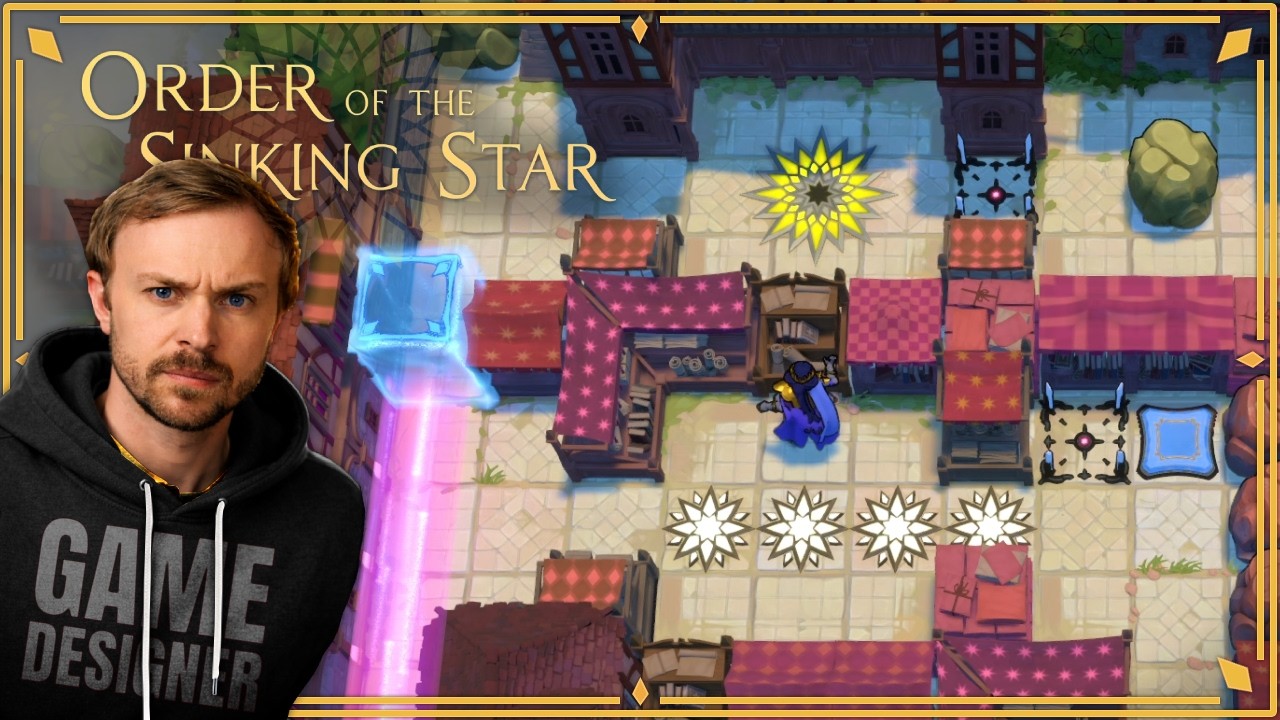
🔴 Beaming Around the Marketplace | Order of the Sinking Star Design Study
Keywords
Summary
379 words
Critical Evaluation
Value of the Information & Strength of the Argument
The informational value here is procedural rather than declarative: what the viewer gains is a documented record of how an experienced designer attacks an unfamiliar puzzle, including the wrong turns. The author narrates his hypotheses explicitly (‘I think this here is probably skipping stones territory’, ‘I have to do it from here’, ‘maybe I made a mistake’), tests them in the game, and revises them in public. Several observations have genuine transferable value for design analysis: the identification of a single spatial asymmetry as the load-bearing insight of an Izzy puzzle, the recognition that layered constraints (a beam that cannot be pushed left, a two-tile-high corridor that prevents entering the beam) are what generate difficulty, and the observation that deactivating a mechanic is itself a design affordance that reopens a level. The multiple-solution discovery — confirmed by chat, then reconciled by the author — is a concrete data point about solution-space breadth in this puzzle family, and he correctly distinguishes his own route from the one he considers ‘intended’ without overclaiming. The argumentation is therefore honest and self-aware, but it remains unstructured: no design framework is stated up front, conclusions are rarely consolidated at the end of a puzzle, and chat tangents (a long digression on Moscow ring-shaped versus Swiss graph-shaped public transport networks) consume significant time. Claims about the developers’ intent, about what a level is ‘for’ in the progression (for example, levels existing purely to open overworld shortcuts), and about difficulty ordering across the Izzy-purple series are inferences from one player’s experience, offered without evidence and sometimes contradicted minutes later. The partial transcript also means the closing ‘Afterword’ segment, where such reflections would normally be consolidated, is largely absent from the record.
Scientific Rigor, Source Quality, Title Accuracy
No external sources, studies or documentation are cited at any point; the session is entirely self-referential. The only substantive references are to the game itself, available on Steam, and to the author’s own playlists, which are production links rather than evidentiary ones. Comparisons drawn in passing — to The Witness and Braid, to Jonathan Blow’s design school, to Mini Motorways as an example of network-optimisation games, and to the Shire-like village of Hobbiton for the decorative style — function as analogies, not as supports for any claim, and carry no citation weight. The author is careful about epistemic status in one specific respect: he repeatedly distinguishes what he knows from a previous session from what he is currently guessing, and he corrects his own earlier misidentification of the hub as a library. He does not, however, distinguish a demonstrated mechanic from a preferred interpretation of that mechanic’s purpose. On title-to-content fit, the match is strong: the session is spent almost entirely on beam manipulation within and around the marketplace hub, and the chaptering (Purple, Izzy, Orange) corresponds exactly to the mechanics actually exercised. One notable absence: no advertisement or sponsored segment occurs in the transcript, so no such caveat applies.
499 words
Title / Content Match
Title is accurate: the entire session takes place in and around the marketplace hub, and nearly all of the play time is spent resolving beam-based puzzles (purple, orange, cross-sections). 'Beaming around the marketplace' is a fair literal description of the content.
Quality & Reliability
5/10
The stream is a first-hand, unedited problem-solving session by a working game designer, so the mechanical reasoning is traceable and self-correcting: hypotheses are stated, tested in-game, and revised when they fail. Reliability is limited by the format itself — no external documentation, no verification of the developer's actual intent, and design claims that rest on inference from a single playthrough. Statements about the game are generally accurate because they are immediately demonstrated on screen, while statements about why the designers built things a certain way remain explicitly speculative and are flagged as such by the author.
Chapters
Cited Sources
- Order of the Sinking Star (Steam page) — The game being played; linked in the video description as the only external reference to the subject matter.
- Order of the Sinking Star — blind playthrough playlist (edited episodes) — The author's own edited series, referenced as the context for previous sessions and for the puzzles revisited at the start of this stream.
- Order of the Sinking Star — live stream playlist — The live-series playlist linked in the description, covering the unedited sessions including this one.
- The Witness (2016 video game) — Invoked in the description and preamble as the game that reshaped the author's thinking about design and as the reason he follows Jonathan Blow's output.
- Jonathan Blow — Named as the designer whose next puzzle game the author was anticipating; the design lens applied throughout the session is explicitly attributed to him.
- Mini Motorways — Cited during the public-transport digression as an example of games built around route optimisation, used as an analogy for network topology.
Contribution & Novelties
The distinctive contribution is not new factual knowledge about the game but a live record of design cognition applied to a puzzle game that is still being documented publicly. The author captures the moment a mechanic’s boundary is discovered rather than its final description: purple beams only trigger on movement, and therefore a cross-section of two purple beams cannot be entered on foot; a beam can be switched off to make its emitter movable, which retroactively repairs a position that looked like a mistake; a character can transmute along a beam axis and be removed from the level entirely by stepping out over empty space. Equally useful is the documented divergence between the author’s solution and those reported by viewers, which turns a single playthrough into a small natural experiment on solution-space width and on which element a designer would treat as the intended climax. The recurring attention to decorative density and to the deliberately reduced scale of the environment relative to the player character offers a secondary, aesthetic-design observation that is rarely stated so plainly in puzzle-game commentary.
Further reading:
- Jonathan Blow — Background on the designer whose teaching philosophy and puzzle-first approach frame the entire analysis.
- The Witness (2016 video game) — The reference point the author cites as having changed how he thinks about design; useful for the ’teach without text’ lineage invoked here.
- Sokoban — The canonical push-box puzzle family that the Izzy goblin-swapping levels descend from; relevant to the constraint reasoning described in the stream.
- Mini Motorways — Mentioned in passing as a route-optimisation game; a concrete example of the network-topology analogy the author draws to public transport.
- Braid — Referenced alongside The Witness as part of the same designer’s catalogue; name cited without a URL to avoid asserting an unverified address.
297 words
Radar Profile
The profile is balanced-to-high on technique and information quality but capped on global reliability, reflecting a dense, mechanically sophisticated commentary delivered in an informal live format without external corroboration. Volume of information is substantial simply because of the three-hour run time, though a meaningful share is spent on chat interaction and digressions rather than on the game. Reliability sits mid-range because the claims are demonstrable when they concern the game's rules and inferential when they concern the designers' intentions.