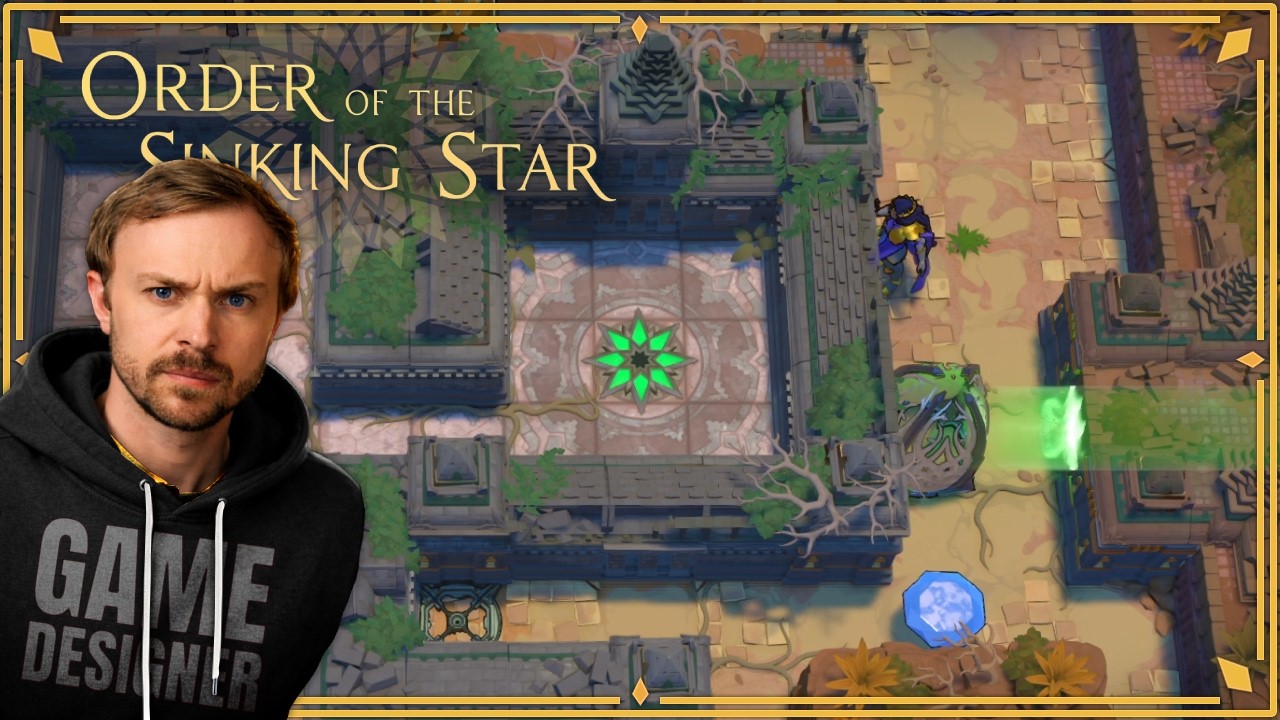
🔴 Breaking In With Beams | Order of the Sinking Star Design Study
Title history
- 🔴 Breaking In With Beams | Order of the Sinking Star Design Study — observed on 20261027-0220 UTC (YouTube)
Keywords
Summary
173 words
Critical Evaluation
Value of the Information & Strength of the Argument
The primary value of this video lies in its insider perspective: Noël, as a game designer, offers articulate, real-time reflections on why certain puzzles work, how the game teaches mechanics, and the cleverness of the level wrap-around design. His arguments are supported by concrete examples from gameplay, and he often confirms or refutes chat hypotheses with first-hand testing. The reasoning is methodical and transparent, though purely experiential and subjective, lacking formal analysis or comparison with other titles. The live interaction adds authenticity but may occasionally distract from the core design commentary.
Scientific Rigor, Source Quality, Title Accuracy
The video relies solely on the game itself and Noël’s expertise; no external academic or industry sources are cited. The description provides links to the series playlist and the Steam page of the game, which serve as reference points for viewers. The title is faithful to the content, accurately signaling a design-focused blind playthrough. There is no explicit scientific rigor, but the consistency of observations and the admission of uncertainty (e.g., about dialogue changes) enhance credibility. The title-content match is strong, with minimal deviation.
190 words
Title / Content Match
The title accurately reflects the content: a deep dive into the Beamcasters area, focusing on breaking through walls using beams, presented as a design study.
Quality & Reliability
7/10
The video offers expert design analysis from a game designer, based on direct gameplay experience. The reasoning is transparent and grounded in the game's mechanics, though subjective and not peer-reviewed.
Chapters
Cited Sources
- Order of the Sinking Star Design Study Playlist — Main playlist for the series, referenced by the creator for continued viewing.
- Live Playlist for Order of the Sinking Star — Playlist of live stream sessions, mentioned as alternative way to join the series.
- Order of the Sinking Star on Steam — The game's Steam page, linked for purchase and further information.
Contribution & Novelties
The video contributes a unique designer’s-eye analysis of a puzzle game in active development, highlighting how the game communicates mechanics through environmental design and looping levels. It offers a candid look at how a developer approaches re-solving puzzles and revisits narrative changes, which is rare in typical playthroughs.
Pour aller plus loin :
- Jonathan Blow — Jonathan Blow is the designer behind Order of the Sinking Star and known for games like Braid and The Witness. This context is relevant to understanding the design philosophy discussed in the video.
- The Witness (video game) — Blow’s previous puzzle game, which the creator cites as transformative for his thinking about game design. Exploring it provides a basis for comparing design principles.
- Sokoban — The game’s puzzle mechanics (pushing blocks, grid-based movement) derive from Sokoban, a classic puzzle genre. Understanding Sokoban helps contextualize the design choices observed.
144 words
Radar Profile
The radar profile shows high quantity of information and moderate quality/fiability, reflecting the extensive but subjective nature of the video. The technical level is moderate, appropriate for a general audience interested in game design, without being overly elementary.