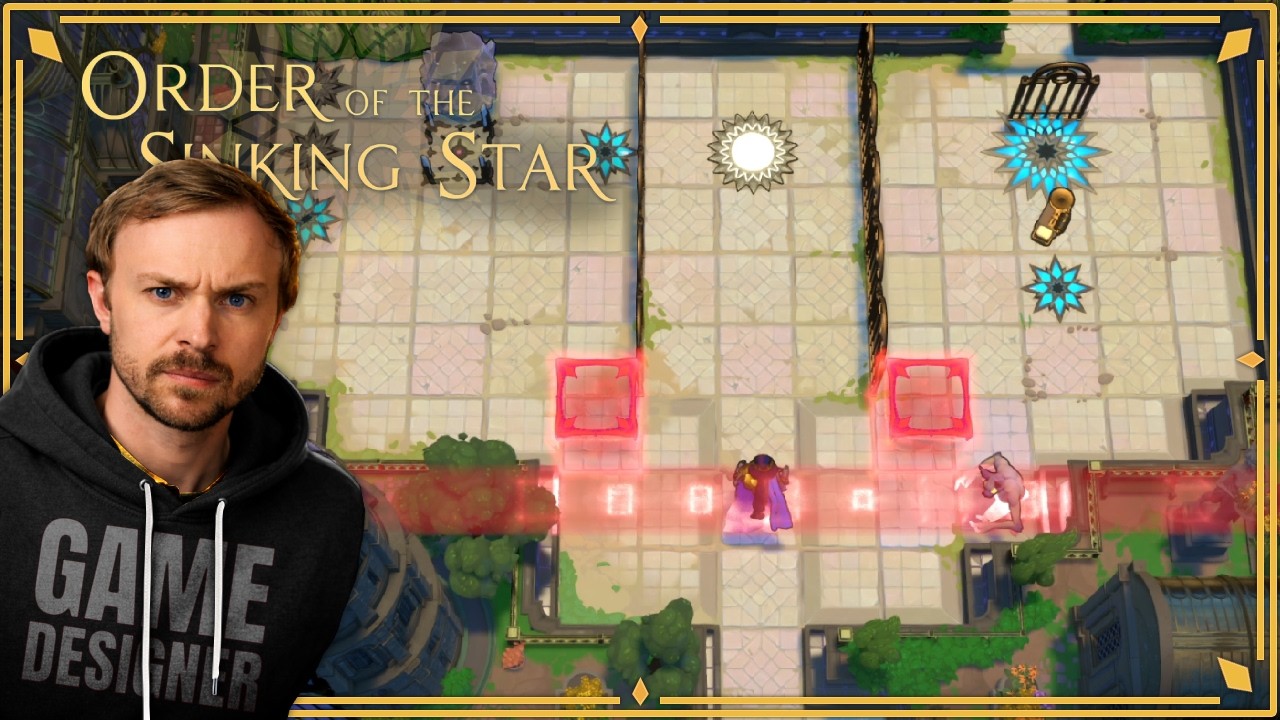
More Than Meets the Beam | Order of the Sinking Star Design Study
Keywords
Summary
343 words
Critical Evaluation
Value of the Information & Strength of the Argument
The informational value lies less in facts about the game than in the articulated reasoning that extracts general design principles from concrete play. The strongest contributions are rule-discovery sequences in which the author isolates one variable at a time: comparing a pushed rock with a pushed crystal inside the same beam to establish that beam sensitivity is object-specific; comparing a pusher inside a beam with a pusher outside it to establish that displacement distance depends on which party is in the beam; and then reusing those established rules as tools in later puzzles. This is genuine hypothesis-testing behaviour, and the argument is carried by observable evidence on screen rather than by assertion, which makes the reasoning followable and falsifiable by the viewer. The critiques of the game’s gating logic are also argued rather than merely asserted: the author identifies that two gates block exits when one would suffice, distinguishes between unlocking that changes the reachable state space and unlocking that does not, and offers a concrete alternative structure (cage the level behind completion of a prerequisite chain) with an explicit trade-off — enforcing order versus permitting parallel progression. Equally, the argumentation has clear limits. Several conclusions are reached quickly and then partially retracted, so the viewer must tolerate a moving target; the diagnosis of a puzzle as requiring the player to solve it backwards is offered as a puzzle-design insight but is supported by a single case and immediately hedged as possibly exceptional. Judgements of ‘bad design’ versus ‘well thought out’ are explicitly traced back to personal preference and to an enjoyment of reading designer intent, which is honest but leaves them as taste claims, not analysis. The comparative material is thin: no measured playtimes, no counterfactual playtests, no reference to the wider puzzle-design literature, so claims about how players in general will read a level remain extrapolations from one expert player’s experience. The value is therefore high as a worked example of design reasoning and moderate as a source of generalisable conclusions.
Scientific Rigor, Source Quality, Title Accuracy
Scientific rigour in the strict sense is absent and not attempted: this is a recorded play session with live commentary, with no method section, no control conditions and no systematic sampling of levels. What substitutes for method is a disciplined habit of stating a prediction, testing it in-game and revising it aloud, which produces internally consistent mechanical rules; the author also flags uncertainty explicitly (’not sure’, ‘maybe I’m making it too complicated’), limiting overreach. Source quality is that of direct primary observation of the artefact itself — arguably the appropriate evidence base for design analysis — but it is not triangulated: no second player, no developer statements, no design literature, no patch notes beyond a passing remark that an area’s pause screen was added in a recent patch. Claims about the game’s teaching philosophy, about sound design that softens repeated triggers, and about adaptive music are accepted from live chat and repeated without verification, and are the weakest evidentially supported passages. No advertising or sponsored segment was identified in the transcript. Regarding title-to-content fit, ‘More Than Meets the Beam’ accurately signals a session devoted to re-reading the beam mechanic and its interactions, and the chaptered structure matches the material delivered, so the title is neither inflated nor misleading.
556 words
Title / Content Match
The title's promise of looking past the surface of the beam mechanic is delivered: the session is organised entirely around re-reading beam types and the interaction between beams, crystals, rocks, goblins and gates. Scope and content align well.
Quality & Reliability
5/10
First-hand, unscripted play of a released commercial puzzle game by a self-identified game designer and programmer. Observations are grounded in directly observable mechanics (beam behaviour, push rules, gate logic, level layouts) and are therefore largely checkable by anyone replaying the same levels, which gives the content real evidential weight. However, everything remains single-observer, anecdotal and improvised: there is no systematic protocol, no measurement, no comparison corpus, no citation of external design literature, and conclusions about 'good' or 'bad' design rest on the author's personal preferences and are explicitly framed as such. The commentary is honest and self-correcting rather than authoritative, which supports moderate rather than high reliability.
Chapters
Cited Sources
- Order of the Sinking Star (Steam store page) — Store page for the game being played, linked in the description; the primary object of the analysis.
- Blind playthrough series playlist (Noël's Study) — Playlist of the full blind playthrough with design commentary, to which this episode belongs.
- Live series playlist (Noël's Study) — Playlist of the same series recorded live, referenced in the description.
Contribution & Novelties
The distinctive contribution is a documented case of rule inference in a game that never states its rules. The author builds an explicit model of beam semantics — object-specific beam sensitivity, displacement distance depending on which party occupies the beam, crystals interacting with gates where inert blocks do not — and then demonstrates the model’s predictive power by applying it to unseen puzzles. This is paired with a vocabulary for evaluating gating: the distinction between unlocking that expands the reachable state space and unlocking that merely stages progress (‘fake progress’), and the observation that parallel level sequences can be arranged so that prerequisite chains impose order without caging content. A further original point concerns puzzle legibility: the argument that a level whose obstacle is only understood at the end should instead be entered from the side that exposes the obstacle, with a concrete redesign proposal for the level in question.
Pour aller plus loin :
- Jonathan Blow — The designer whose work the author cites as the reason for following this game; useful context for the design lineage being discussed.
- The Witness (2016 video game) — The earlier puzzle game the author names as having reshaped his thinking about teaching without words; direct point of comparison for the legibility arguments made here.
- Sokoban — The canonical push-block puzzle whose displacement rules underlie the crystal, rock and goblin manipulation analysed in the session.
- Level design — Background on the discipline the author practises and applies to the gating and sequencing critiques.
- Diegetic or wordless onboarding, the design pattern under discussion whenever the author asks how much a level should telegraph its own problem — cited by name only, as no single authoritative reference covers it under that exact label.
288 words
Radar Profile
The profile is balanced and mid-range: solid information density and technical level reflect sustained mechanical reasoning, while reliability stays moderate because everything rests on a single observer's live interpretation. The absence of any low score reveals the profile of an honest, exploratory commentary rather than a poorly evidenced one — the ceiling comes from the format, not from weak reasoning.