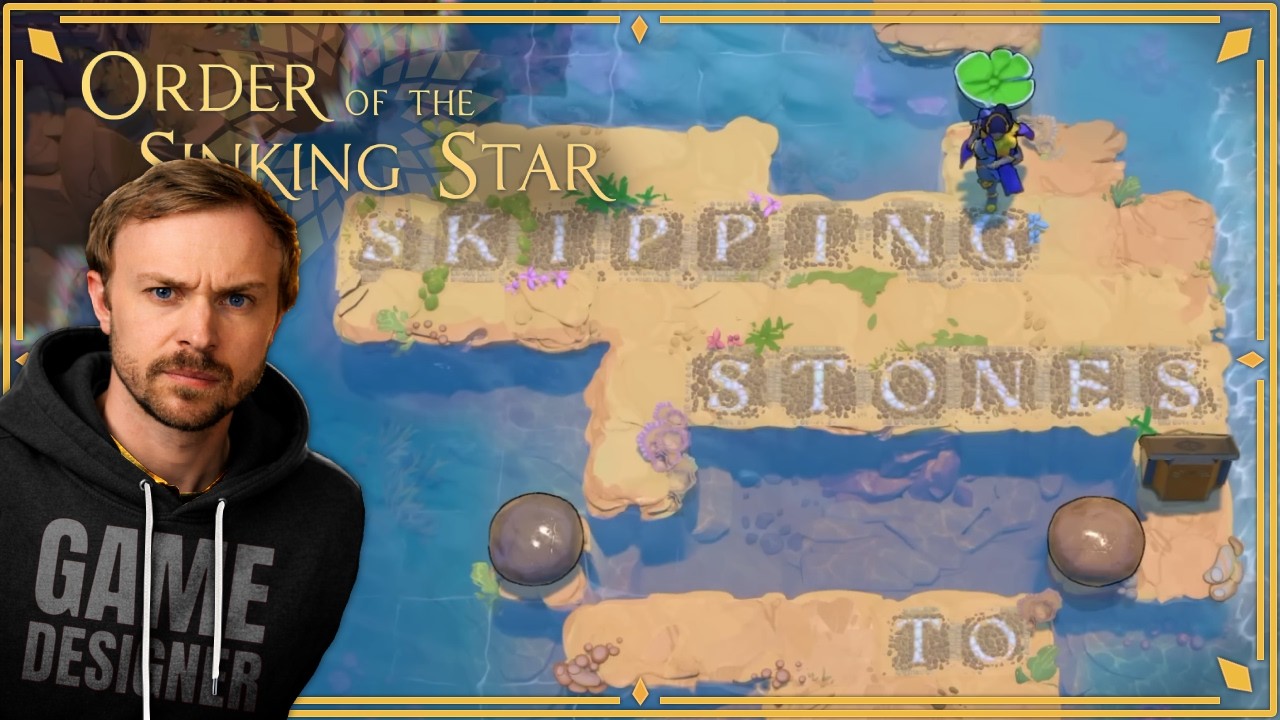
Skipping Stones on Release Day | Order of the Sinking Star Design Study
Title history
- Skipping Stones on Release Day | Order of the Sinking Star Design Study — observed on 20261025-1531 UTC (YouTube)
- Skipping Stones to Break My Bones | Order of the Sinking Star Design Study — observed on 20261010-1012 UTC (PSI archive)
Keywords
Summary
165 words
Critical Evaluation
Value of the Information & Strength of the Argument
VALUE: The video provides valuable insight into the thought processes of a game designer when confronting new puzzle mechanics. Noël’s commentary highlights the importance of ’tells’ (visual hints) and how players reason about space and constraints. He also discusses the potential for timing exploits and how the game elegantly handles them. This is informative for aspiring game designers or puzzle enthusiasts. ARGUMENTATION: Noël builds his arguments carefully, often drawing diagrams and hypothesizing about intended solutions. He supports his observations with concrete examples from the gameplay, and he is transparent about his uncertainties. The argumentation is solid but inherently speculative since he is figuring out puzzles live. He does not make unsupported claims; instead, he bases each theory on observed behavior and prior game knowledge.
Scientific Rigor, Source Quality, Title Accuracy
RIGOR: The creator maintains a rigorous approach by documenting his playthrough thoroughly, referencing previous episodes and in-game observations. However, he does not cite external academic sources, which is typical for this type of design commentary. The analysis is methodical, but it is a single-person perspective. SOURCES: The video description provides links to the series playlists and the Steam page for the game. These are the only direct references. The creator’s expertise is evident, but no research papers or external design references are mentioned. ADEQUATION TITRE: The title clearly conveys that this is a design study of the ‘Skipping Stones’ level on release day, which matches the content. No discrepancy.
248 words
Title / Content Match
The title accurately reflects the content: it is a design study of the 'Skipping Stones' level in the game, taking place on the release day, with a focus on design analysis.
Quality & Reliability
7/10
The video offers deep, informed design observations from a professional game designer, but it is a blind playthrough with real-time reasoning, so some insights are exploratory rather than definitive. The creator is credible, but the analysis is subjective and not backed by formal research.
Chapters
Cited Sources
- Order of the Sinking Star Design Study Series Playlist (Full) — Full playlist of the author's design study series.
- Order of the Sinking Star Design Study Live Series Playlist — Live streamed version of the design study series.
- Order of the Sinking Star on Steam — Official store page for the game being analyzed.
Contribution & Novelties
This video contributes a unique, in-the-moment design analysis from a professional game designer, offering insights into how an expert parses puzzle mechanics and anticipates level design intentions. The creator’s hypotheses about the transaction system and the use of ’tells’ are original observations that could inspire further debate.
Pour aller plus loin :
- The Witness (video game) — Relevant because the creator mentions being influenced by this game and its design principles.
- Jonathan Blow — The designer of The Witness and Braid, whose work forms the basis of this design study.
- Sokoban — The core puzzle genre for many of the mechanics discussed, emphasizing box-pushing logic.
105 words
Radar Profile
The radar profile shows high scores in information quantity and quality, moderate technical depth, and good reliability. The video is rich in content and offers reasoned analysis, though it is not highly formal or academically structured.