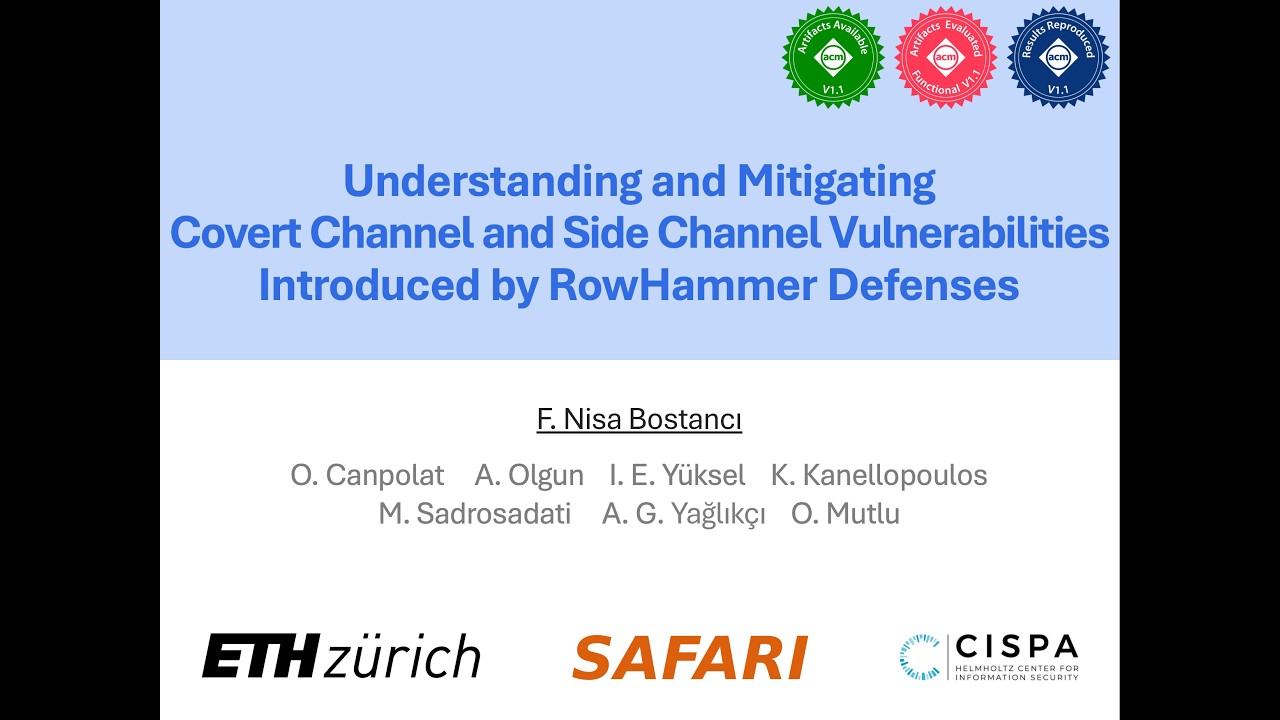
Timing Channel Vulnerabilities Introduced by RowHammer Defenses - MICRO'25 Talk by Nisa Bostanci
Keywords
Summary
195 words
Critical Evaluation
Value of the Information & Strength of the Argument
The talk provides significant value by identifying previously unknown security implications of industry-standard Rowhammer defenses. The argumentation is solid: the presenter systematically defines the threat model, explains the fundamental features (high-latency preventive actions and attacker-controllable triggering), and supports the attacks with rigorous simulation-based experiments. The case studies are well-structured and credible, with detailed attack mechanisms and performance evaluations. The channel capacity analysis under varying noise levels shows realistic conditions, and the proposed countermeasures are evaluated across multiple workloads. However, the lack of real hardware validation (PRAC and RFM are not yet widely available) limits empirical confirmation, though the use of established simulators strengthens the methodological soundness.
Scientific Rigor, Source Quality, Title Accuracy
The talk adheres to high scientific rigor: it references the authors’ own paper (arxiv.org/pdf/2503.17891) and open-source code (github.com/CMU-SAFARI/LeakyHammer), and builds upon prior foundational work on RowHammer, TPR/DRFM, and memory-centric computing. The sources cited in the description are authoritative and directly relevant. The title accurately reflects the content: it focuses on timing channel vulnerabilities introduced by RowHammer defenses, and the talk delivers on that promise. No commercial sponsorship or advertising segments are present, and the presentation is purely technical. The audience appears specialized, but the talk is well-organized for those familiar with computer architecture.
214 words
Title / Content Match
The title accurately reflects the content: the talk systematically analyzes new timing channel vulnerabilities introduced by RowHammer defenses and presents mitigation strategies.
Quality & Reliability
8/10
Talk based on a peer-reviewed MICRO'25 paper, with detailed methodology, clear evaluation using validated simulators, and open-source code. The claims are well-supported by experiments, though the absence of real hardware validation (due to unavailability of PRAC/RFM in commercial chips) slightly limits practical verification.
Key Moments
Markers derived by PSI from the transcript: the creator did not define chapters.
- Introduction and motivation: shared systems vulnerable to covert/side channels, timing differences leak information.
- Explanation of Rowhammer and its defenses (PRAC and RFM) introduced in DDR5.
- LeakyHammer overview: key observation that preventive actions cause high latencies and can be triggered intentionally.
- Case study 1: Prime+Probe covert channel achieving 39 Kbps, with noise analysis.
- Case study 3: Website fingerprinting attack with 75% classification accuracy.
- Countermeasures: Fixed-Rate RFM, randomized counters, and bank-level PRAC, with performance evaluation.
- Conclusion and open-source release of code and data.
Cited Sources
- LeakyHammer paper (PDF) — The paper describing the LeakyHammer attack and countermeasures.
- LeakyHammer source code — Open-source implementation used for evaluation.
- Talk slides (PDF) — Slides accompanying the presentation.
- RowHammer Retrospective (IEEE TCAD) — Background on RowHammer vulnerabilities.
External References
Contribution & Novelties
This talk introduces LeakyHammer, a novel class of timing attacks that exploit the latency characteristics of RowHammer defenses (PRAC and RFM) to create covert channels and side channels. The key novelty is demonstrating that the very mechanisms designed to mitigate RowHammer introduce new vulnerabilities, a significant and previously unexplored security implication. The work establishes covert channels with up to 39 Kbps capacity and a website fingerprinting attack with 75% accuracy, both validated through cycle-accurate simulation. The proposed countermeasures, especially Fixed-Rate RFM, provide practical mitigation strategies. This contribution is original and impactful, extending the understanding of hardware security in DRAM systems.
Pour aller plus loin :
- Row hammer (Wikipedia) — Overview of the RowHammer phenomenon and its implications.
- Side-channel attack (Wikipedia) — General principles of side-channel attacks, relevant to LeakyHammer.
- Covert channel (Wikipedia) — Definition and examples of covert channels in computer security.
142 words
Radar Profile
The radar profile shows high technical level (9) and strong quality of information (8), with slightly lower but still solid quantity (8) and reliability (8). This indicates a technically deep and well-supported presentation, though the reliance on simulation rather than real hardware slightly reduces perceived reliability.