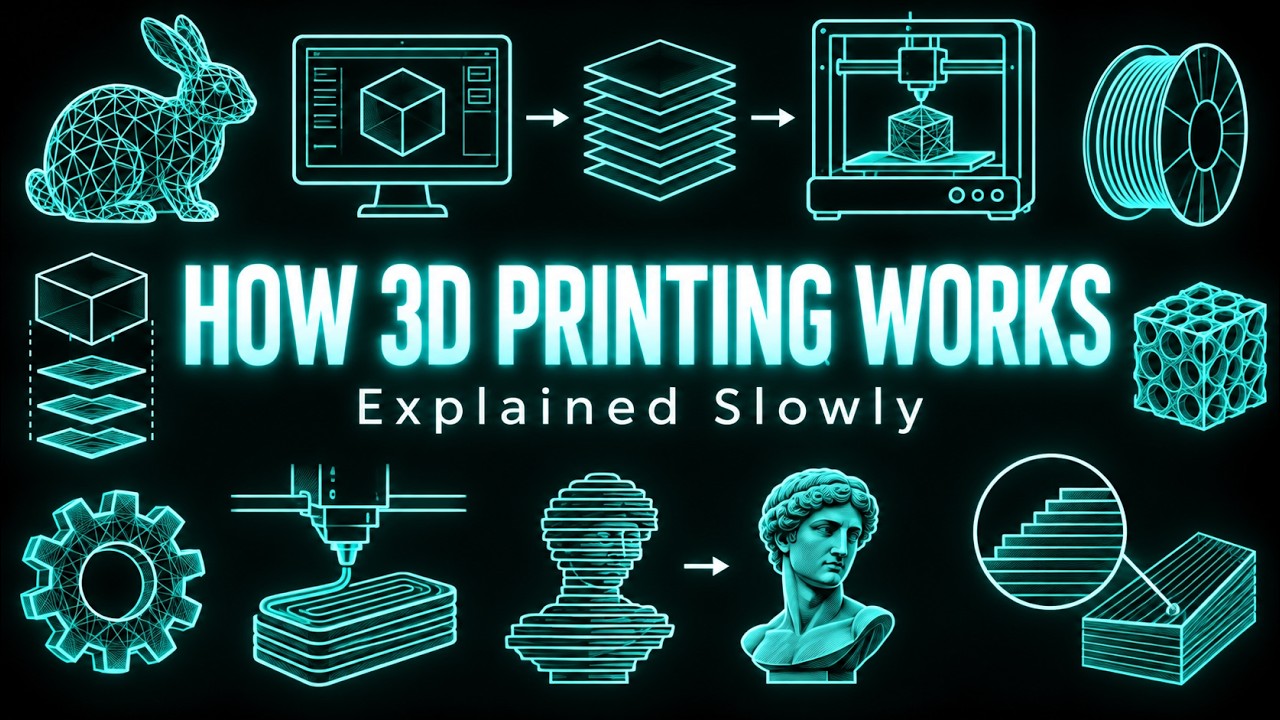
Everything About How 3D Printing Works Explained Slowly
Title history
- Everything About How 3D Printing Works Explained Slowly — observed on 20261110-0824 UTC (YouTube)
Keywords
Summary
182 words
Critical Evaluation
Value of the Information & Strength of the Argument
The video provides substantial value by combining historical narrative with technical detail. It clarifies that 3D printing is not a single technology but a family of processes, and explains the physics behind each. The argumentation is logical and well-supported with specific examples (e.g., buy-to-fly ratio, pancake analogy for anisotropy). The progression from subtractive to additive, then through the three main methods, builds a coherent understanding. The story of RepRap and patent expiry convincingly explains the consumer 3D printer boom. The evidence presented is accurate and aligns with established knowledge, though some simplifications are made for accessibility. The creator’s perspective is balanced, acknowledging both the advantages and limitations of current technologies.
Scientific Rigor, Source Quality, Title Accuracy
The video demonstrates strong scientific rigor by referencing authoritative sources in its description, including the National Institute of Standards and Technology (NIST), Encyclopaedia Britannica, the U.S. Department of Energy, and NASA. While these are not cited in the transcript itself, they lend credibility. The title accurately reflects the content, which is indeed about everything related to how 3D printing works, explained at a slow, accessible pace. The content is consistent with public knowledge about the history and mechanisms of additive manufacturing. No contradictions with established facts were found. The video’s reliance on widely recognized historical milestones and technical explanations makes it a trustworthy educational resource.
230 words
Title / Content Match
The title matches the content perfectly: the video provides a thorough, step-by-step explanation of how 3D printing works, including history, mechanism, and applications.
Quality & Reliability
8/10
The video is well-structured, historically accurate, and covers the main technologies with a clear narrative. It builds on well-known facts and is consistent with public documentation on 3D printing. Slight simplifications are present, but no major errors or misleading claims were found.
Key Moments
Markers derived by PSI from the transcript: the creator did not define chapters.
- Introduction of the additive vs subtractive manufacturing concept
- Hideo Kodama's early work on photopolymer solidification and the patent issue
- Chuck Hull and the invention of stereolithography (SLA) with detailed description of the SLA-1 machine
- Explanation of selective laser sintering (SLS) and Carl Deckard's contribution
- Scott Crump and the invention of fused deposition modeling (FDM) - the idea from a glue gun experiment
- The RepRap project and the expiry of FDM patents leading to the consumer 3D printing boom
Cited Sources
- National Institute of Standards and Technology — Additive Manufacturing — Reference for official information on additive manufacturing
- Encyclopaedia Britannica — 3D Printing — General reference on 3D printing technology
- U.S. Department of Energy — Additive Manufacturing — Government resource on additive manufacturing
- NASA — 3D Printing — Mentioned as a resource for 3D printing applications
- Spotify Show Link — Link to the podcast version of the video
Concurring Sources
- Britannica — 3D Printing — Corroborates the basic mechanisms and history of 3D printing
Contribution & Novelties
This video stands out by offering a comprehensive narrative of 3D printing that integrates historical, technical, and economic perspectives. It goes beyond simple explanations by detailing the physics behind each method and the social factors that shaped the industry. The original contribution lies in its accessible yet detailed synthesis, linking early inventors to modern consumer printers.
Pour aller plus loin :
- 3D printing - Wikipedia — General overview of 3D printing technologies and history.
- Fused deposition modeling - Wikipedia — Detailed look at the FDM process.
- Stereolithography - Wikipedia — Explanation of SLA technology.
- Selective laser sintering - Wikipedia — Insights into SLS and powder-based printing.
- RepRap project — Overview of the open-source self-replicating printer initiative.
116 words
Radar Profile
The radar profile shows excellent quantity and quality of information, with slightly lower technical depth and reliability scores. The video is very rich in content and well-presented, but the technical details are simplified for a broad audience, and the reliance on a single narrative source may slightly reduce the reliability score. Overall, it is a valuable educational resource.