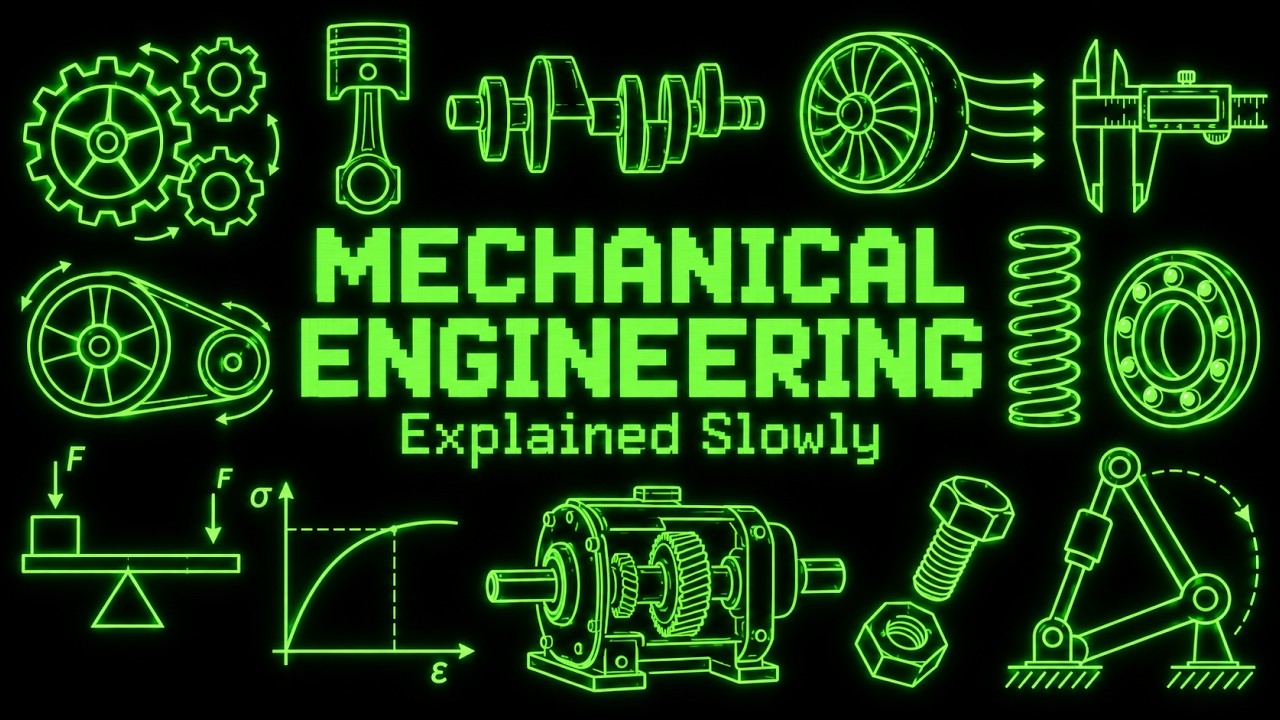
Explaining Confusing Mechanical Engineering Concepts To Help You Sleep
Keywords
Summary
160 words
Critical Evaluation
Value of the Information & Strength of the Argument
The video’s value lies in its accessible, story-driven approach to complex engineering topics. By framing concepts around historical failures and everyday observations, it makes the material intuitive without oversimplifying. The argumentation is solid: cause-and-effect relationships are clearly explained, and the narrative arc from force to fatigue is coherent. Each concept is introduced with a relatable example, then linked to real-world engineering practice, such as the use of safety factors in bridge construction. The discussion of resonance and flutter is nuanced, acknowledging the evolving understanding of these phenomena. The historical anecdotes are accurate and well-integrated, providing memorable illustrations of theoretical principles. The pacing is slow and deliberate, fulfilling the ‘for sleep’ promise, but the content remains rigorous enough for a university-level introduction.
Scientific Rigor, Source Quality, Title Accuracy
The scientific rigor is commendable for a popular-science format. The video references authoritative educational resources: OpenStax for torque and stress-strain, MIT OpenCourseWare for mechanics of materials, and FAA documentation on fatigue. These sources are directly relevant and add credibility. The title-content alignment is excellent—the video explicitly sets out to explain confusing concepts in a sleep-friendly manner and does exactly that. No promotional content is present; the production is clean. The historical accounts of the Menai and Tacoma Narrows bridges are well-documented and accurately presented, with proper context regarding the evolution of engineering understanding. The only minor critique is that the distinction between classical resonance and aeroelastic flutter could be more rigorously defined, but this is a semantic subtlety that does not detract from the overall accuracy. The video’s slow pace and repetitive framing might dilute the density of information, but for its intended purpose, it is highly effective.
284 words
Title / Content Match
The title accurately reflects the content: it explains confusing mechanical engineering concepts in a slow, relaxing manner suitable for sleep.
Quality & Reliability
8/10
The video is well-structured, historically accurate, and scientifically sound. It draws on credible educational resources openstax and MIT OCW, and mentions the FAA for fatigue. The narrative includes real engineering failures (Tacoma Narrows, Versailles) with precise technical explanations. Minor imprecisions exist (e.g., the exact role of flutter vs. resonance) but overall the quality is high.
Key Moments
Markers derived by PSI from the transcript: the creator did not define chapters.
- Introduction to force and Newton's first law, explaining balanced forces with a book on a table.
- Torque explained: force multiplied by distance, with everyday examples like doors and wrenches.
- Stress and strain: definitions, Hooke's law, Young's modulus, and the difference between elastic and plastic deformation.
- Thomas Telford's Menai Bridge: material choices and safety factors in early engineering.
- Resonance and the Tacoma Narrows Bridge collapse, including aeroelastic flutter discussion.
- Metal fatigue: the Versailles railway accident and the discovery of crack propagation under cyclic loads.
Cited Sources
- OpenStax – Torque — Referenced for the definition and physics of torque.
- OpenStax – Stress, Strain, and Elastic Modulus — Referenced for the explanation of stress, strain, and Young's modulus.
- MIT OpenCourseWare – Mechanics of Materials — Referenced as a deeper resource for the mechanics of materials.
- FAA – Fatigue and Damage Tolerance — Referenced in the context of metal fatigue and damage tolerance in aviation.
External References
Contribution & Novelties
The video’s original contribution is its innovative format: packaging advanced engineering concepts into a slow, relaxing narrative specifically intended for sleep. This approach makes technical material approachable without sacrificing accuracy. The historical storytelling adds memorable context, turning abstract principles into vivid case studies.
Pour aller plus loin :
- Fatigue (material) – Wikipedia — Provides a thorough overview of fatigue mechanics and its history.
- Aeroelastic flutter – Wikipedia — Explains flutter phenomena relevant to the Tacoma Narrows bridge discussion.
- Young’s modulus – Wikipedia — Offers a detailed definition and typical values for various materials.
- Menai Suspension Bridge – Wikipedia — Historical details on Telford’s bridge and its engineering challenges.
108 words
Radar Profile
The radar profile shows consistently high scores across quantity and quality of information, with a slightly lower technical level indicating the content is accessible. The fiabilité is also strong, supported by credible references. This balances depth with clarity.