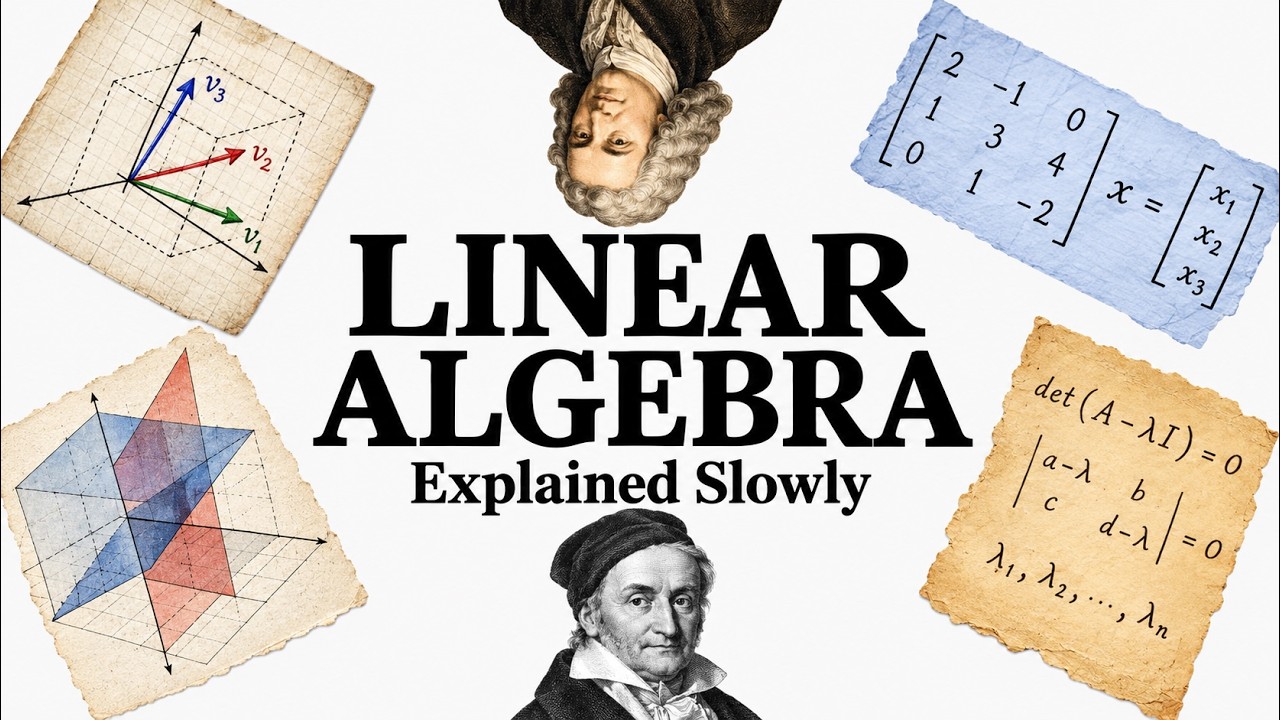
Every Confusing Thing About Linear Algebra Explained Slowly (For Sleep)
Keywords
Summary
132 words
Critical Evaluation
Value of the Information & Strength of the Argument
The video provides a solid and accessible introduction to linear algebra, weaving historical anecdotes with conceptual explanations to build intuition. Its value lies in connecting abstract definitions to tangible examples, such as the wheat-and-barley problem and the non-commutativity of rotations, which illuminates the practical necessity of matrix algebra. The argumentation is coherent, stepping from basic ideas to advanced topics like vector spaces and eigen-decomposition. However, it lacks rigorous proofs and occasionally glosses over subtle points, but for an overview, it is effective. The speaker’s calm tone and repetitive reinforcement help cement understanding, though the coverage is broad rather than deep.
Scientific Rigor, Source Quality, Title Accuracy
The video demonstrates reasonable scientific rigor: the mathematical content is accurate and standard, consistent with established textbooks. It references reputable resources (MIT OpenCourseWare, Khan Academy, Wolfram MathWorld) in the description, which enhances credibility. The historical claims about Babylonian and Chinese contributions are plausible and align with known scholarship, though the presentation simplifies some nuances. The title is highly fitting: it explicitly states the video’s purpose and pacing, and the content matches that promise. The absence of sponsorship or intrusive ads keeps the focus on education, and the lack of any misleading claims bolsters trustworthiness.
209 words
Title / Content Match
The title accurately describes the video: a slow, comprehensive exposition of linear algebra's confusing aspects, designed to be relaxing and suitable for sleep.
Quality & Reliability
7/10
Content is accurate and standard, with historical context and clear explanations. It covers a broad range of topics without deep technical depth, but the information is reliable and well-structured.
Key Moments
Markers derived by PSI from the transcript: the creator did not define chapters.
- Introduction to the concept of linearity and the historical roots of linear algebra.
- Babylonian methods for solving systems of equations and the origins of algorithms.
- The Nine Chapters on the Mathematical Art and early Gaussian elimination in China.
- Arthur Cayley's formalization of matrices as mathematical objects.
- Hermann Grassmann's abstract vector spaces and their initial neglect.
- Definition of vector spaces and their axioms, with examples.
- Linear transformations and the correspondence with matrices.
- Eigenvalues and eigenvectors, with geometric interpretations and applications.
Cited Sources
- MIT OpenCourseWare — Linear Algebra — Listed as a resource in the video description.
- MIT OpenCourseWare — Linear Algebra (Gilbert Strang) — Listed as a resource in the video description.
- Khan Academy — Linear Algebra — Listed as a resource in the video description.
- Wolfram MathWorld — Linear Algebra — Listed as a resource in the video description.
- Spotify Show — Cosmo Explains — Mentioned as an audio streaming option in the video description.
Concurring Sources
- MIT OpenCourseWare — Linear Algebra — Standard academic course covering the same concepts in more depth.
- Khan Academy — Linear Algebra — Interactive tutorials reinforcing the topics presented.
Contribution & Novelties
The video’s original contribution is its synthesis of historical narrative with conceptual teaching, making linear algebra less intimidating by placing it in a human context. It does not offer new mathematical results, but it effectively repackages known material for accessibility.
Pour aller plus loin :
- Gaussian elimination — The core algorithm for solving linear systems, with historical notes extending to Chinese mathematics.
- Vector space — The formal definition and examples that underpin the entire subject.
- Eigenvalues and eigenvectors — Essential concepts with applications across physics, engineering, and data science.
89 words
Radar Profile
The profile shows balanced strengths across information quantity, quality, and reliability, with a slightly lower technical depth score, reflecting the video's aim to explain rather than rigorously prove. It is a solid introductory resource.