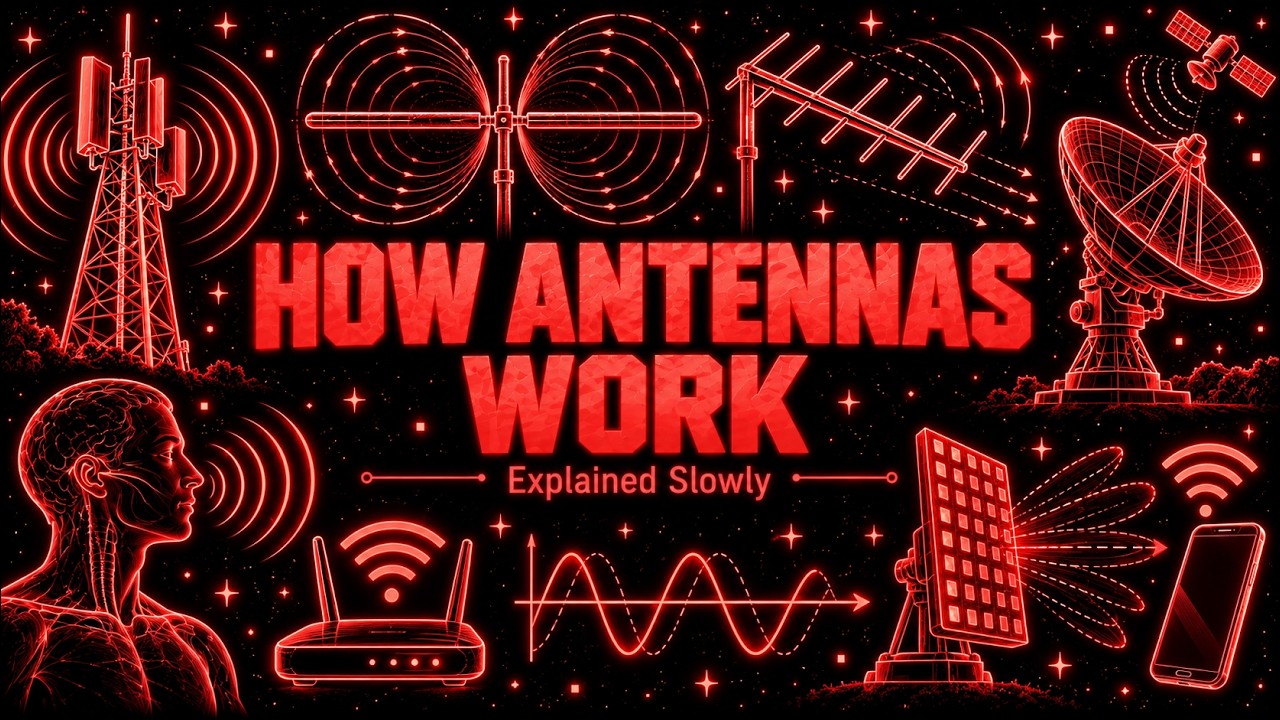
Every Confusing Thing About How Antennas Work Explained Slowly (For Sleep)
Keywords
Summary
103 words
Critical Evaluation
Value of the Information & Strength of the Argument
The video’s value lies in its ability to demystify antennas by building intuition from first principles. It uses a historical narrative to explain why antenna size matches wavelength, how ground planes work, and how radiation patterns shape signal distribution. The argumentation is solid, relying on well-established physics and several credible references. The explanation of the relationship between antenna dimensions and wavelength is particularly effective, using analogies like guitar strings and swinging. The video also clarifies common misconceptions, such as why household wiring doesn’t broadcast radio waves, by emphasizing cancellation of fields. Overall, the content is both educational and engaging, providing a thorough understanding of antenna operation.
Scientific Rigor, Source Quality, Title Accuracy
The video’s scientific rigor is supported by the sources listed in the description, including NIST, NASA, the Nobel Prize organization, and the Clerk Maxwell Foundation, which provide authoritative information on antennas, electromagnetic theory, and Marconi’s work. The transcript, however, does not contain explicit citations, so the reliability relies on the general accuracy of the content. The title is an accurate reflection of the video’s nature: it is slow and thorough, designed to explain confusing aspects of antennas, and the ‘for sleep’ part matches the calm, soothing narration style. The video adheres to the title’s promise.
216 words
Title / Content Match
The title accurately reflects the video's slow, comprehensive explanation of antenna physics, and the 'for sleep' aspect matches the calming tone.
Quality & Reliability
7/10
The video presents accurate and well-structured content, referencing credible sources like NIST, NASA, and Nobel Prize. However, it lacks explicit citations within the narration and is produced by a small channel with limited audience engagement, which slightly reduces its reliability score.
Key Moments
Markers derived by PSI from the transcript: the creator did not define chapters.
- Introduction to the mystery of antennas
- Maxwell's equations predict electromagnetic waves
- Hertz's experiments prove EM waves with spark apparatus
- Marconi's wireless telegraphy and the monopole antenna
- Radiation patterns and the donut-shaped pattern of dipole antennas
- Modern antennas: Yagi, parabolic, phased arrays, satellites
Cited Sources
- Spotify - Cosmo Explains — Podcast version of the video on Spotify
- Clerk Maxwell Foundation - Electromagnetic Theory — Source on Maxwell's electromagnetic theory
- NASA - Antennas of the Deep Space Network — Information on antennas used in deep space communications
- NIST - Antenna System Guide — NIST publication providing an antenna system guide
- Nobel Prize - Guglielmo Marconi Biography — Biographical information on Marconi from the Nobel Prize organization
Contribution & Novelties
The video’s original contribution is the synthesis of historical context with physical principles in a slow, accessible format. It uniquely combines the stories of Maxwell, Hertz, and Marconi with a clear explanation of antenna physics, making it ideal for learners who prefer a narrative-driven approach. The ‘for sleep’ aspect allows for immersive, relaxed listening while absorbing technical information.
Pour aller plus loin:
- Maxwell’s equations — The fundamental equations that describe electromagnetic waves.
- Antenna (radio) — General overview of antennas, including types and radiation patterns.
- Ionosphere — The atmospheric layer that reflects certain radio waves, explaining Marconi’s transatlantic transmission.
98 words
Radar Profile
The radar profile shows high scores in information quantity and quality, with moderate technical depth and reliability, indicating a well-rounded educational video that covers extensive material accurately.