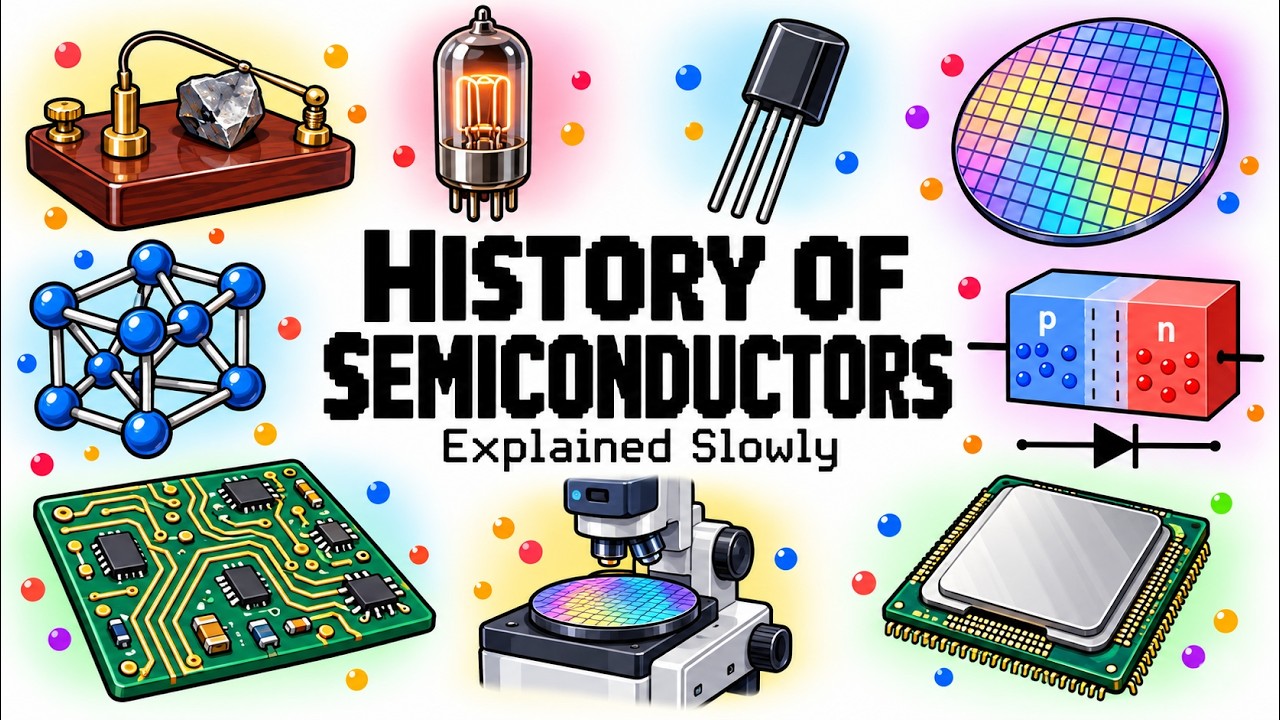
The Entire History Of Semiconductors Explained Slowly (For Sleep)
Keywords
Summary
115 words
Critical Evaluation
Value of the Information & Strength of the Argument
The video provides substantial value by weaving together historical anecdotes, fundamental physics, and engineering breakthroughs into a coherent and engaging story. The argumentation is solid, as it systematically builds a logical chain from early observations to modern applications, explaining each step with clarity. It effectively uses analogies (e.g., ‘one-way valve’ for rectification) to make complex concepts accessible. The narrative is well-paced and avoids oversimplification, correctly highlighting the interplay between theory and practice. The inclusion of specific dates and key figures adds credibility, and the explanation of the PN junction is particularly illuminating.
Scientific Rigor, Source Quality, Title Accuracy
The video demonstrates strong scientific rigor by referencing established sources such as Encyclopaedia Britannica, the Computer History Museum, and the Nobel Prize. These are authoritative and directly support the historical claims. The content aligns well with the provided sources, and no major inaccuracies are apparent. The title perfectly matches the content: it is indeed a slow, thorough history intended for sleep, and the presentation style (calm, unhurried) fulfills this promise. While the video is technically rich, it does not delve into overly advanced math, making it suitable for a broad audience without sacrificing correctness.
201 words
Title / Content Match
The title accurately describes the content: a slow, comprehensive history of semiconductors designed for sleep, which matches the calm narration and breadth.
Quality & Reliability
8/10
The video provides a well-structured historical narrative with references to reputable sources like Britannica and the Nobel Prize. It explains complex concepts accurately, though some simplifications are made.
Key Moments
Markers derived by PSI from the transcript: the creator did not define chapters.
- Introduction to transistors and their ubiquity.
- Faraday's discovery of temperature-dependent conductivity in silver sulfide.
- Braun's crystal rectifier and the cat's whisker detector.
- Limitations of vacuum tubes and the need for a better solution.
- Quantum mechanics and band theory explaining semiconductor behavior.
- Wartime radar and the push for reliable crystal detectors.
- Discovery of the PN junction and its significance.
- Invention of the transistor at Bell Labs in 1947.
- Development of integrated circuits and microprocessors.
Cited Sources
- Encyclopaedia Britannica — Semiconductor — Provides background on semiconductor materials and properties.
- Encyclopaedia Britannica — Transistor — Details the invention and functioning of the transistor.
- Computer History Museum — The Silicon Engine — Offers a timeline of semiconductor milestones.
- Nobel Prize — Physics 1956 — Awarded to Shockley, Bardeen, and Brattain for the transistor.
Concurring Sources
- Encyclopaedia Britannica — Semiconductor — Concordant with the video's explanation of semiconductor properties.
- Computer History Museum — The Silicon Engine — Supports the chronological milestones described.
External References
Contribution & Novelties
The video’s original contribution lies in its synthesis of the entire history of semiconductors into a coherent, sleep-friendly narrative. It connects early 19th-century observations with modern chip technology, emphasizing the role of war, quantum mechanics, and industrial research. The explanation of the PN junction is particularly clear and ties together many threads.
Pour aller plus loin :
- PN junction - Wikipedia — Detailed technical explanation of the junction’s physics.
- Moore’s Law - Wikipedia — Origins and implications for semiconductor scaling.
- History of the transistor - Wikipedia — Further reading on the invention and its pioneers.
95 words
Radar Profile
The radar profile shows high scores in information quantity and reliability, with moderately high technical level. This indicates a comprehensive and trustworthy overview, though the technical depth is not extreme, making it accessible to a broad audience.