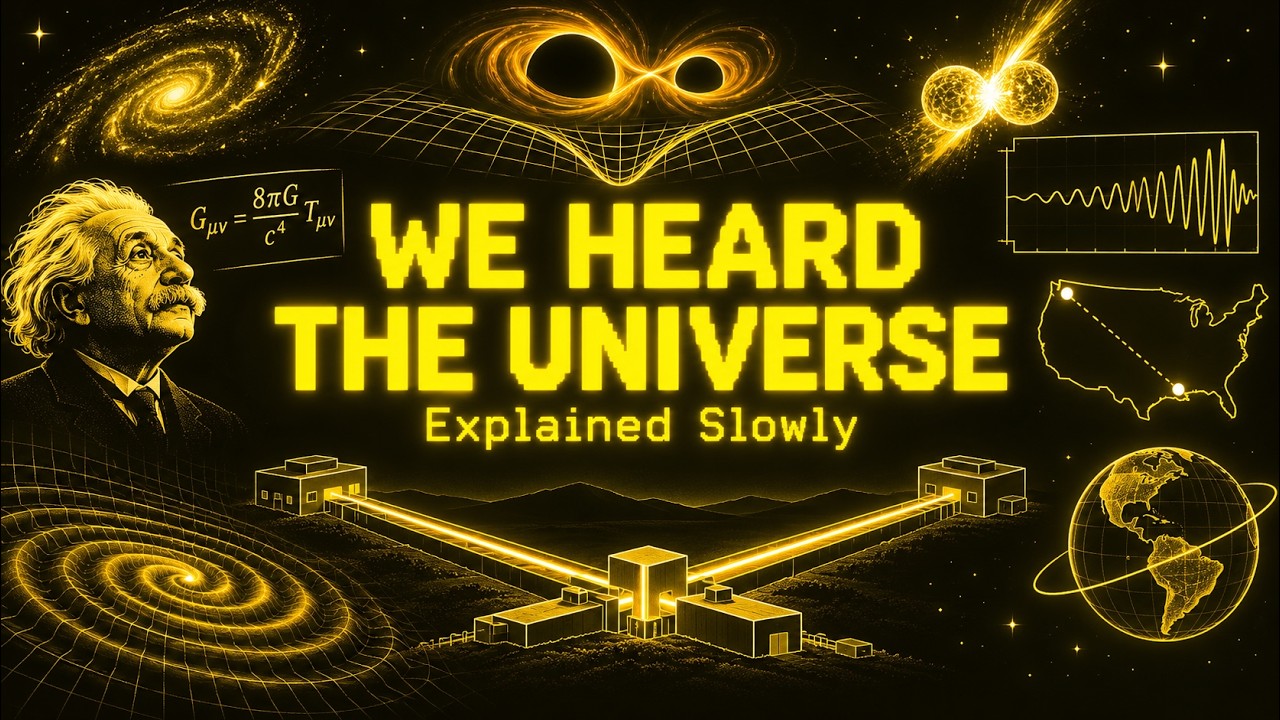
How Gravitational Waves Were Detected For The First Time (Explains Slowly)
Title history
- How Gravitational Waves Were Detected For The First Time (Explains Slowly) — observed on 20261121-0316 UTC (YouTube)
Keywords
Summary
164 words
Critical Evaluation
Value of the Information & Strength of the Argument
The video offers a compelling narrative that combines historical context with scientific explanation. Its value lies in making complex physics accessible while preserving accuracy. The argumentation is structured coherently: starting with Einstein’s theories, then addressing the controversy about gravitational waves’ existence, and systematically presenting the challenges and solutions in detection. The sticky bead argument is explained clearly to establish physical reality. The discussion of Weber’s failure and subsequent adoption of interferometry effectively justifies why LIGO’s approach succeeded. The narrative builds logically towards the final detection, giving credit to the many contributors and emphasizing the technical hurdles. The video excels in connecting theoretical predictions to experimental outcomes, and it supports its claims with authoritative sources in its description.
Scientific Rigor, Source Quality, Title Accuracy
The scientific rigor is high for a popular documentary. It accurately portrays historical events and fundamental physics without major simplifications that would mislead. The sources listed in the description are authoritative: LIGO Caltech’s official news and explanatory pages, and the Nobel Prize summary. These are reliable primary references for the content. The title ‘How Gravitational Waves Were Detected For The First Time’ is directly matched by the video’s thorough exposition of this exact topic. While the video does not cite inline sources, the provided resources reflect a solid foundation. The narrative also mentions the Weber controversy accurately, reinforcing its credibility. No apparent discrepancies between the title and the content were identified; the slow, detailed style is appropriately reflected in the subtitle ‘Explains Slowly’.
255 words
Title / Content Match
The title accurately reflects the content: a detailed and methodical explanation of how gravitational waves were first detected, as promised by 'Explains Slowly'.
Quality & Reliability
8/10
The video provides a thorough and accurate historical account of gravitational wave detection, covering Einstein's theory, the development of detectors, and the eventual success. It cites reputable sources in the description, such as LIGO and the Nobel Prize. The narrative is consistent with established knowledge and does not appear to contain inherent errors.
Key Moments
Markers derived by PSI from the transcript: the creator did not define chapters.
- Introduction to the idea of ripples in spacetime and the peaceful but dynamic nature of the universe.
- Discussion of Einstein's special relativity and the concept of spacetime, leading to his 10-year effort to unify gravity with relativity.
- Presentation of general relativity and the prediction that accelerating masses create gravitational waves.
- The sticky bead argument by Richard Feynman that settles the debate: gravitational waves carry energy.
- Joseph Weber's resonant bar detectors and his controversial claims of detection, later discredited.
- The shift to laser interferometers, with early prototypes by Forward and the theoretical groundwork by Gersenshtein and Pustovoit.
- Rainer Weiss's detailed interferometer design, which becomes the foundation for LIGO.
- The construction of LIGO and the historic detection of GW150914 on September 14, 2015.
Cited Sources
- LIGO Caltech — Gravitational Waves Detected 100 Years After Einstein's Prediction — Official LIGO announcement of the detection, cited as the primary source for the event.
- LIGO Caltech — What Are Gravitational Waves? — General explanation of gravitational waves, referenced in the video for foundational concepts.
- LIGO Caltech — How Does LIGO Work? — Technical description of the interferometer principle, used to explain LIGO's operational mechanism.
- Nobel Prize — The Nobel Prize in Physics 2017 — Details of the Nobel Prize awarded for the detection of gravitational waves, confirming the scientific recognition.
- Cosmo Explains podcast — The channel's companion podcast, included as an additional resource for viewers.
Concurring Sources
- LIGO Caltech — Gravitational Waves Detected 100 Years After Einstein's Prediction — Confirms the detection event and its significance.
- Nobel Prize — The Nobel Prize in Physics 2017 — Validates the scientific achievement of gravitational wave detection.
Contribution & Novelties
The video adds value by weaving a comprehensive historical narrative that connects Einstein’s equations to modern experimental physics, offering context often missing in typical physics explanations. It highlights the human side of science, including Weber’s tragic overclaims and the persistence of others, making the final success more meaningful. The ‘Explains Slowly’ format allows for deep exploration of the concepts.
Pour aller plus loin :
- Gravitational wave — Background on the theoretical concept and properties.
- LIGO — Detailed information about the Laser Interferometer Gravitational-Wave Observatory and its operations.
- Nobel Prize in Physics 2017 — Recognition of the detection and the work of its pioneers.
103 words
Radar Profile
The radar chart would show high scores across information quantity and quality, reflecting the video's comprehensive and accurate content. The technical level is moderately high, suitable for audiences familiar with basic physics, but the clarity makes it accessible. Overall, the video exhibits a balanced profile typical of a quality science documentary.