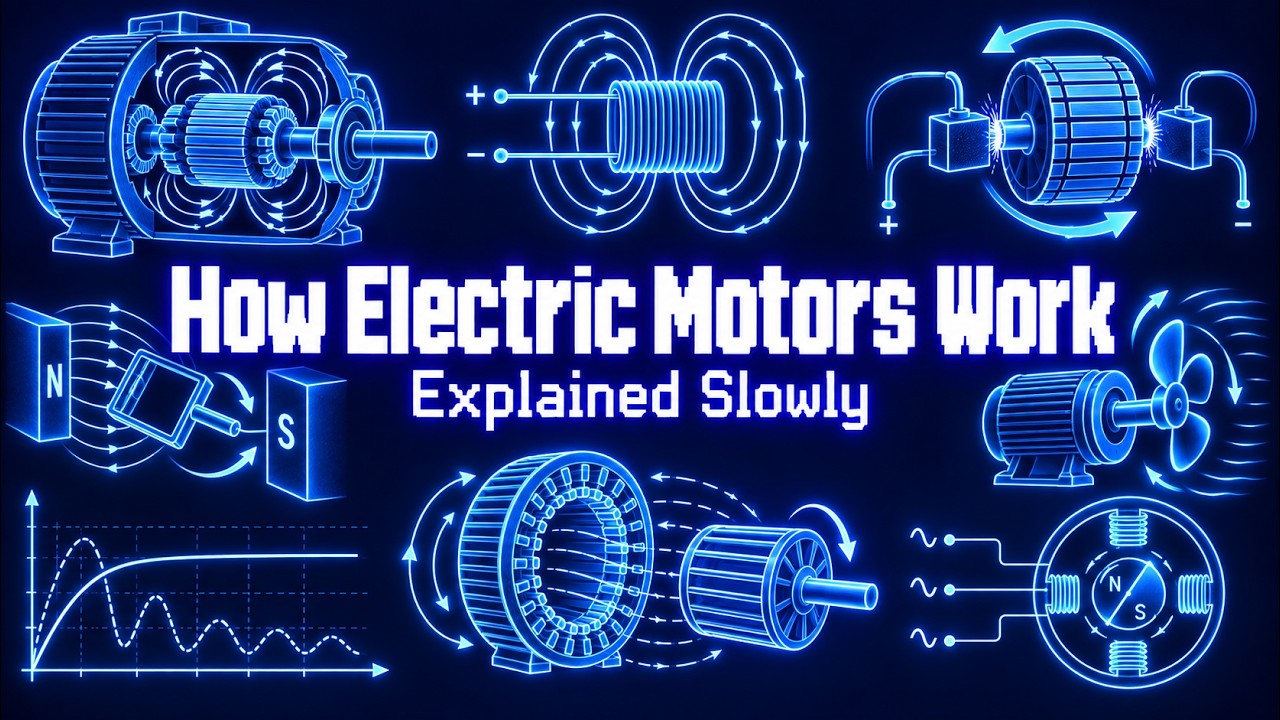
Literally Everything About How Electric Motors Work Explained Slowly (For Sleep)
Keywords
Summary
170 words
Critical Evaluation
Value of the Information & Strength of the Argument
The video offers substantial value by weaving together the history of electromagnetism and the engineering of electric motors into a coherent narrative. It explains key concepts such as the creation of magnetic fields by current, the principle of electromagnetic induction, and the role of the commutator in producing continuous rotation. The argumentation is solid: it builds from basic physics to practical applications, showing how theoretical discoveries led to technological breakthroughs. The explanation of the motor-generator duality is particularly clear and insightful. The video also correctly identifies the main obstacle to early electric motors—the lack of cheap electricity—and how the invention of generators solved it. The reasoning is logical and well-supported by historical examples, though it occasionally simplifies complex topics. The value lies in its ability to make abstract physics accessible through historical storytelling, without sacrificing accuracy.
Scientific Rigor, Source Quality, Title Accuracy
The scientific rigor is high: the physics described is correct and consistent with established knowledge. The historical account is accurate, with proper attribution to key figures like Gilbert, Ørsted, Ampère, and Faraday. The video does not cite sources within the narration, but the description lists reputable references: Encyclopaedia Britannica entries on electric motors and electromagnetism, MIT OpenCourseWare on electricity and magnetism, and OpenStax on electromagnetic induction. These are credible and relevant. The title accurately reflects the content, promising a slow and comprehensive explanation, though the video is more historical than a complete technical breakdown of all motor types. The adéquation is strong, with only minor deviation in emphasis. No comments were provided, so no audience analysis is included.
269 words
Title / Content Match
The title promises a comprehensive, slow explanation of electric motors, and the content delivers a detailed historical and technical overview, though it focuses more on history than on modern motor types. The match is good.
Quality & Reliability
8/10
The video presents a historically accurate and scientifically sound account of the development of electric motors, from Gilbert to Faraday, with correct explanations of electromagnetic induction, commutators, and the motor-generator duality. It relies on well-established physics and history, and cites reputable sources in the description (Britannica, MIT OpenCourseWare, OpenStax). No factual errors were detected in the transcript, though the presentation is simplified and lacks primary source citations within the narrative.
Key Moments
Markers derived by PSI from the transcript: the creator did not define chapters.
- Introduction: electric motors are ubiquitous, from phones to cars.
- Ancient observations of magnetism and static electricity by the Greeks.
- William Gilbert's 1600 book distinguishing magnetism from electricity.
- Ørsted's 1820 discovery that electric current deflects a compass needle.
- Ampère's mathematical description of forces between current-carrying wires.
- Faraday's 1821 experiment: the first electric motor using a wire rotating around a magnet in mercury.
- Faraday's 1831 discovery of electromagnetic induction using an iron ring and coils.
- Explanation of the commutator and its role in continuous rotation.
- Early practical motors by Davenport and Jacobi, and their limitations due to battery costs.
- The 1873 Vienna exhibition demonstration of motor-generator reversibility and power transmission.
Cited Sources
- Encyclopaedia Britannica — Electric Motor — General reference on electric motors, cited in the description as a resource.
- Encyclopaedia Britannica — Electromagnetism — Reference on electromagnetism, listed in the description.
- MIT OpenCourseWare — Electricity and Magnetism — University-level course materials on electricity and magnetism, provided as a resource.
- OpenStax — Electromagnetic Induction — Open textbook chapter on electromagnetic induction, cited in the description.
Concurring Sources
- Encyclopaedia Britannica — Electric Motor — Confirms the historical development and basic principles described in the video.
- OpenStax — Electromagnetic Induction — Supports the explanation of electromagnetic induction and its role in motors and generators.
External References
Contribution & Novelties
The video’s original contribution lies in its slow, narrative-driven synthesis of the history of electric motors, connecting scientific discoveries to engineering applications in an accessible way. It emphasizes the interplay between theoretical insights and practical inventions, and highlights the often-overlooked role of power generation in making motors viable. While it does not present new research, it offers a well-crafted educational overview that could serve as an introduction for lay audiences.
Pour aller plus loin :
- Michael Faraday — Wikipedia article on Faraday’s life and scientific contributions.
- Electromagnetic induction — Wikipedia article explaining the principle discovered by Faraday.
- Electric motor — Wikipedia article covering types, history, and working principles of electric motors.
111 words
Radar Profile
The radar profile shows high scores in information quantity, quality, and reliability, reflecting a well-researched and accurate presentation. The technical level is moderate, as the content is accessible but not deeply mathematical. Overall, the profile indicates a solid educational video with a strong historical narrative.