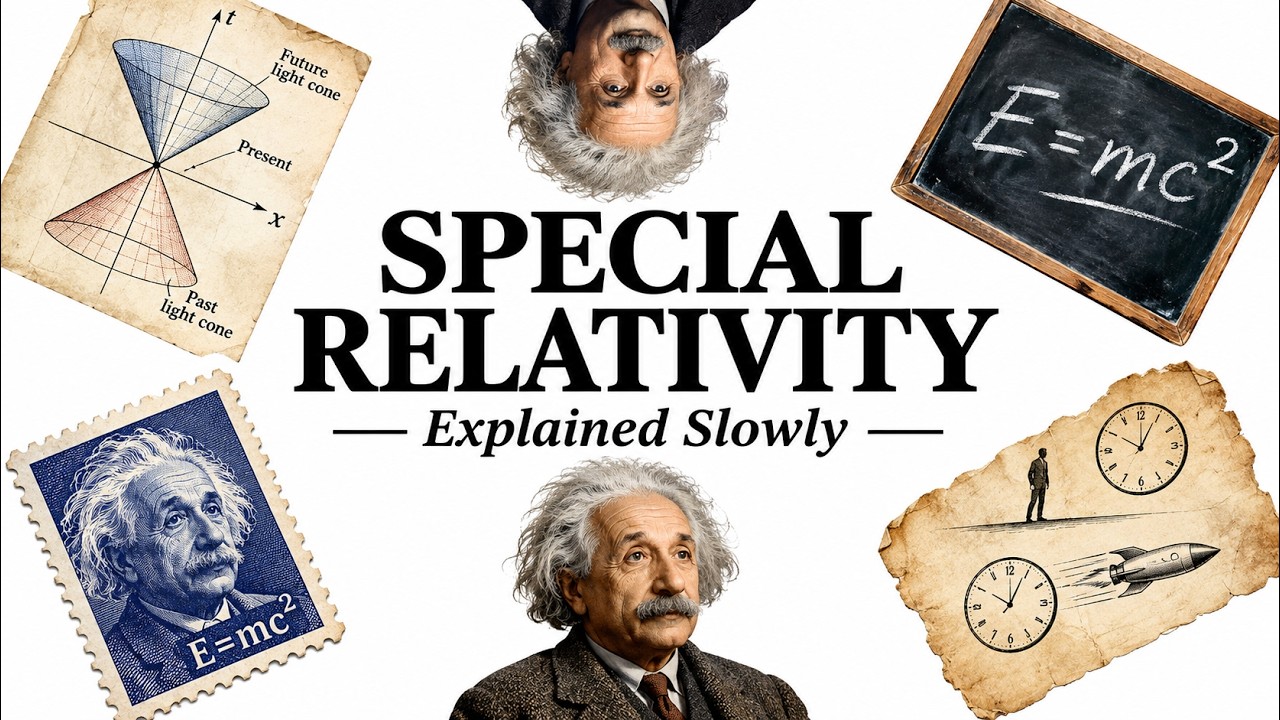
Literally Everything There Is To Know About Special Relativity
Title history
- Literally Everything There Is To Know About Special Relativity — observed on 20261114-0303 UTC (YouTube)
Keywords
Summary
231 words
Critical Evaluation
Value of the Information & Strength of the Argument
The video’s principal value lies in the rarity of its approach: it takes the time to motivate each component of special relativity from the historical problems that forced physicists to abandon absolute space and time. Instead of presenting formulas as given, it derives the logical necessity of time dilation and length contraction from the two postulates, using the light-clock and the train-and-lightning thought experiments. The argumentation is clear and progresses cumulatively: the constant speed of light is established historically (Rømer, Michelson–Morley), then the postulates are stated, and all consequences follow deductively. The continuous reminder ‘always the second postulate’ strengthens the pedagogical rigor. However, the video would benefit from more explicit mathematical derivations of the Lorentz factor and from an explicit treatment of energy–momentum and E=mc² promised in the title and description, which are barely touched in the transcript provided. As a scientific argument, it is convincing and faithful to mainstream physics; its minor denominational slips (units in the Rømer value, the spelling ‘Ola Romer’) do not undermine the reasoning.
Scientific Rigor, Source Quality, Title Accuracy
Scientific rigor: the video is scientifically sound and up-to-date regarding the standard narrative of special relativity. The physics is correct in its main claims (constancy of c, gamma factor values at 10% and 90% of c, the null result of Michelson–Morley). Two minor issues: the speed given for Rømer’s estimate is stated as ‘131,000 m/s’ (should be miles per second), and the name ‘Ola Romer’ should be ‘Ole Rømer’. Sources: the description links to reliable reference resources (Britannica, Stanford Encyclopedia of Philosophy, NASA Imagine the Universe, Einstein Online) which support the claims; no peer-reviewed primary literature is cited in the transcript, but for this level of exposition that is not a defect. Title/content fit: the title ‘Literally Everything There Is To Know About Special Relativity’ is ambitious; the video covers the fundamental postulates and kinematical consequences very well (and given its two-hour runtime, it may well go further than the transcript shown), but the provided content stops before some promised topics (E=mc², applications). Overall, the fit is good — the title slightly overpromises ’everything’ — but the discrepancy is modest and mostly due to the partial transcript.
371 words
Title / Content Match
The title is ambitious ('everything about special relativity'); the video covers the historical and conceptual core in depth, though the transcript stops before some promised topics (e.g., E=mc²). Overall, the fit is good, with a slight overstatement.
Quality & Reliability
7/10
Overall accurate and consistent with standard physics, with solid historical grounding (Rømer, Michelson–Morley, Einstein). Strengths: constancy of c, the postulates-to-time-dilation/length-contraction derivation, correct gamma values. Minor flaws: incorrect units for Rømer's estimate (131,000 m/s instead of mi/s) and the spelling 'Ola Romer'. Description sources are recognized and reliable. No appeal to controversy.
Key Moments
Markers derived by PSI from the transcript: the creator did not define chapters.
- Introduction: light moving at ~670 million mph; the constancy of light speed as the seed of special relativity.
- Galileo's lantern experiment and the first real measurement by Rømer (Jupiter's moons).
- Wave vs particle theories of light; Young's double-slit; the need for a luminiferous ether.
- Michelson–Morley experiment: null result and the crisis of the ether.
- Fitzgerald and Lorentz; Lorentz transformations as an 'ad hoc' fix.
- Einstein's 1905 paper; the two postulates of special relativity.
- Time dilation with the light clock; the gamma factor.
- Length contraction; space measured differently in relative motion.
- Relativity of simultaneity: the train and two lightning bolts.
Cited Sources
- Encyclopaedia Britannica — Special Relativity — Reference resource cited in the video description for the general topic of special relativity.
- Einstein Online — Special Relativity (elementary) — Educational resource cited for accessible explanations of special relativity.
- Stanford Encyclopedia of Philosophy — Space and Time: Inertial Frames — Philosophical backdrop for the concept of inertial reference frames used in the video.
- NASA — Imagine the Universe — Cited for astronomical context and applications of the speed of light.
- Cosmo Explains podcast (Spotify) — Companion podcast promoted in the description; audio format of the content.
Concurring Sources
- Special relativity — Wikipedia — Corroborates the two postulates and kinematical consequences (time dilation, length contraction, relativity of simultaneity).
- Time dilation — Wikipedia — Supports the light-clock thought experiment and the quantitative gamma factor values given in the video.
External References
Contribution & Novelties
The video’s main contribution is a patient, historically grounded exposition of special relativity that anchors each conceptual leap (constancy of light, time dilation, length contraction, relativity of simultaneity) in the historical problems the theory was built to solve (ether drift, Michelson–Morley null result, Maxwell’s equations). It does not present new research, but it offers a coherent pedagogical narrative that connects Galileo, Rømer, Young, Maxwell, Michelson–Morley, Lorentz and Einstein in a single arc. The use of the light clock and the train/lightning thought experiments makes the counterintuitive results intelligible without obscuring their mathematical basis (gamma factor).
Pour aller plus loin :
- Twin paradox — A classic consequence of time dilation, often used to probe whether a ‘correct’ frame exists; directly tests the symmetrical nature of proper time.
- Lorentz transformation — The mathematical core of special relativity; expresses how coordinates and times change between inertial frames.
- Michelson–Morley experiment — The famous 1887 null result that motivated ether theory’s decline; the video retells it in detail.
- Minkowski space — The four-dimensional spacetime setting in which special relativity is usually formulated; links time dilation and length contraction into a single geometry.
187 words
Radar Profile
The radar profile shows a rich informational volume with good (not perfect) quality and reliability; the technical level remains high and consistent with a physics-education audience. The slight gap between quantity and reliability highlights the few minor errors detected (units and spelling) without undermining the overall pedagogical value.