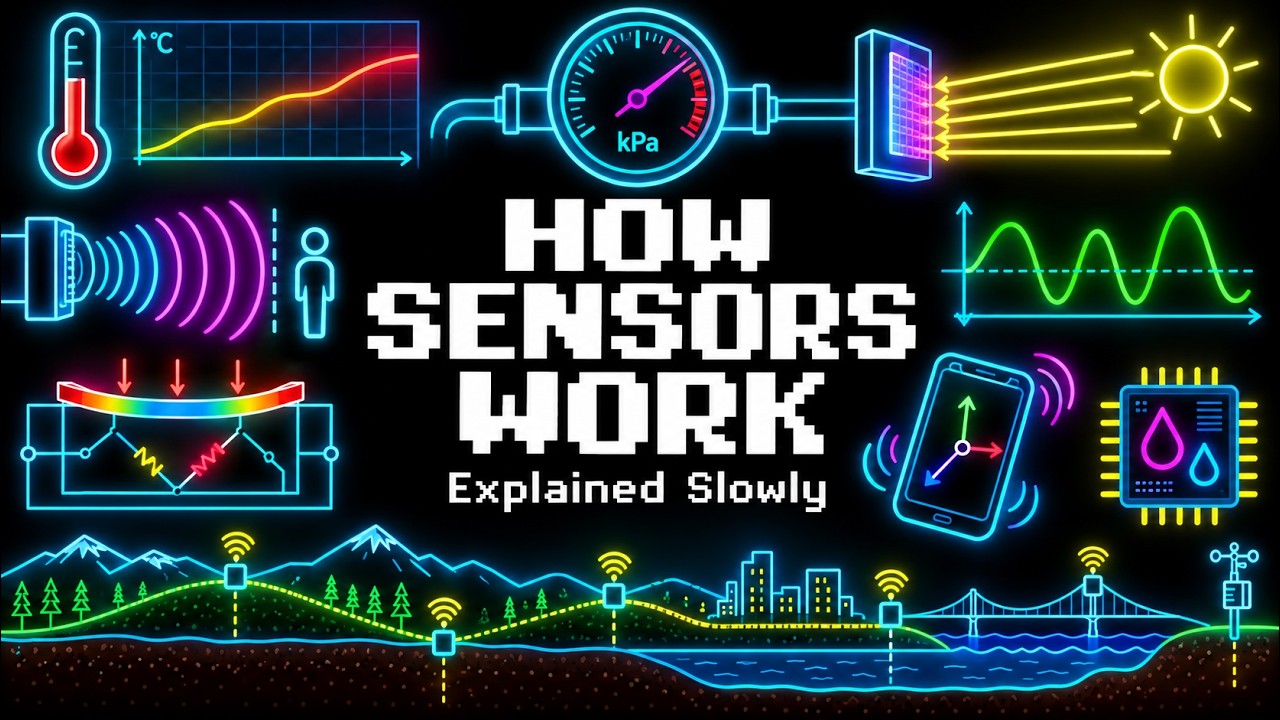
Literally Everything About How Sensors Measure the World Explained Slowly (For Sleep)
Title history
- Literally Everything About How Sensors Measure the World Explained Slowly (For Sleep) — observed on 20261024-0735 UTC (YouTube)
Keywords
Summary
127 words
Critical Evaluation
Value of the Information & Strength of the Argument
The video provides substantial educational value by weaving together historical anecdotes and technical explanations to illustrate the principles behind sensor technology. The argumentation is solid, built on a logical progression from simple measurement devices to complex systems, and it effectively explains how sensors solve real-world problems. The narrative is engaging and easy to follow, despite the technical depth, and it successfully conveys the importance of measurement standards and calibration. The inclusion of specific historical figures and experiments adds credibility, and the explanations are clear enough for a non-specialist to grasp the core ideas.
Scientific Rigor, Source Quality, Title Accuracy
The video demonstrates scientific rigor by referencing authoritative sources like Encyclopaedia Britannica and the National Institute of Standards and Technology (NIST) in the description. The historical accounts are accurate and well-researched, with proper attributions to key inventors and experiments. The title promises a comprehensive overview, and while ’literally everything’ is an exaggeration, the video does cover a broad range of sensor types and principles. The slow pacing aligns with the stated purpose for sleep, and the content is presented in a calm, structured manner. The sources are credible, and the video does not appear to introduce misleading information.
206 words
Title / Content Match
The title accurately describes a comprehensive overview of sensors, though 'Literally Everything' is hyperbolic; the slow pace matches the 'For Sleep' intention.
Quality & Reliability
8/10
The video cites reputable sources such as Encyclopaedia Britannica and NIST, and the historical accounts align with established knowledge. However, some details are simplified for a general audience.
Key Moments
Markers derived by PSI from the transcript: the creator did not define chapters.
- Introduction to sensors as translators of physical phenomena
- Ancient nilometers and the political impact of measurement
- Development of thermometers and the standardization of temperature scales
- Torricelli's barometer and the measurement of atmospheric pressure
- Pendulum clocks and the problem of longitude
- John Harrison's marine chronometers and the use of bi-metallic strips
- The Watt governor and the concept of feedback in sensors
Cited Sources
- Sensor - Encyclopaedia Britannica — General definition and overview of sensors
- Thermocouple - Encyclopaedia Britannica — Explanation of thermocouple operation and history
- Transducer - Encyclopaedia Britannica — Definition and types of transducers
- Metrology - National Institute of Standards and Technology — Standards and measurement science
External References
Contribution & Novelties
The video’s contribution lies in its accessible synthesis of sensor history and technology, connecting ancient measurement tools to modern applications without oversimplifying the underlying physics. It demonstrates how core principles like calibration, sensitivity, and cross-sensitivity have persisted over centuries, and how they remain relevant in contemporary MEMS and sensor fusion. The narrative emphasizes the human element behind inventions, making the content memorable and engaging.
Pour aller plus loin :
- Thermocouple - Wikipedia — Covers the Seebeck effect and practical uses.
- Microelectromechanical systems (MEMS) - Wikipedia — Details on MEMS sensors and their fabrication.
- Sensor fusion - Wikipedia — Discusses combining data from multiple sensors for improved accuracy.
107 words
Radar Profile
The scores indicate a strong performance in information quantity and quality, with a slightly lower technical depth, suggesting the video is accessible to a general audience while maintaining reliability. The high fiabilite_globale reflects the use of credible sources and accurate historical accounts.