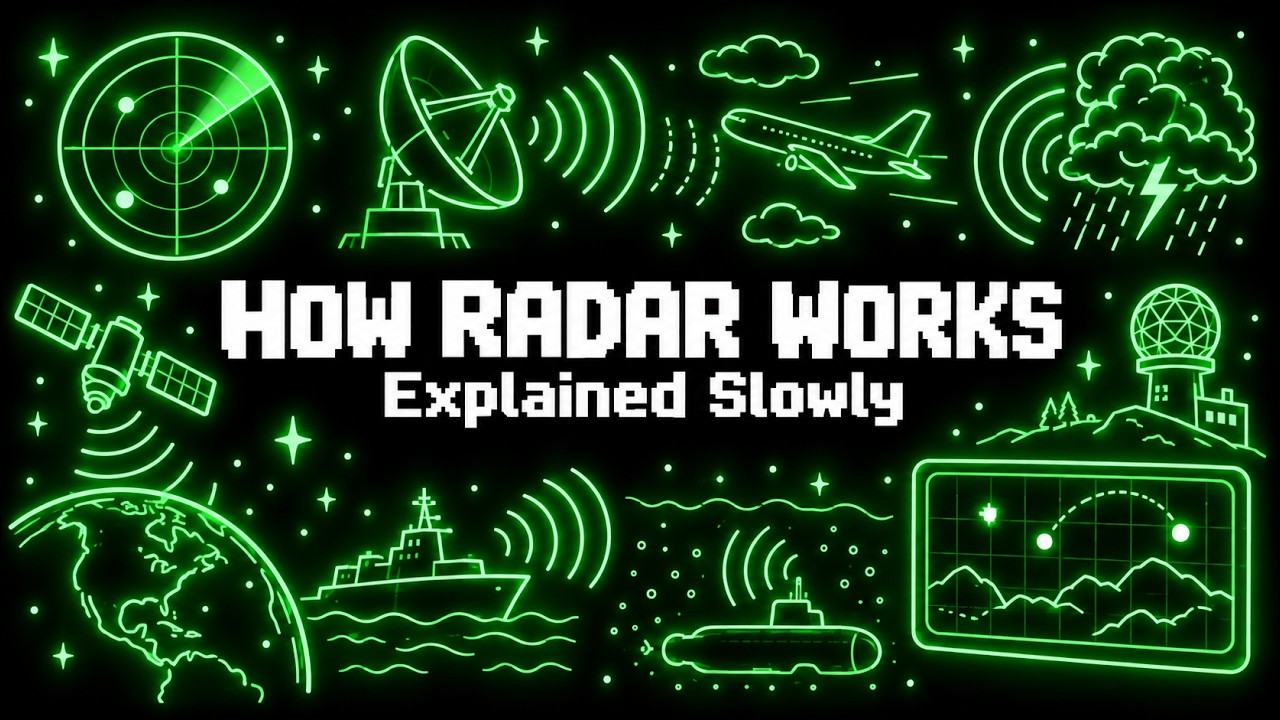
Literally Everything About How Radar Works Explained Slowly (For Sleep)
Keywords
Summary
200 words
Critical Evaluation
Value of the Information & Strength of the Argument
The video provides substantial value by weaving together physics, engineering history, and military strategy into a coherent narrative. The argumentation is solid: each technological development is logically connected to the previous one, from Maxwell’s theory to Hertz’s experiments to the practical applications. The explanation of Chain Home’s significance is particularly strong, emphasizing that its operational integration - the human operators, filter rooms, and command architecture - mattered as much as the hardware itself. The description of the cavity magnetron’s inner workings uses a clear mechanical analogy (spiraling electrons setting up resonant oscillations like blowing across a bottle) that makes complex physics accessible. The video avoids overstating claims and acknowledges limitations (e.g., Chain Home’s inability to detect low-flying aircraft). The pacing deliberately slows for a ‘sleep’ format but the information density remains significant, with each concept building on previous ones.
Scientific Rigor, Source Quality, Title Accuracy
The scientific rigor is generally high. Historical facts (Maxwell’s 1864 papers, Hertz’s 1887 experiments, the 1940 naming of ‘RADAR’ by the US Navy, Watson-Watt’s 1935 demonstration, the February 1935 Daventry test) align with established historical accounts. The physics explanations (electromagnetic wave propagation, pulse-echo ranging, the speed of light calculations) are accurate. The source list in the description includes authoritative references: Encyclopaedia Britannica, NOAA’s National Weather Service, NASA’s Earth Observatory, and MIT Lincoln Laboratory - all recognized institutions for radar-related knowledge. The title (‘Everything About How Radar Works’) is ambitious but the video does deliver a genuinely comprehensive overview within its 2h10m runtime, and the delivery matches the subtitle’s promise of a slow and relaxing presentation.
269 words
Title / Content Match
The title accurately reflects the comprehensive coverage of radar, from fundamental physics to historical development and modern applications. The delivery is indeed slow and methodical, matching the stated 'for sleep' subtitle.
Quality & Reliability
8/10
The video presents historically accurate information about radar's development, correctly attributing Maxwell's equations, Hertz's experiments, Hülsmeyer's patent, and Watson-Watt's work. The physics (electromagnetic wave propagation, pulse timing, Doppler effect) is correctly explained. Authoritative institutional sources are listed in the description, and the narrative avoids sensationalism or speculative claims.
Key Moments
Markers derived by PSI from the transcript: the creator did not define chapters.
- Introduction: the concept of radar and its ubiquity in modern life
- Maxwell's equations predict electromagnetic waves (1864)
- Hertz demonstrates radio wave reflection off metal surfaces (1887)
- Hülsmeyer's Telemobiloscope: the first radar-like patent (1904)
- Watson-Watt's Daventry demonstration proves aircraft detection (1935)
- Chain Home: the fixed-tower radar network and its technical design
- Dowding system: the command-and-control architecture of Battle of Britain
- Cavity magnetron: Randall and Boot invent microwave radar
Cited Sources
- Encyclopaedia Britannica — Radar — General reference on radar technology, listed as primary resource in the video description
- NOAA National Weather Service — Radar — Educational resource on weather radar operations, cited in description
- NASA — Radar / Earth Observatory — NASA Earth observation resources, relevant to radar applications in Earth science
- MIT Lincoln Laboratory — Radar — MIT research institution known for radar development, listed as reference
- Spotify — Cosmo Explains podcast — Podcast platform where the video's audio content is also distributed
Concurring Sources
- Encyclopaedia Britannica — Radar — Corroborates the historical timeline and technical explanations presented in the video
- NOAA — Weather Radar — Supports the video's explanations of weather radar principles and Doppler applications
Contribution & Novelties
The video’s original contribution lies in its pedagogical synthesis: it connects the full arc of radar’s development - from Maxwell’s theoretical equations to Hertz’s laboratory demonstrations to the large-scale military systems of WWII - into a single, coherent, slow-paced narrative designed for relaxed consumption. Its integration of operational history (Dowding system) with technical engineering (Chain Home design, cavity magnetron) provides a holistic understanding rarely found in single treatments. The ‘for sleep’ framing is a distinctive format choice that, surprisingly, does not compromise depth.
Pour aller plus loin :
- Radar — Wikipedia — Comprehensive article covering radar principles, types, and applications; directly extends the video’s overview.
- Chain Home — Wikipedia — Detailed history of the British radar network central to the video’s WWII narrative.
- Cavity magnetron — Wikipedia — In-depth technical article on the device the video describes as the most important WWII invention.
- Doppler effect — Wikipedia — Physics principle underlying velocity measurement in radar, prominently featured in the video’s topic set.
162 words
Radar Profile
The scores profile shows a well-balanced video with high values in information quantity (8), information quality (8), and global reliability (8), with a slightly lower technical level (7). This profile indicates a thoroughly researched educational work that maintains solid scientific accuracy while remaining accessible to a general audience.