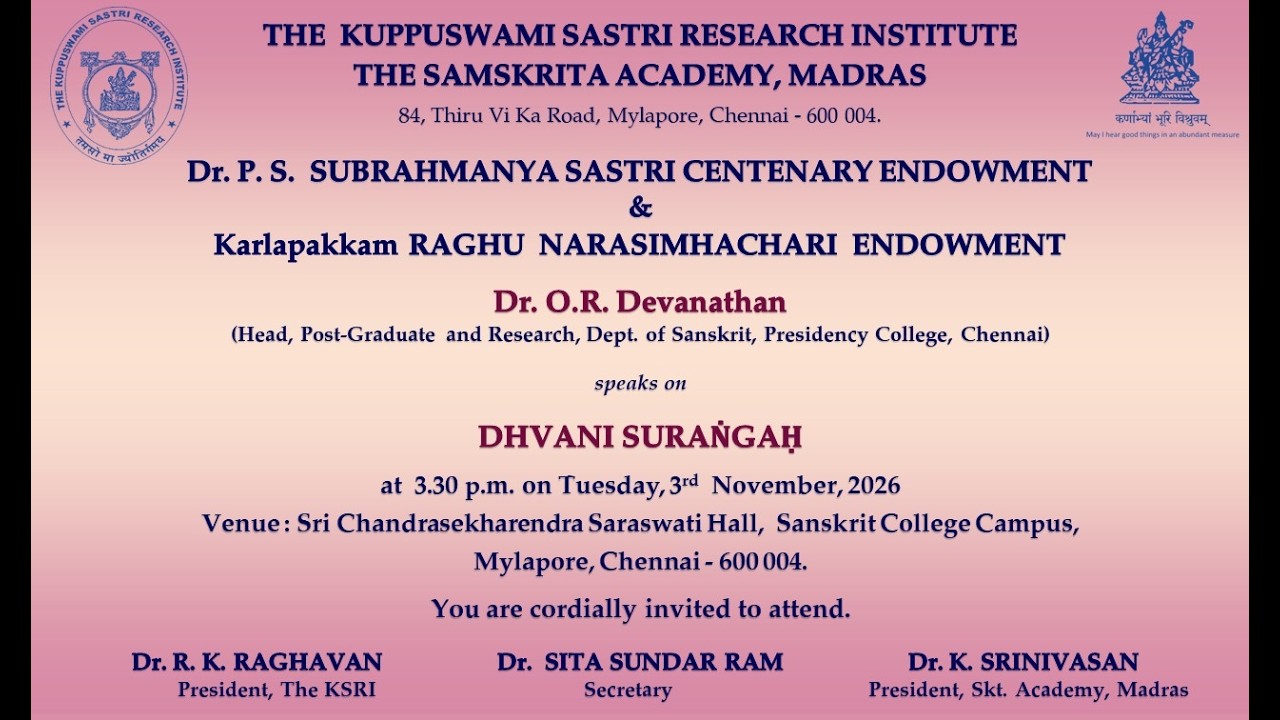
Dr. O.R. Devanathan (Head, Dept. of Sanskrit, Presidency College, Chennai) speaks on DHVANI SURANGAH
Title history
- Dr. O.R. Devanathan (Head, Dept. of Sanskrit, Presidency College, Chennai) speaks on DHVANI SURANGAH — observed on 20261110-1132 UTC (YouTube)
Keywords
Summary
183 words
Critical Evaluation
Value of the Information & Strength of the Argument
The value of the information lies in the expert exposition of a complex literary theory, grounded in canonical texts like Dhvanyaloka and Kavya Prakasha. Dr. Devanathan’s argumentation is systematic: he first establishes the rarity of truly novel ideas, then categorizes the types of similarity (samvada) with precise Sanskrit terminology, and finally demonstrates with numerous examples how dhvani functions as a creative mine. The argument is persuasive because it is built on primary sources and the speaker’s own compositional experience, yet it remains anecdotal rather than rigorously analytical. The lecture offers a deep appreciation of Sanskrit literary theory, though it presupposes familiarity with the tradition.
Scientific Rigor, Source Quality, Title Accuracy
The speaker demonstrates rigorous reliance on classical texts, citing specific verses from Dhvanyaloka, Kavya Prakasha, Rathna Kosam, and others. However, no external references or citations are provided, which limits verifiability. The title accurately describes the content, focusing on Dhvani as a ‘surangah’ (tunnel/mine) and the speaker’s credentials. The lecture adheres to the announced topic and does not deviate into unrelated material.
180 words
Title / Content Match
The title accurately reflects the content: a lecture on Dhvani surangah (the mine of suggestion) by the Sanskrit scholar.
Quality & Reliability
8/10
The lecture is delivered by a recognized scholar and refers to classical texts, demonstrating deep expertise. However, it is an oral exposition without formal citations or references.
Key Moments
Markers derived by PSI from the transcript: the creator did not define chapters.
- Introduction to the endowment and tribute to Prof. P.S. Subramania Sastri and the speaker's background.
- Discussion on the revolutionary nature of the author of Dhvanyaloka and the purpose of the text.
- Explanation that dhvani is a philosophy that existed before and cannot be defined; examples from famous shlokas.
- Introduction of 'samvada' and the three types: bimba-pratibimba, alekhya-karavat, and the third type where the poet adds soul.
- Examples from Champu Ramayana and personal compositions illustrating samvada.
- Discussion of Desikan's Shlokas and the Subhashita Nivi, showing dhvani as a mine of suggestion.
- Analysis of the 'Jayati' shloka and the use of transitive/intransitive verbs, leading to a prayer to Agastya.
- Explanation of how Desikan's verses on the cloud and Pandya rivers illustrate dhvani, and whether he knew Dhvanyaloka.
- Conclusion summarizing that dhvani is an endless mine and that poets can continue to draw from it.
Cited Sources
- Dhvanyaloka — The foundational text on dhvani, discussed throughout the lecture.
- Kavya Prakasha — A commentary that the speaker refers to for examples and definitions.
- Sri Gunaratna Kosam — Mentioned as a work by Bhattar, used to illustrate poetic expression.
- Champu Ramayana — Quoted for examples of samvada.
- Raghuvamsam — Referenced to show how Kalidasa used words from Valmiki.
- Subhashita Nivi — Desikan's work analyzed for dhvani examples.
Contribution & Novelties
The lecture offers an original oral synthesis of the concept of dhvani as an inexhaustible source of poetic creativity. It contributes by weaving together classical references and personal compositions to illustrate the theoretical points, emphasizing the perpetual freshness of suggestion despite limited novelty in ideas. The speaker’s emphasis on ‘surangah’ (tunnel/mine) as a metaphor for dhvani provides a vivid interpretative lens.
Pour aller plus loin :
- Dhvani (poetics) — Overview of the concept of suggestion in Sanskrit literary theory.
- Dhvanyaloka — The foundational work by Anandavardhana, central to this lecture.
- Kavya Prakasha — A key commentary that expands on dhvani, frequently referenced in the lecture.
105 words
Radar Profile
The radar profile shows balanced scores across quantity, quality, and technical level, with reliability high. This indicates a well-structured and erudite presentation, though its specialized nature may limit accessibility to a broader audience.