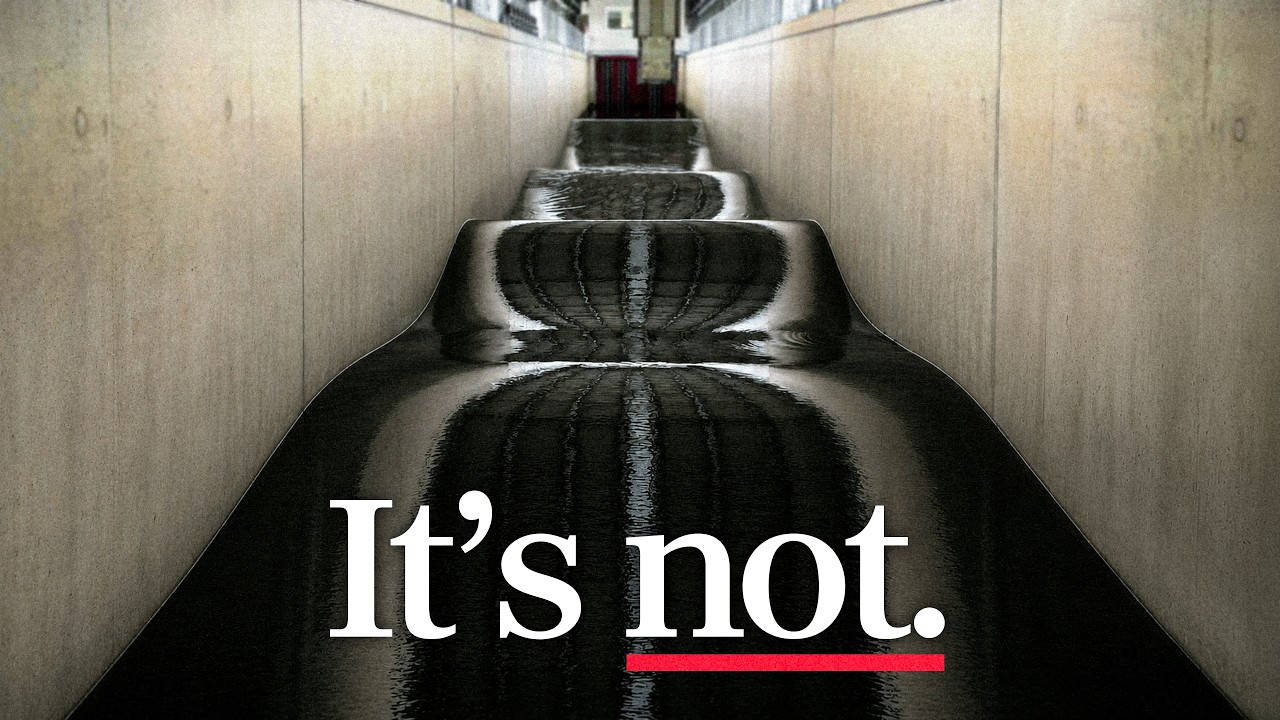
Scientists Said This Wave Was Impossible
Keywords
Summary
374 words
Critical Evaluation
Value of the Information & Strength of the Argument
The informational density is high for a 28-minute film and almost every segment carries a mechanism rather than a mere assertion. The argument is built as a progressive elimination: tsunamis are excluded on quantitative grounds (depth-limited amplification of about 2.5 over 70 m of water), wind-generated waves are excluded by the breaking limit observed in the flume, superposition is introduced and then immediately problematised by the combinatorics of energy redistribution, and the statistical correction using the square-of-height energy cost is a genuinely instructive move that replaces the naive exponential drop with the real sea-state distribution. Each step is anchored either in a measurement, a laboratory demonstration or an expert on camera, and the film is careful to say that a giant wave is ’technically possible but not likely’ rather than implying inevitability. The historical thread is used argumentatively rather than decoratively: the d’Urville and Russell episodes both illustrate the same failure mode, a model mistaken for reality, and the film states that moral explicitly instead of leaving it implicit. The narrative is popularised and occasionally dramatised — the rig manager’s order to go inside, the chase on horseback, the bicycle substitute for the horse — but these flourishes do not distort the physics. The weakest argumentative link is the transition from the Draupner event to the two-storm crossing-sea explanation, which is presented as the resolution but is supported by laboratory wave-basin reconstructions rather than by a direct reconstruction of that specific sea state. A sponsor segment of roughly one minute closes the video; it is clearly separated from the scientific content and has no bearing on the assessment.
Scientific Rigor, Source Quality, Title Accuracy
The sourcing is unusually transparent for the format. Institutions are named (Imperial College London hydrodynamics laboratory, the GWK large wave flume in Hannover, the Okinawa Institute of Science and Technology), individual researchers are credited both on camera and in the description, historians are acknowledged for the two historical sections, and a consolidated reference list is linked from the description rather than scattered across the video. Numerical claims are attributable: the Draupner crest and trough-to-peak heights, the MaxWave result of more than ten waves above 25 m in just over three weeks, the 429 freak-wave events between 2005 and 2021, and the Ucluelet wave at roughly three times the surrounding sea. The treatment of the historical controversy is fair rather than Manichaean: Airy and Stokes are shown to be individually correct about dispersion and steepening, and Russell is vindicated only because the two effects cancel — a nuance that a lesser production would have flattened into heroes and villains. What is missing is on-screen citation granularity: the viewer must leave YouTube to see which paper supports which figure, and a couple of quantitative statements (the 30–35 m equivalent of the directional-focusing experiment, the one-in-3000-year return period) arrive without an uncertainty range. Title-to-content fit is strong, since the dismissals the title alludes to are reconstructed with names, dates and quotations.
501 words
Title / Content Match
The title is honoured: the film shows two historical episodes in which established scientists declared an observed wave impossible (Arago dismissing d'Urville's 1829 report, Airy and Stokes rejecting Russell's solitary wave), and explains why both verdicts were wrong.
Quality & Reliability
8/10
The film rests on a well-documented measurement (the Draupner platform record: an 18.5 m crest and roughly 25.6 m trough-to-peak against a background sea of about 6 m), on a named satellite campaign (the EU MaxWave survey using ESA imagery, which returned more than ten waves above 25 m in just over three weeks) and on a clearly identified body of theory (superposition, dispersion, solitons, Benjamin–Feir/modulational instability, crossing seas). It was made with named specialists and institutions — Imperial College London's hydrodynamics laboratory, the GWK large wave flume in Hannover, the Okinawa Institute of Science and Technology — plus historians for the d'Urville and John Scott Russell sections, and the description links to a dedicated reference list. Claims are usually tied to a magnitude or a mechanism rather than left vague. The main deductions are for the dramatised narrative framing, for a few figures quoted without an uncertainty range or a precise citation on screen, and for an argumentative shortcut where a rare statistical tail is presented with the same narrative weight as the laboratory demonstrations.
Chapters
Cited Sources
- Veritasium reference list for this episode (Rogue Wave Refs) — Consolidated bibliography linked in the description, covering the Draupner measurement, the MaxWave satellite survey, the soliton literature and the rogue-wave/optical-rogue-wave work discussed in the final chapters.
Concurring Sources
- Rogue wave — Wikipedia — Confirms the standard definition (wave height exceeding roughly twice the significant wave height), the Draupner event, the MaxWave campaign and the list of modern recorded events, consistent with the film's framing.
- Modulational instability — Wikipedia — Provides the general theory behind the Benjamin–Feir instability described in the wave-group chapter, including its occurrence in optics, plasmas and condensates.
- John Scott Russell — Wikipedia — Corroborates the 1834 canal observation, the 'wave of translation', and the opposition of Airy and Stokes as presented in the historical sections.
External References
Contribution & Novelties
The distinctive contribution is pedagogical rather than empirical: the film assembles in one continuous argument threads that are usually taught separately — the Draupner measurement, the MaxWave satellite statistics, the Airy/Stokes versus Russell controversy, dispersive focusing, the Benjamin–Feir instability and crossing seas — and shows why none of the first four explanations alone can reproduce the Draupner crest, only the combination of two storm systems. The combinatorial ‘stones’ model of energy redistribution, corrected by the quadratic cost of wave height, is an effective way of conveying why the sea-state distribution has a bell shape with an infinite tail instead of a monotonic decay toward small waves. The extension beyond hydrodynamics — rogue holes, optical rogue waves in fibre optics, superfluids, Bose–Einstein condensates, plasmas, the solar wind — reframes the phenomenon as a generic feature of nonlinear dispersive media rather than a maritime curiosity. The closing use of Korzybski’s map/territory distinction to reinterpret d’Urville’s rejection turns a history-of-science anecdote into an epistemological lesson about model revision.
Further reading:
- Rogue wave — Overview of definitions, known events and the competing generation mechanisms discussed in the film.
- Modulational instability — The general phenomenon behind the Benjamin–Feir instability used to explain wave-group collapse.
- John Scott Russell — The engineer behind the 1834 ‘wave of translation’ observation and the canal experiments mentioned here.
- Soliton — The class of stable localised waves produced by the balance of dispersion and nonlinearity.
- The Draupner ‘New Year wave’ record itself (the 1995 North Sea measurement) — primary dataset behind the film’s opening sequence; cited by name rather than by URL.
261 words
Radar Profile
The profile is high across the board, with information quantity and quality close to the top and reliability only slightly behind because of narrative dramatisation and off-screen citation granularity. Technical level is elevated for a general-audience production: dispersion relations, solitons, modulational instability and crossing seas are all explained rather than merely named. The shape is that of a well-sourced science documentary rather than a commentary or an opinion piece.