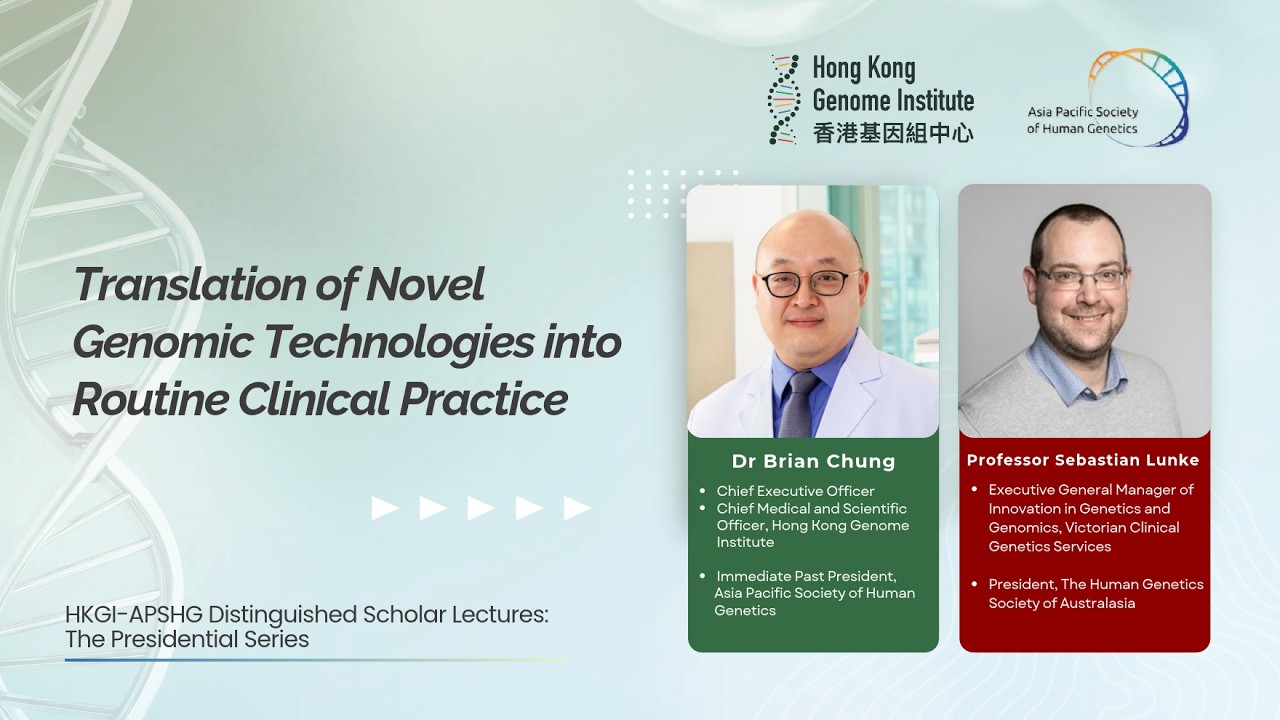
【Translation of Novel Genomic Technologies into Routine Clinical Practice】
Title history
- 【Translation of Novel Genomic Technologies into Routine Clinical Practice】 — observed on 20261110-0854 UTC (YouTube)
Keywords
Summary
243 words
Critical Evaluation
Value of the Information & Strength of the Argument
The video provides high value by sharing concrete, practical experiences in genomic technology translation, particularly the detailed journey of validating long-read sequencing. The speaker argues that while new technologies bring immense benefits, they also introduce unforeseen complexities—such as reference genome errors and phasing limitations—that must be rigorously assessed. His argumentation is strong: he uses empirical data (e.g., false-positive rates, phase contiguity percentages) and real examples (structural variant causing 20% false positives) to support his claims. He also balances enthusiasm for novel capabilities with a cautionary note about overpromising, reinforcing the necessity of scientific rigor in clinical adoption.
Scientific Rigor, Source Quality, Title Accuracy
The lecture demonstrates high scientific rigor. The speaker references his own laboratory’s validation data, peer-reviewed concepts, and established frameworks (e.g., NIH translation model). He acknowledges limitations and challenges, which enhances credibility. The use of specific examples and quantitative results grounds the discussion in evidence. Regarding sources, the description provides links to the Hong Kong Genome Institute and Asia Pacific Society of Human Genetics as further resources, which are relevant. The title accurately captures the content; the lecture indeed focuses on translating novel genomic technologies into routine practice, with a significant portion dedicated to long-read sequencing validation. No commentary analysis is included as no comments were provided.
218 words
Title / Content Match
The title accurately reflects the content: the lecture focuses on the practicalities and challenges of translating new genomic technologies into routine clinical care, drawing on the speaker's extensive experience.
Quality & Reliability
9/10
The speaker is President of the Human Genetics Society of Australasia and leads a clinical genomics service, providing firsthand experience in technology validation and clinical implementation. His arguments are supported by concrete data from his laboratory's work, including challenges and solutions in long-read sequencing.
Key Moments
Markers derived by PSI from the transcript: the creator did not define chapters.
- Introduction by Dr Brian Chung, host, and presentation of speaker Sebastian Lunke
- Sebastian Lunke begins, acknowledging traditional owners, outline of talk
- Overview of Human Genetics Society of Australasia and Victorian Clinical Genetics Services
- Concept of clinical translation: validation, accreditation, implementation, ELSI
- Example of whole exome sequencing validation a decade ago; challenges with data volume and interpretation
- Introduction to long-read sequencing validation; initial poor results with false positive rates up to 10%
- Explanation of reference genome errors unmasked by long-read; example of structural variant causing 20% false positives
- Achievement of clinical accreditation for ONT long-read whole genomes; benefits and limitations of phasing
- Discussion on repeat expansion sizing and discrepancies with Southern blotting
- Conclusions on translation principles and importance of rigorous validation; closing remarks
Cited Sources
- Hong Kong Genome Institute — Co-host of the lecture series; provides resources on genomic medicine in Hong Kong.
- Asia Pacific Society of Human Genetics — Co-host of the lecture series; promotes genetics research and collaboration in the region.
Contribution & Novelties
The lecture offers original insights into the real-world challenges of implementing novel genomic technologies, particularly long-read sequencing, in a clinical diagnostic laboratory. It contributes to the field by sharing specific validation experiences—such as the discovery that reference genome errors can cause significant false-positive rates, and the nuance that phasing is not complete across the genome. These lessons are valuable for other laboratories undertaking similar translations. The presentation also emphasizes the importance of understanding the limitations of new technologies before adopting them clinically.
Pour aller plus loin :
- Long-read sequencing — Overview of technologies like Oxford Nanopore and PacBio, their principles and applications.
- Southern blot — Traditional method for detecting specific DNA sequences, often used for repeat expansion sizing; contrasted with new sequencing methods.
- Exome sequencing — Technique for sequencing all protein-coding regions; foundational to clinical genomics and validation discussed in the talk.
142 words
Radar Profile
The profile shows high scores across all dimensions, with particularly strong performance in quality of information and global reliability, reflecting the speaker's expertise and data-backed presentation. The slightly lower quantity score (8) suggests the lecture is rich but not exhaustive, while technical level (8) indicates a high degree of specialization that may be challenging for a general audience. The overall profile is balanced, indicating a reliable and informative scientific lecture.