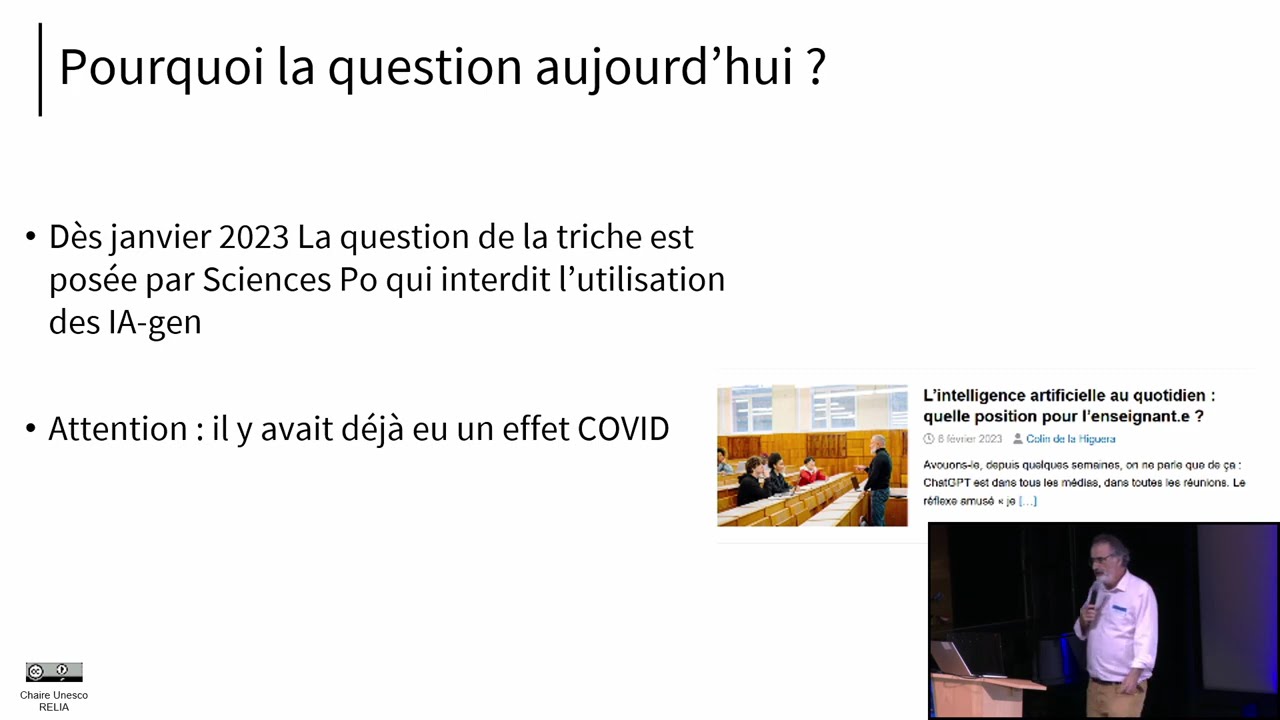
Révolution IA générative au cœur de l’université de Technologie de Troyes
Generative AI revolution at the heart of the University of Technology of Troyes
Keywords
Summary
128 words
Critical Evaluation
Value of the Information & Strength of the Argument
The talk provides a thoughtful, critical perspective on AI’s role in education, grounded in real-world observations and policy initiatives. The speaker argues convincingly that cheating is not a simple moral failing but a systemic issue linked to assessment design and ambiguous rules. He highlights the risk of over-reliance on AI among privileged students and the need to protect learning outcomes. The argumentation is coherent, though it relies on personal experience and anecdotal evidence rather than systematic research. The value lies in raising awareness of the gap between institutional optimism and students’ actual behaviors, and in proposing a nuanced breakdown of formative vs summative assessment as a key analytical framework.
Scientific Rigor, Source Quality, Title Accuracy
The speaker cites his own blog and UNESCO-related projects, but no specific academic publications are mentioned. The single external source in the description is the symposium announcement. The title is appropriate and does not overstate the content. There is no explicit mention of specific studies, and the argumentation is mostly opinion-based, though clearly informed by professional experience. The talk lacks concrete citations, which limits its rigor, but the perspective from a UNESCO chair adds institutional credibility.
200 words
Title / Content Match
The title accurately reflects the content, discussing the integration and implications of generative AI at the University of Technology of Troyes and beyond.
Quality & Reliability
7/10
The speaker is a recognized expert (UNESCO chair) and provides a balanced, critical perspective on AI in education, though the talk contains no original empirical data.
Key Moments
Markers derived by PSI from the transcript: the creator did not define chapters.
- Introduction of speaker and UNESCO chair on open educational resources.
- Overview of collaborative projects (AIDL, Gen Schools, Integrity AI, etc.).
- French government announcement to teach AI in secondary schools from 2027.
- Definition and critical comparison of formative vs summative assessment.
- Discussion on cheating: definition from Larousse and its implications.
- Why cheating matters: moral, personal, cost, trust, and learning degradation.
- Proposed solutions: long-term overhaul, traffic-light approaches, and rethinking evaluation.
Cited Sources
- Symposium sur l'IA générative au cœur des universités — Official page of the symposium where this keynote took place.
Contribution & Novelties
The talk offers an expert perspective on a pressing issue, but its novelty is limited as it synthesizes existing debates rather than presenting new research. The speaker’s emphasis on distinguishing formative and summative assessment as a lens to understand AI-related cheating is a useful framework. It also highlights the discrepancy between institutional optimism and student realities, urging caution.
Pour aller plus loin :
- UNESCO Recommendation on the Ethics of Artificial Intelligence — A foundational reference for ethical AI, directly relevant to the speaker’s UNESCO affiliation.
- Formative assessment (Wikipedia) — Provides background on the concept of assessment for learning, central to the talk.
- Academic integrity (Wikipedia) — Offers context on cheating and plagiarism in educational settings.
115 words
Radar Profile
The radar profile shows a balanced shape with moderate scores across information quantity, quality, and reliability, while technical level is lower, reflecting a non-technical, policy-oriented talk. The strengths lie in the coherence and expertise of the speaker rather than technical depth.