RuCCS - Dr. Luiz Pessoa - In Person Talk - Tuesday, November 10, 2026
Keywords
Summary
304 words
Critical Evaluation
Value of the Information & Strength of the Argument
The informational value of the talk lies in the synthesis rather than in new results. Pessoa offers a compact, well-ordered conceptual map of a live dispute in systems neuroscience: whether the brain is best decomposed into regions with assignable functions or treated as an interactionally complex system whose functional units are transiently recruited networks. The value is highest where he converts a general slogan (’the brain is complex’) into checkable architectural claims — short anatomical paths between any two regions, dense individual-region connectivity, context dependence mediated by a large family of neuromodulators, non-linear re-entrant processing, and many-to-many structure-function mapping. The periaqueductal grey example is the most concrete and the most persuasive, because it spells out what would follow observationally from treating a region as a simple output stage versus a bidirectionally embedded node. The emotion section is used to make a broader point about disciplinary boundaries: if affective, perceptual and attentional effects interpenetrate, then chapter divisions inherited from folk psychology are a poor guide to neural organisation.
The argumentation, however, is programmatic rather than demonstrative. Several key moves are asserted with little visible support in the recorded portion: that the brain is not nearly decomposable is argued largely by appeal to the density of connectivity, which does not by itself settle the question of decomposability; ’emergence’ is invoked as a ‘scary’ and contested notion and then softened into a metaphor of coupled differential equations without specifying the formalism; and the claim that no region can be said to ‘do X’ is stated in strong form while the speaker simultaneously concedes that other network types may exist. The urgency-spectrum account of cortical-subcortical loops is offered as a motivating rationale with the promise that worked examples exist rather than as an argument developed in the talk. The most interesting conceptual consequence — that standard accounts of causation are poor fits for distributed, mutual, reciprocal interactions — is gestured at but not developed. The overall argument is coherent, self-aware about its own status as a framework proposal, and valuable as a map of the problem space, but it remains an agenda for research rather than a demonstration.
Scientific Rigor, Source Quality, Title Accuracy
Scientifically, the talk is careful about the epistemic status of its claims: Pessoa repeatedly labels his principles as quasi-principles, notes that the number of cortical subdivisions depends on the anatomist, grants that alternative parcellations are legitimate, and explicitly declines to present data. Historically, the anchors he invokes are real and correctly attributed in substance — Brodmann’s cytoarchitectonic map, the Vogt programme of myeloarchitectonic subdivision, Herbert Simon’s early-1960s treatment of the architecture of complexity and near-decomposability, Paul MacLean’s limbic/visceral brain, and the Phelps–Carrasco line of work on fearful cues and contrast sensitivity. The weakness is one of documentation rather than of knowledge: sources are cited conversationally, without author-year precision, without bibliographic pointers and without slide-level references in the recorded segment, so a viewer cannot follow up a specific claim without independent searching. Some names are handled hesitantly, which slightly weakens the impression of scholarly precision. The description text accompanying the video is the only structured source and is itself a summary of the speaker’s framework rather than a reference list. A further limitation is that the argument leans heavily on the speaker’s own prior publications, so the reader gets an integrated but author-centred view of the debate rather than a survey of competing positions — alternative programmes are characterised briefly and mostly in order to be contrasted with the entangled-brain position.
On title/content adequacy, the title is purely logistical (institution, speaker, date) and makes no claim about the content; it is accurate and creates no expectation that the talk fails to meet. No comment data were supplied with this video, so no inference about audience reception is drawn here.
637 words
Title / Content Match
The title is a bare seminar announcement (centre, speaker, date) and does not describe any content; it is nonetheless fully accurate, since the video is indeed an in-person RuCCS talk by Dr. Pessoa. Adequacy is therefore correct but uninformative.
Quality & Reliability
7/10
Conceptual seminar given by a recognised specialist in affective and systems neuroscience, arguing in favour of a complex-systems reading of brain organisation. The reasoning is internally coherent and explicitly presented as a set of working principles rather than established fact, and the speaker repeatedly flags alternative views (modular, localisationist, one-to-one mapping). Weaknesses for a reliability assessment: almost no primary data are shown in the recorded portion, references are made orally and informally (Brodmann, Vogt, Simon, MacLean, Phelps and Carrasco) without bibliographic detail, and several claims about distributed, emergent function are asserted at a programmatic level rather than demonstrated. The content is therefore trustworthy as an expert synthesis and framing of a debate, not as evidence for a specific empirical claim.
Key Moments
Markers derived by PSI from the transcript: the creator did not define chapters.
- Host introduction: Pessoa's interdisciplinary background in computer science, computational neuroscience and psychology, and his book The Entangled Brain.
- Statement of intent: a deliberately conceptual talk rather than an experimental one, examining assumptions common in neuroscience; opening analogy with modular AI architectures (perception, cognition, action, emotion, motivation).
- How the brain is organised: cortical areas as candidate functional units, Brodmann's 100-year-old parcellation and the Vogt proposal linking structure to function, then the computational metaphor that made areas 'compute' functions.
- Herbert Simon's nearly decomposable systems and the architecture of complexity: the divide-and-conquer strategy is only defensible if the brain belongs to that class; the question of where the brain sits on a strong/weak/non-decomposable gradient.
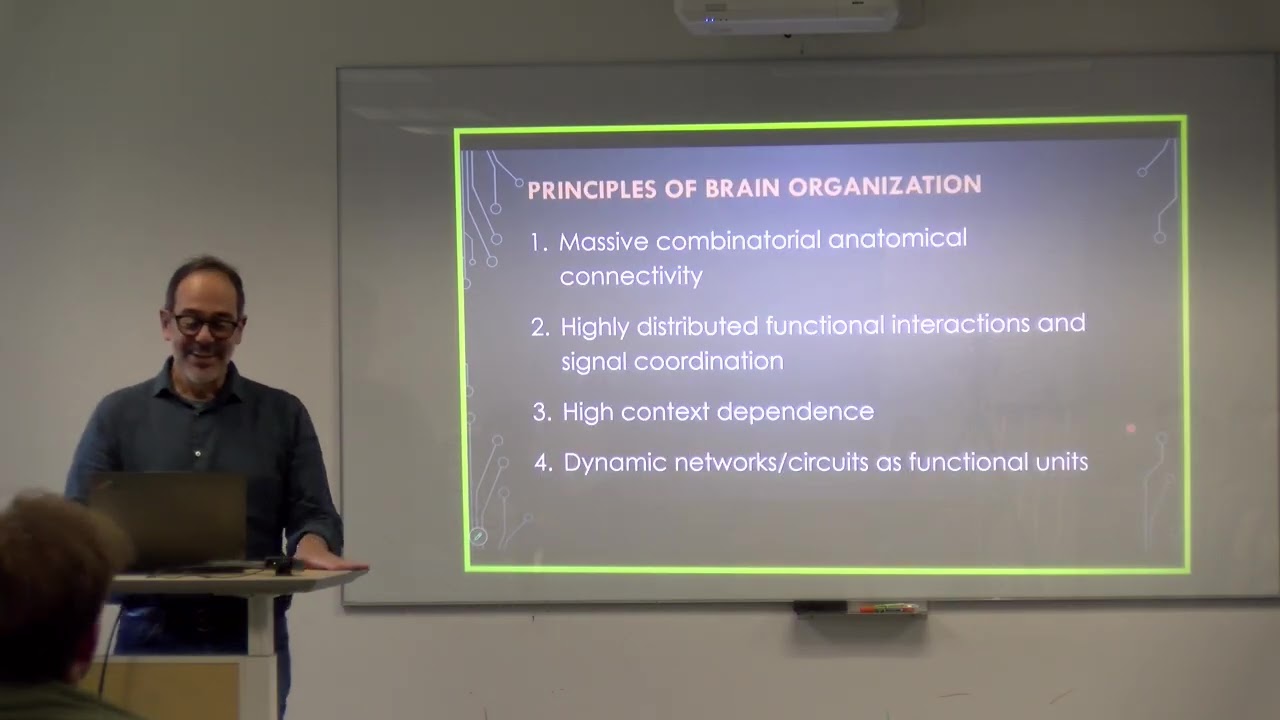
- Principle 1: massive combinatorial anatomical connectivity — short paths between any two brain points, and dense connectivity of individual structures such as the basolateral amygdala (hundreds to a thousand connections estimated in rodents).
- Principles 2 and 3: functional relationships as distinct from anatomical highways, strong context dependence (familiarity, attention, social, emotional and motivational factors) and the role of dozens of neuromodulators.
- Meta-principle: circuits and networks, dynamically recruited to current behavioural demands, rather than brain regions, are the functional units — yielding many-to-many instead of one-to-one structure-function mapping.
- Re-entrant cortical-subcortical architecture and the 'spectrum of urgency' rationale, with predator-prey illustrations of how proximity constrains control and decision-making.
- The periaqueductal grey as a test case: classically treated as a pure output station for freezing, it is bidirectionally connected and sensitive to expectancy and shock frequency, implying a far richer functional role.
- Emotion in the brain: from MacLean's limbic/visceral brain to today's shifting 'core' set of regions, and evidence that affective cues (briefly flashed fearful faces) alter contrast sensitivity, with spatial specificity; an EEG follow-up is announced.
Cited Sources
- Brodmann cytoarchitectonic parcellation of the cerebral cortex — Invoked as the still-influential century-old subdivision of cortex into areas treated as functional units.
- Vogt myeloarchitectonic programme (structure-function linkage) — Cited as the early working hypothesis that structural differences in cortex instantiate specific functions.
- Herbert A. Simon — 'The Architecture of Complexity' (early 1960s), nearly decomposable systems — Framework used to ask whether the brain is a strongly, weakly or non-decomposable system.
- Paul MacLean — limbic / visceral brain — Presented as one of the first influential proposals of a circumscribed set of regions constituting the 'emotional brain'.
- Luiz Pessoa — review of the emotional brain and its shifting core regions — The speaker's own review used to show that the set of regions designated as the emotional brain varies across authors.
- Elizabeth Phelps, Marissa Carrasco and collaborators — fearful face cues and contrast sensitivity — Behavioural study showing that a briefly flashed (75 ms) fearful face reduces the contrast needed to detect Gabor patches, with spatial specificity.
- EEG follow-up study on affective modulation of visual processing — Announced at the end of the recorded segment as a follow-up to the behavioural experiment; details not reached.
- Pessoa — The Entangled Brain (book) — Referenced in the host's introduction as the public-facing synthesis of the framework discussed in the talk.
Concurring Sources
- Complex system — General framing of emergence, non-linearity and decentralised interaction that underpins the entangled-brain argument.
- Connectome — Corroborates the premise of dense, short-path anatomical connectivity used as the talk's first principle.
- Limbic system — Supports the historical account of MacLean's limbic/visceral brain and its contested boundaries.
- Heterarchy — Concept matching the call for decentralised, non-hierarchical descriptions of brain organisation.
Dissenting Sources
- Modularity of mind tradition (Fodor and later domain-specificity programmes) — These programmes hold that at least some cognitive and neural systems are usefully described as encapsulated, functionally dedicated modules — a position directly challenged by the claim of many-to-many mapping and dynamically recruited network units.
- Basic-emotion / discrete-category approaches in affective neuroscience — Such accounts retain a core set of regions with relatively stable functions, whereas the talk argues that the designated emotional regions shift across authors and that affective processing is distributed and interwoven with perception and attention.
- Classical Granger / interventionist causal-inference practice in neuroimaging — The talk contends that traditional accounts of causality are poor candidates for explanation in interactionally complex systems with mutual and reciprocal interactions, implying that much region-level causal attribution may be mis-specified.
Contribution & Novelties
The talk’s originality is not in any single result but in the way it turns a diffuse intuition about brain complexity into an explicit, contestable set of architectural principles and then draws consequences for how research should be organised. The most useful move is methodological: instead of arguing directly that localisationism is wrong, Pessoa identifies the implicit premise that would make it right — that the brain is a nearly decomposable system in Simon’s sense — and then attacks that premise with connectivity and context-dependence evidence. The second contribution is the shift from regions to dynamically recruited networks as functional units, with the corollary that structure-function relations are many-to-many, which reframes what a lesion or a functional-imaging contrast can be taken to show. The third is the use of the periaqueductal grey as a demonstration that even a region with an apparently obvious output role is bidirectionally embedded, undermining any clean input-output partition of the nervous system. The final contribution is normative: if interactions are distributed, mutual and reciprocal, then standard causal-explanatory schemes fit poorly, and the field should pursue decentralised, heterarchical descriptions and lower the boundaries between biology, psychology, mathematics, computer science and philosophy.
Pour aller plus loin :
- Luiz Pessoa — Entry point on the speaker’s work and the affective/systems-neuroscience context of the entangled-brain framework.
- Herbert A. Simon — Background on the author of the near-decomposability argument used here as the pivot of the whole critique of divide-and-conquer neuroscience; see also, by name, his 1962 paper ‘The Architecture of Complexity’.
- Periaqueductal gray — Anatomical and functional overview of the midbrain region used in the talk as the counter-example to a pure output-station view.
- Heterarchy — Concept explicitly invoked to characterise decentralised, non-hierarchical anatomical-functional organisation.
- Emergence — The ‘scary concept’ the speaker acknowledges and reframes as collective constraint among coupled components.
- Connectome — Empirical field underlying the claim of massive combinatorial anatomical connectivity and short path lengths.
- Limbic system — Historical and current framing of the MacLean tradition whose shifting boundaries the talk highlights.
335 words
Radar Profile
The profile is that of a high-level conceptual seminar: moderate on information quantity, high on technical vocabulary and conceptual density, and strong on coherence rather than on evidential display. Reliability sits in the upper-middle range because the speaker is an established specialist who flags the provisional status of his own framework, while the absence of formal citations and of primary data in the recorded portion keeps the quantitative and probative dimensions from scoring higher.