RuCCS - Dr. Marjorie Rhodes - In Person Talk - Tuesday, September 29, 2026 Rhodes Social MisLearning
Keywords
Summary
206 words
Critical Evaluation
Value of the Information & Strength of the Argument
The talk offers substantial value by presenting a coherent theoretical framework (Cartesian vs. Spinozan models) and testing it with carefully designed developmental experiments. The argumentation is strong: the speaker clearly states hypotheses, describes methods, presents results, and acknowledges limitations. The use of a novel animal category (‘modies’) and a within-subject design with agreement/disagreement trials is methodologically sound. The distinction between belief rejection and belief selection is a key theoretical contribution, as it helps reconcile the literature’s emphasis on children’s selective trust with the observed difficulty in rejecting false testimony. The argument that executive function predicts rejection ability is well-supported by the data, though the speaker notes potential confounds (yes bias, encoding strength) and addresses them in Study 2. The discussion of open questions (e.g., whether the initial belief lingers) shows intellectual honesty. The argumentation is not overly technical but assumes familiarity with developmental psychology concepts. Overall, the value lies in advancing a mechanistic account of why social learning sometimes fails, with clear implications for understanding belief formation and persistence.
Scientific Rigor, Source Quality, Title Accuracy
The talk demonstrates high scientific rigor. The speaker grounds the work in established literature (Cartesian and Spinozan models, trust and testimony paradigms) and cites collaborative work with Eric Mandelbaum and a graduate student. The methods are described in detail, including controls for potential biases (e.g., yes bias addressed in Study 2). The speaker openly discusses limitations and alternative explanations, such as the correspondence problem and encoding strength, showing methodological reflexivity. The title ‘Social MisLearning’ accurately reflects the content, though it is broad; the talk specifically focuses on belief rejection and generic language. The adéquation titre/contenu is good: the title captures the core theme without overpromising. No external sources or URLs are provided in the description, so no verification of cited works is possible beyond the speaker’s own references. The talk is a research seminar, not a peer-reviewed publication, but the level of detail and transparency is consistent with high-quality academic discourse.
335 words
Title / Content Match
The title accurately reflects the content: the talk focuses on social mislearning, specifically children's difficulties in rejecting false testimony and over-generalizing from generic language. The title is somewhat generic but appropriate.
Quality & Reliability
8/10
The talk presents original experimental work with clear methods, hypotheses, and preliminary results. The speaker acknowledges methodological concerns (yes bias, encoding strength, order effects) and discusses them openly. However, the work is presented as ongoing and not yet peer-reviewed in the talk itself, and some findings are preliminary. The theoretical framing is grounded in established models (Cartesian vs. Spinozan belief formation). Overall, high credibility for a research seminar.
Key Moments
Markers derived by PSI from the transcript: the creator did not define chapters.
- Introduction of Dr. Marjorie Rhodes and her research on social mislearning.
- Explanation of children's expertise tracking and selective social learning.
- Anecdote about son Isaac and dolphins illustrating early deference to expertise.
- Anecdote about daughter Tally and lions in Central Park, introducing belief rejection failure.
- Introduction of Cartesian vs. Spinozan models of belief formation.
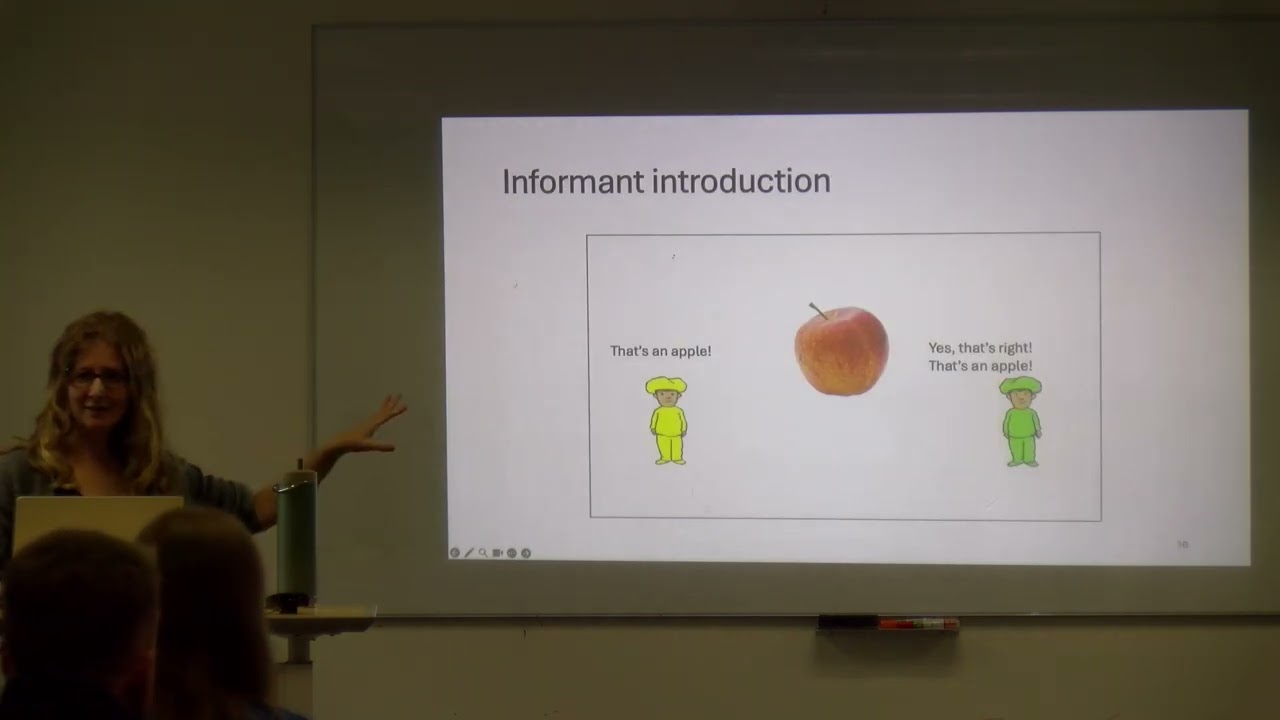
- Description of Study 1: memory test with 'modies' and expert/novice informants.
- Results of Study 1: lower executive function predicts misremembering false as true.
- Discussion of methodological concerns: yes bias and encoding strength.
- Introduction of Study 2: belief selection vs. belief rejection conditions.
- Results of Study 2: children better at selecting than rejecting, especially with low executive function.
Contribution & Novelties
This talk presents novel empirical work on the mechanisms of social mislearning, specifically the distinction between belief rejection and belief selection. The key innovation is demonstrating that children with lower executive function struggle more with rejecting false testimony than with selecting between competing beliefs, which helps reconcile prior findings on children’s selective trust. The work also introduces a new paradigm using a novel animal category (‘modies’) to test memory for testimony. The theoretical integration of Cartesian and Spinozan models with developmental data is a significant contribution. The findings suggest that preserving epistemic information (who said what and whether it was rejected) is a central challenge in social learning, with implications for understanding belief persistence and over-generalization.
Pour aller plus loin :
- Spinozan vs. Cartesian belief formation — Overview of the theoretical debate on belief formation that frames the study.
- Executive function — Background on the cognitive processes measured in the study.
- Selective trust in testimony — General context on how children evaluate informants.
- Generic language and cognition — Related to Part 2 of the talk on over-generalization from generic statements.
180 words
Radar Profile
The radar profile shows high information quantity and quality, with strong reliability and moderate technical depth. The talk is rich in experimental detail and theoretical framing, though it is a seminar rather than a peer-reviewed article. The technical level is appropriate for an academic audience, and the reliability is high due to transparent methods and acknowledgment of limitations.