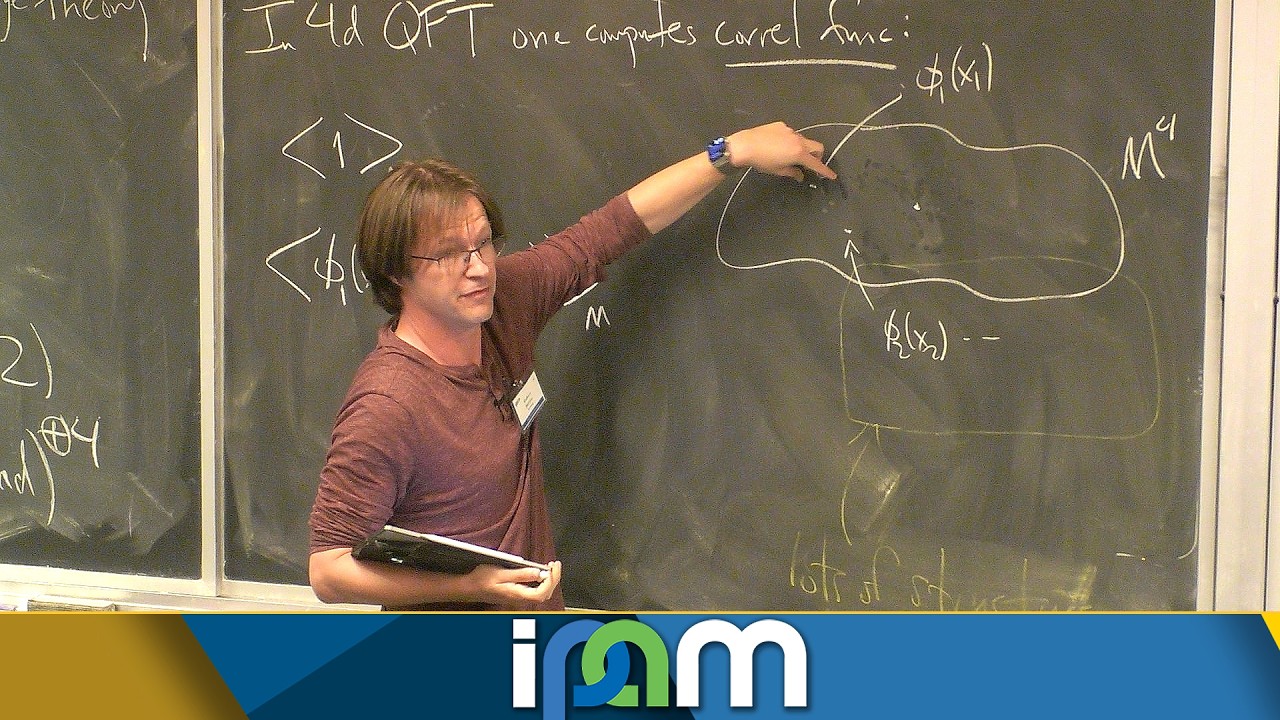
Andrew Neitzke - Skeins, line defects and supersymmetric quantum field theory - IPAM at UCLA
Title history
- Andrew Neitzke - Skeins, line defects and supersymmetric quantum field theory - IPAM at UCLA — observed on 20261101-0214 UTC (YouTube)
Keywords
Summary
159 words
Critical Evaluation
Value of the Information & Strength of the Argument
The talk provides a unifying perspective that clarifies the deep connections between seemingly disparate areas of mathematics and physics. The argumentation is built on conceptual reasoning and examples, such as the four-punctured sphere case where the theory is SU(2) Yang-Mills with four flavors. The speaker carefully distinguishes between the physical line defect and the skein curve, preventing a common confusion. The presentation is logically structured, moving from the 6D theory to 4D, then to line defects and their categorical structure. While no theorems are proved, the arguments are compelling because they integrate many known results from both mathematics and physics, making a strong case for the validity of the picture.
Scientific Rigor, Source Quality, Title Accuracy
The talk is scientifically rigorous in its use of established concepts, and the speaker credits prior work such as that by Dyerin, Morrison, and Okuda for the dictionary between line defects and curves. The only explicit reference provided is the IPAM workshop page, which is appropriate for a workshop talk. The title is well matched to the content, covering both skeins and line defects within the framework of supersymmetric QFT. No comments were provided for analysis, so no public reception trends are discussed.
208 words
Title / Content Match
The title accurately reflects the content: the talk discusses skein algebras, line defects in quantum field theory, and their relation to supersymmetric theories.
Quality & Reliability
8/10
The talk is a survey by an established physicist, covering known results with a few new ideas. No theorems stated, but the conceptual framework is well-established. The presentation is clear and connects multiple fields.
Key Moments
Markers derived by PSI from the transcript: the creator did not define chapters.
Cited Sources
- IPAM Workshop II: Contact Geometry, Cluster Algebras and Skein Theory — Description of the workshop where this talk was given
Concurring Sources
- IPAM Workshop II: Contact Geometry, Cluster Algebras and Skein Theory — Workshop where the talk took place, aligning with the content presented
Contribution & Novelties
This talk contributes a clear synthesis of the physical interpretation of skein algebras, emphasizing the dual role of line defects. While most content is a review, the speaker hints at new approaches, such as using the framework for conformal blocks of W_N vertex algebras. The novel perspective could inspire future research directions at the intersection of skein theory and quantum field theory.
Pour aller plus loin :
- Skein algebra - Wikipedia — Provides background on skein modules and algebras, essential to the talk.
- Class S theory - nLab — Explains the class S theories that are central to the discussion.
- Cluster algebra - Wikipedia — Relevant to the cluster structures mentioned in the talk.
114 words
Radar Profile
The radar profile shows high scores in technical level and quality of information, moderately high in quantity, and slightly lower in global reliability. This indicates a talk that is dense and rich in content but relies on established physics plausibility rather than formal proof, making it more suitable for specialists.