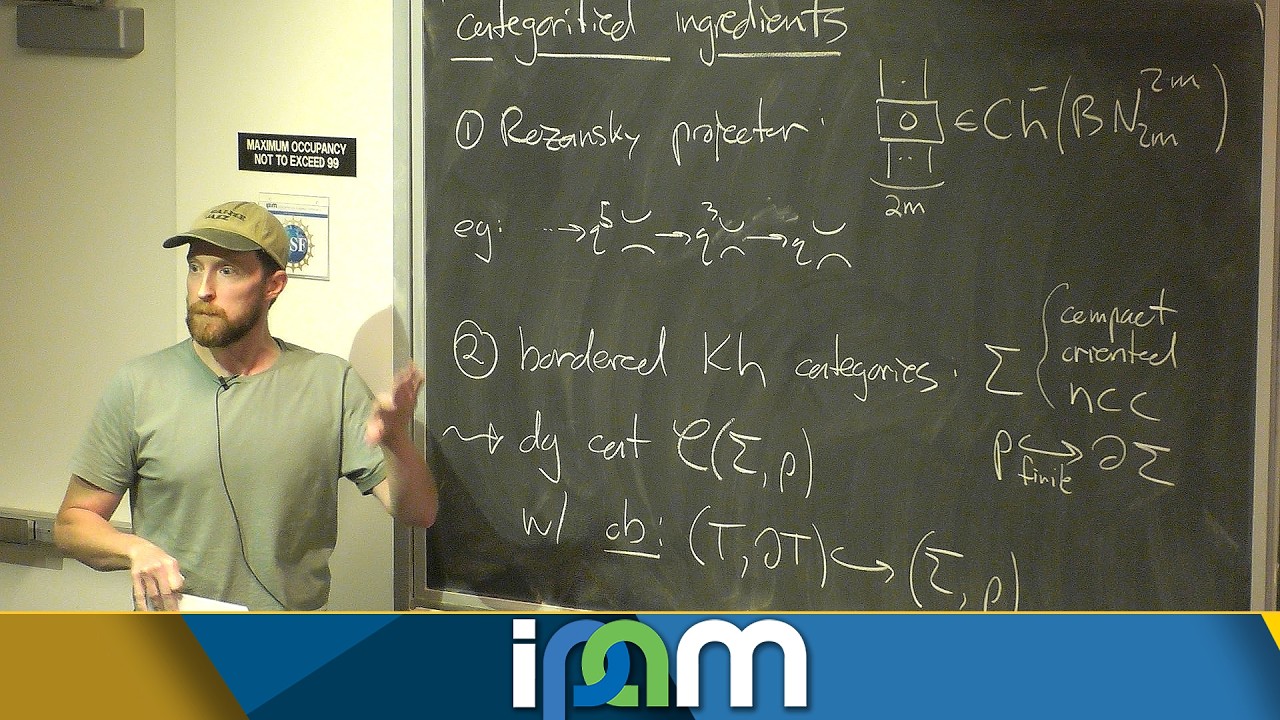
David Rose - Heegaard Khovanov Homology - IPAM at UCLA
Title history
- David Rose - Heegaard Khovanov Homology - IPAM at UCLA — observed on 20261118-1746 UTC (YouTube)
Keywords
Summary
141 words
Critical Evaluation
Value of the Information & Strength of the Argument
The talk provides a high-level yet technically dense exposition of a novel construction. The argumentation follows a clear logical progression: starting from classical Turaev-Viro and Roberts’s description, it identifies the categorification steps and addresses key technical challenges (e.g., using DG categories and a-infinity structures). The speaker’s explanations of the Kirby color properties and the role of the Rozansky projector are well-motivated. The main claim—that the resulting chain complex is a manifold invariant—is presented as a theorem, though the full proof is not detailed in the talk. The presentation balances conceptual overview with explicit formulas, making it valuable for experts in categorification and quantum topology.
Scientific Rigor, Source Quality, Title Accuracy
The talk is built on a solid scholarly foundation, citing the work of Roberts, Crane-Frankle, Walker, and the speaker’s joint projects. The sources are appropriately referenced in context, though no external URLs are given beyond the workshop page. The title matches the content precisely, as the talk indeed introduces a Heegaard-Khovanov homology invariant. The speaker does not make unsubstantiated claims; he clearly distinguishes what is proven versus what is in progress. The audience engaged with technical questions, and the speaker responding coherently, indicating a well-prepared and robust presentation.
207 words
Title / Content Match
The title accurately reflects the content: the talk presents a new Heegaard Khovanov homology invariant for 3-manifolds.
Quality & Reliability
9/10
The talk is an expert presentation at a research workshop, introducing a new invariant with rigorous mathematical details. The speaker is a recognized researcher, and the content is at the cutting edge of quantum topology.
Key Moments
Markers derived by PSI from the transcript: the creator did not define chapters.
- Introduction and outline of the talk: categorification of Turaev-Viro invariant via Khovanov homology.
- Statement of the main theorem: construction of a chain complex invariant for closed 3-manifolds.
- Review of Roberts' description of Turaev-Viro using Kirby color and third degree zero projector.
- Definition of the Kirby color and its properties: handle cancellation and handle slide.
- Introduction of the bordered Khovanov categories and their role in the construction.
- Details of the Rozansky projector and its categorification via bar complexes.
- Explanation of how the invariant is computed from a Heegaard diagram, including adjustments for braidings.
- Concluding remarks and discussion of future work, including the WRT version and derived Lasagna modules.
Cited Sources
- IPAM Workshop: Categorification in Quantum Topology — Workshop page where the talk was recorded and additional resources are provided.
Concurring Sources
- Khovanov homology (Wikipedia) — Related work on categorified link invariants that the talk builds upon.
Contribution & Novelties
This talk presents original research developing a categorified Turaev-Viro invariant via Khovanov homology. The novelty lies in the introduction of a derived Kirby object and the use of bordered Khovanov categories to handle handle slides and cancellations. This approach avoids the need for roots of unity, working at generic q with homotopical algebra. The construction is anticipated to connect with derived Lasagna modules and potentially detect exotic smooth structures.
Pour aller plus loin :
- Khovanov homology — Foundational concept; this talk categorifies Jones polynomial invariants.
- Heegaard splitting — Background on Heegaard diagrams used in the construction.
- Turaev–Viro invariants — The target of categorification; the talk provides a homological version.
109 words
Radar Profile
The radar profile shows very high scores in technical level and quality of information, reflecting a dense expert talk. The quantity of information is high but slightly lower due to the focused scope. Overall fiabilite is strong, without any discordant sources.