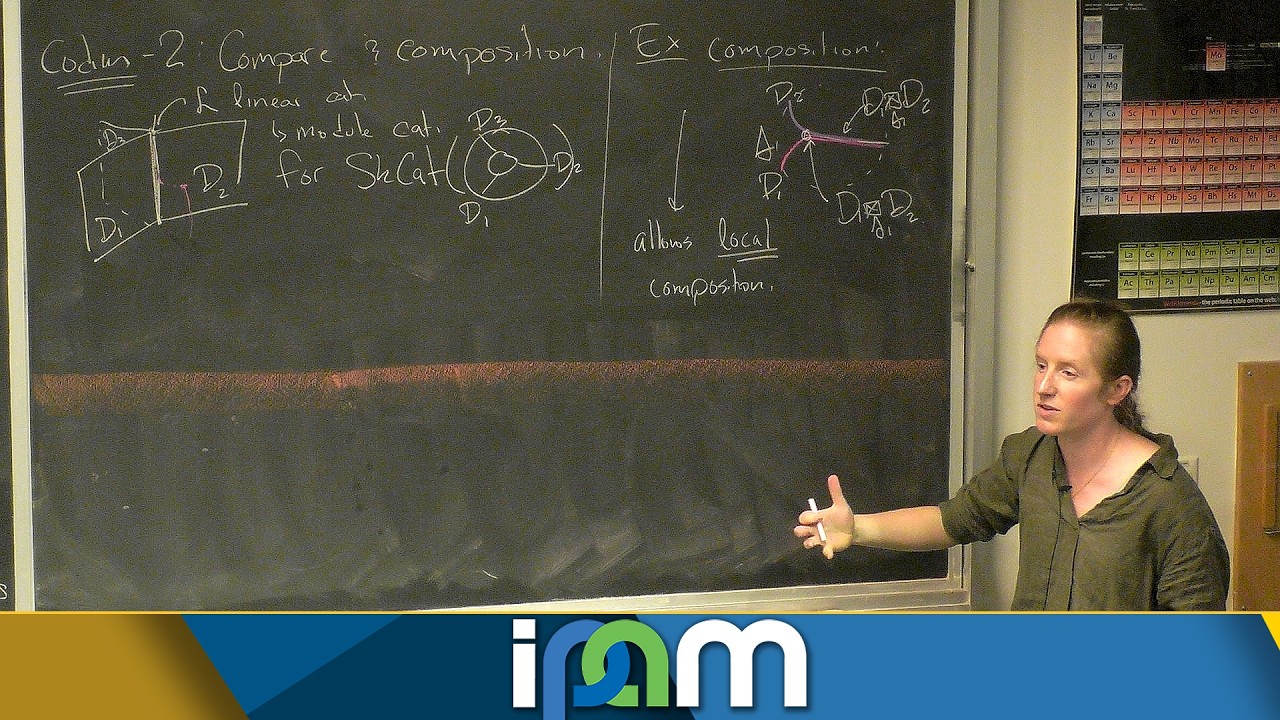
Jennifer Brown - Parabolic Structures in Skein Theory - IPAM at UCLA
Title history
- Jennifer Brown - Parabolic Structures in Skein Theory - IPAM at UCLA — observed on 20261117-1758 UTC (YouTube)
Keywords
Summary
128 words
Critical Evaluation
Value of the Information & Strength of the Argument
The value of the talk lies in providing a unifying categorical framework that allows translating group-theoretic structures like parabolic subgroups and Weyl groups into topological defects in skein theory, potentially simplifying computations. The argumentation is solid: the speaker starts with basic definitions, builds up the defect formalism rigorously, and demonstrates key behaviors (e.g., crossing simplification) that motivate the approach. Proofs are only sketched, but references to joint work with David Jordan and others give credibility. The speaker also handles questions well, clarifying technical points.
Scientific Rigor, Source Quality, Title Accuracy
The scientific rigor is high; the talk is part of a professional workshop and the speaker is affiliated with a renowned institution. The content aligns with established research in categorification and quantum topology. The only explicit source provided is the IPAM workshop page, which supports the context but does not provide direct references. The title is a perfect match for the content, clearly indicating the specific topic and venue. No concern of mismatch.
172 words
Title / Content Match
The title accurately and precisely describes the talk's focus on parabolic structures within skein theory.
Quality & Reliability
8/10
Advanced technical talk given by a researcher at IPAM workshop; the content is logically structured and consistent with established mathematical frameworks, but relies on prior publications and no external sources other than the workshop page.
Key Moments
Markers derived by PSI from the transcript: the creator did not define chapters.
- Introduction and motivation for using defects in skein theory.
- Definition of skein modules and categories without defects.
- Introduction to codimension-1 defects and their algebraic data.
- Parabolic reduction defect for G/T and its properties.
- Weyl group defect and examples.
- Applications and future directions.
Cited Sources
- IPAM Workshop: Categorification in Quantum Topology — Homepage of the workshop where the talk was recorded, providing background and related materials.
Contribution & Novelties
The talk contributes a novel categorical description of parabolic structures as defects in skein theory, which had not been systematically developed. It unifies several known techniques and suggests simplifications in studying character stacks. The framework is presented with concrete examples, and the speaker indicates potential applications to quantum cluster coordinates.
Pour aller plus loin :
- Skein theory — Directly relevant background on the invariant theory of links and graphs.
- Categorification — The broader program under which this work falls, aiming to lift algebraic structures to categorical ones.
- Quantum group — The algebraic structures underlying the representations discussed in the talk.
- Weyl group — A key group appearing in the construction, acting on weight spaces.
114 words
Radar Profile
The radar profile shows a very high level of technical depth (10) and moderate to high scores on quantity, quality, and reliability. This indicates a specialized, rigorous mathematical talk that is rich in content and likely trustworthy, but highly advanced, limiting its accessibility.