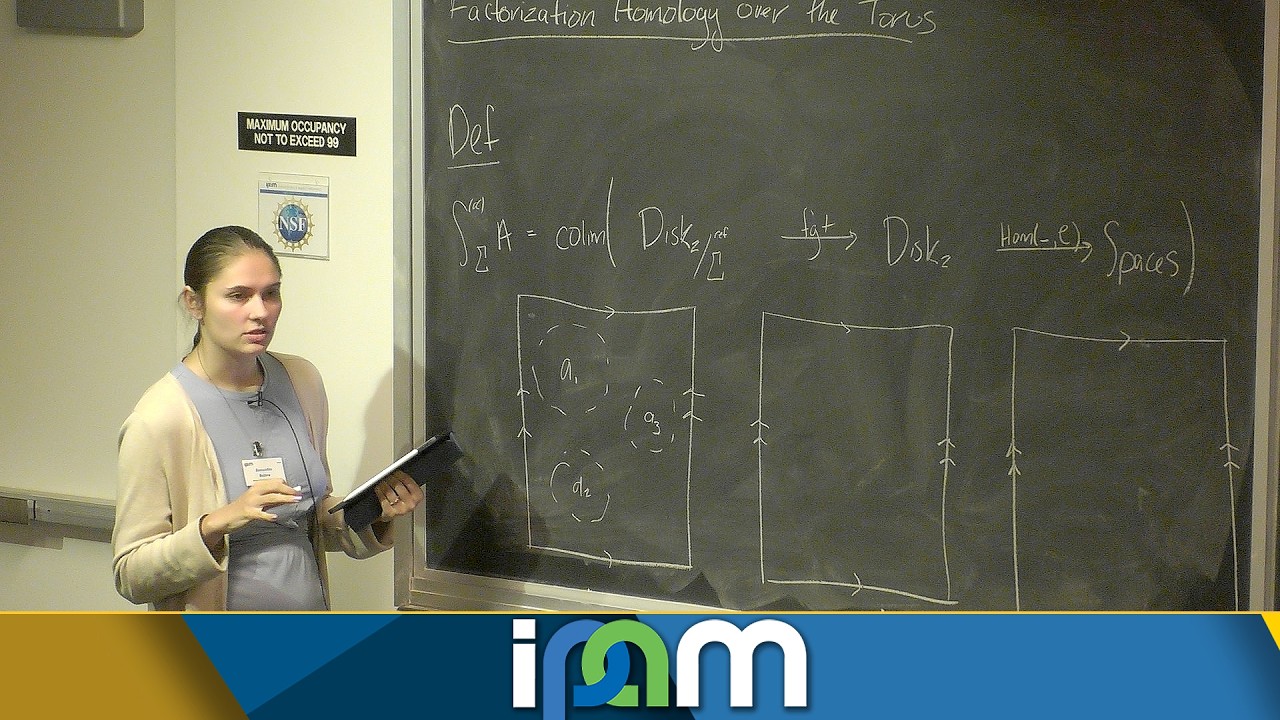
Alexandra Ballow - Factorization Homology over the Torus - IPAM at UCLA
Title history
- Alexandra Ballow - Factorization Homology over the Torus - IPAM at UCLA — observed on 20261119-2148 UTC (YouTube)
Keywords
Summary
196 words
Critical Evaluation
Value of the Information & Strength of the Argument
The value of the information is high: the talk offers a new perspective on factorization homology over surfaces, making connections to string nets, pasting diagrams, and computable examples. The argumentation is solid, with clear step-by-step generalizations from simple algebras to categories and 2-categories, and explicit computational results. The speaker acknowledges limitations (e.g., two-dimensional cases are difficult) and references prior work (e.g., Ayala, Francis, and Lurie) to ground the discussion. The proof sketch for the one-dimensional case is convincing and illustrates the power of the paracyclic approach.
Scientific Rigor, Source Quality, Title Accuracy
The scientific rigor is high, with definitions carefully stated and distinctions between levels of abstraction preserved. The talk cites concrete literature, notably the IPAM workshop and a paper on cyclic nerves, although the exact references are not precisely transcribed in the transcript. The title accurately reflects the content. The speaker’s informal asides (e.g., ’this is tech, I made this up’) are honest but do not affect the formal correctness. No audience comments were provided, so no public reception trends could be assessed.
183 words
Title / Content Match
The title perfectly matches the content, as the talk specifically focuses on factorization homology over the torus and its categorified variants.
Quality & Reliability
9/10
The talk presents rigorous mathematical content with clear definitions, a proof sketch, and references to prior work. The speaker is a researcher at Montana State University, and the presentation is aimed at an expert audience. Mispronunciations and informal asides do not undermine the technical validity.
Key Moments
Markers derived by PSI from the transcript: the creator did not define chapters.
- Definition of factorization homology with disks labeled by an E2 algebra over a surface, exemplified on the torus.
- Introduction of a categorical version (beta 1): labeling arcs and vertices with objects and morphisms in a monoidal category, linking to string nets.
- Transition to disc-stratified manifolds and 2-categorical labels, connecting to pasting diagrams and computads.
- Discussion of one-dimensional case: factorization homology over the circle, using the paracyclic category for computability.
- Statement and proof sketch of the computation for finite-dimensional vector spaces as Hochschild homology, using induction and the Read filtration.
- Motivation and definition of 2-quivers, with desired properties: gauntness, description of 2-morphisms, and characterization of toroidal 2-quivers.
Cited Sources
- Workshop III: Categorification in Quantum Topology - IPAM at UCLA — This video is a recorded talk from this workshop, providing context for the lecture.
- Symmetries of a cyclic nerve (Ayala, Masilg, Rosen bloom) — Mentioned in the talk as a reference for factorization homology over the circle and the equivalence of different co-limits.
Contribution & Novelties
This talk advances factorization homology by explicitly connecting categorical formulations to string nets and proposing 2-quivers as a computational tool for the torus. The main novelty is the extension of factorization homology to categorified settings and the concrete computation for finite-dimensional vector spaces, which the speaker states is not written down in the literature. The development of 2-quivers provides a new combinatorial framework for handling the torus, overcoming the limitations of pasting diagrams.
Pour aller plus loin :
- Factorization homology (nLab) — Core concept underlying the talk, with general definitions and context.
- Higher category theory (nLab) — Background for the categorified structures used, including 2-categories and infinity categories.
- String-net condensation (Wikipedia) — Related to the string net diagrams mentioned, relevant for topological order and quantum topology.
126 words
Radar Profile
The radar profile shows very high technical level (10) and high quality/fiabilité scores (9), with slightly lower quantity of information (8) due to the concise length. This reflects a dense, expert-level presentation with strong content but limited space for extensive background.