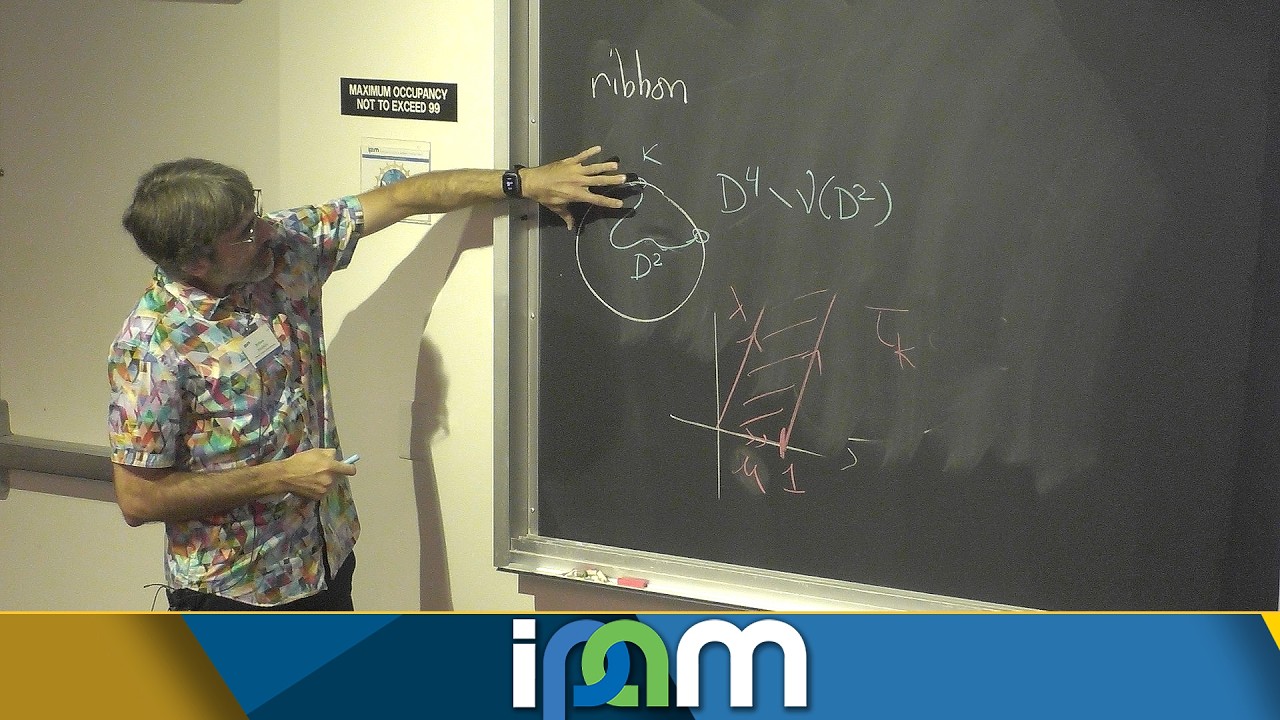
Nathan Dunfield - Ribbon concordances and slice obstructions: experiments and examples
Title history
- Nathan Dunfield - Ribbon concordances and slice obstructions: experiments and examples — observed on 20261025-1526 UTC (YouTube)
Keywords
Summary
188 words
Critical Evaluation
Value of the Information & Strength of the Argument
The value of this work is exceptional: it provides an unprecedented census of slice and ribbon knots, turning a largely theoretical field into a data-driven discipline. The argumentation is solid and methodical: the speaker first defines the objects, then outlines the two complementary strategies (finding ribbon knots via band moves and obstructing sliceness via invariants), and finally integrates hyperbolic geometry to generate new pairs of interest. The logical flow is clear, and the speaker frequently pauses for questions, demonstrating an openness to scrutiny. The reliance on multiple independent invariants (signature, Fox-Milnor, Casson-Gordon, Khovanov homology, Heegaard Floer) strengthens the conclusions, and the explicit mention of exceptions (about 0.003% unresolved) shows intellectual honesty. The experimental nature is acknowledged, but the scale and consistency lend high credibility to the results.
Scientific Rigor, Source Quality, Title Accuracy
The talk demonstrates a high level of scientific rigor. The speaker cites classical results (Fox’s question, Milnor’s conditions, Casson-Gordon invariants) and recent developments (Lipshitz, Sarkar, Piccirillo, etc.) without referencing them by paper titles but clearly indicates the lineage of ideas. The use of Snappy, a well-established software for 3-manifolds, adds reliability. The title precisely matches the content: the presentation indeed focuses on ribbon concordances, slice obstructions, and highlights both experiments (large-scale computation) and examples (specific knots, plots). The interplay between theory and computation is exemplary, and the speaker does not overstate conclusions, explicitly stating when things remain unknown. The description points to the workshop page, which provides context, but no direct link to the paper is given; however, the talk is clearly a research presentation. The overall fit between title and content is excellent, and the level of detail is appropriate for a specialist audience.
287 words
Title / Content Match
The title accurately reflects the core content: a computational and experimental investigation of ribbon concordances and slice obstructions, with extensive examples.
Quality & Reliability
9/10
The talk presents a large-scale computational study of 352 million prime knots, using a variety of established and novel invariants from quantum topology and hyperbolic geometry. The methods are rigorous, the data is made available, and the results are consistent with known conjectures, though some conclusions remain experimental and rely on heavy computation.
Key Moments
Markers derived by PSI from the transcript: the creator did not define chapters.
- Introduction: definition of knots, unknots, and the notion of slice knots.
- Main computational results: of 352M knots, 1.6M are ribbon, 350.5M are not slice, with few exceptions.
- Explanation of band moves and the combinatorial search for ribbon knots.
- Methods for showing knots are not slice: signature, Fox-Milnor, Casson-Gordon, Khovanov homology, Heegaard Floer, and Piccirillo's technique.
- Generation of zero-friends via hyperbolic geometry and drilling geodesics; discussion of candidate exotic 4-spheres.
- Patterns in the data, open questions, and remarks on the concordance structure.
Cited Sources
- IPAM Workshop: Hyperbolic Structures and Quantum Invariants — Workshop page where the talk was recorded, providing official context and abstract.
Contribution & Novelties
The talk provides the first comprehensive, large-scale determination of sliceness for all prime knots up to 19 crossings, with a remarkably low failure rate. It introduces a method to generate vast numbers of zero-friend pairs via hyperbolic Dehn filling, which may be relevant to the smooth 4-dimensional Poincaré conjecture. The work also highlights the exceptional utility of Khovanov homology and its odd variant in obstructing sliceness. The data offers empirical support for several conjectures and suggests new patterns linking hyperbolic volume and crossing number of slice candidates.
Pour aller plus loin :
- Khovanov homology — Central to the quantum invariants used for slice obstructions.
- Heegaard Floer homology — Source of the tau invariant used in the talk.
- Casson–Gordon invariants (maybe not exactly, but likely exists; if uncertain, we can leave without URL) — The generalised Alexander polynomial methods.
- Hyperbolic Dehn surgery — Underlies the zero-friend generation technique.
- Slice knot — Wikipedia article on slice knots, providing background.
157 words
Radar Profile
The radar profile shows very high scores across all dimensions, with the highest in technical level and quantity of information. Reliability is slightly lower but still strong, reflecting the experimental nature of some results. Overall, the talk is a dense, cutting-edge research presentation with robust methodology.