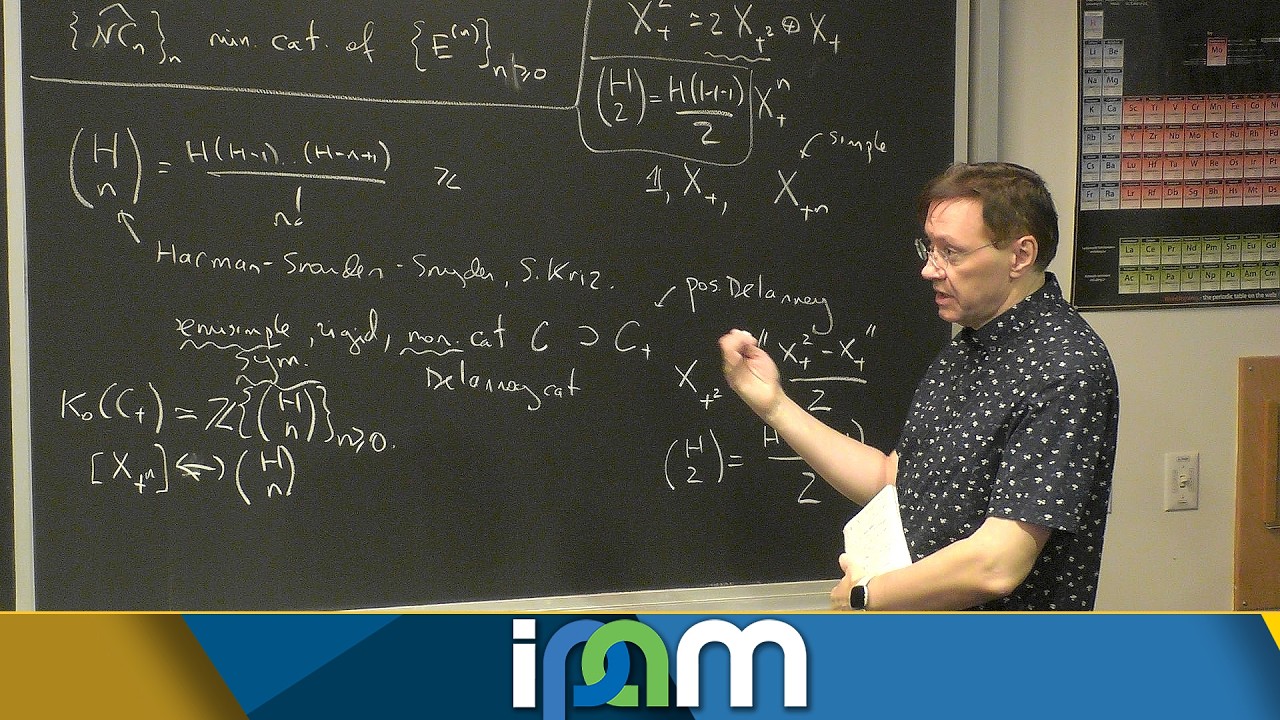
Mikhail Khovanov - Minimal & semisimple categorifications, subalgebras of classical & quantum sl(2)
Title history
- Mikhail Khovanov - Minimal & semisimple categorifications, subalgebras of classical & quantum sl(2) — observed on 20261119-2148 UTC (YouTube)
Keywords
Summary
174 words
Critical Evaluation
Value of the Information & Strength of the Argument
The value of the information is high: the talk presents new results in categorification, a central topic in modern mathematical physics and representation theory. The argumentation is rigorous and detailed, with explicit constructions and examples of idempotents and category axioms. Khovanov carefully explains how to overcome the division by factorials through matrix algebra decompositions, and the logical flow from minimal categorification to Cartan categorification is clear. He also notes limitations and open questions, which strengthens the academic honesty of the presentation. However, the third announced topic is not developed in the transcript, leaving an incomplete picture.
Scientific Rigor, Source Quality, Title Accuracy
The scientific rigor is typical of a research talk by an expert: definitions, diagrams, and relations are given with precision. The title matches the content exactly, although the third part (coherent sheaves) is missing from the transcript. The only source provided is a link to the IPAM workshop page, which is relevant as it contains the abstract and context. No external citations are given in the transcript or description beyond this link, so the source base is minimal and not independently verifiable. The talk relies on the audience’s familiarity with categorification and quantum groups.
205 words
Title / Content Match
The title accurately reflects the content: the talk discusses minimal and semisimple categorifications of subalgebras of sl(2), as presented.
Quality & Reliability
8/10
The talk is given by a leading expert (M. Khovanov) and presents recent research with rigorous construction. However, the transcript is incomplete (the third topic is announced but not developed), and no sources beyond the workshop page are provided.
Key Moments
Markers derived by PSI from the transcript: the creator did not define chapters.
- Introduction to categorification of quantum groups and integral bases
- Construction of the minimal algebra nĈ_n for categorification of positive part
- Categorification of the Cartan subalgebra using the positive Delannoy category
- Introduction to the third story with coherent sheaves on projective space (announced but not detailed)
Cited Sources
- Workshop III: Categorification in Quantum Topology — The talk was presented at this workshop; the page contains the abstract and program details.
Contribution & Novelties
The talk presents a new minimal categorification of the positive nilpotent part of quantum sl(2), using a very small subalgebra of the nil-Hecke algebra. This is a simplification that captures the essential idempotents needed for dividing by factorials. The second contribution is a categorification of the Cartan subalgebra via the positive Delannoy category, which provides a semisimple symmetric monoidal category whose Grothendieck ring is the ring of integer-valued polynomials. This explicitly makes the Cartan part part of a categorical framework, something previously lost in most categorifications. The approach uses a clever integration over real line configurations with compact Euler characteristic, leading to idempotents and decomposition of the generating object.
Pour aller plus loin :
- Categorification — General concept of lifting algebraic structures to categories, relevant to the entire talk.
- Nil-Hecke algebra — The algebra underlying the minimal categorification; the talk uses a subalgebra of it.
- Delannoy numbers — The Delannoy category is named after these numbers; they appear in combinatorial compositions.
- Quantum group — The background of sl(2) and its categorifications.
171 words
Radar Profile
The radar profile shows very high scores in technical level and information quality, with slightly lower on quantity and reliability, reflecting the dense content and the incomplete transcript, but with a strong basis of expertise.