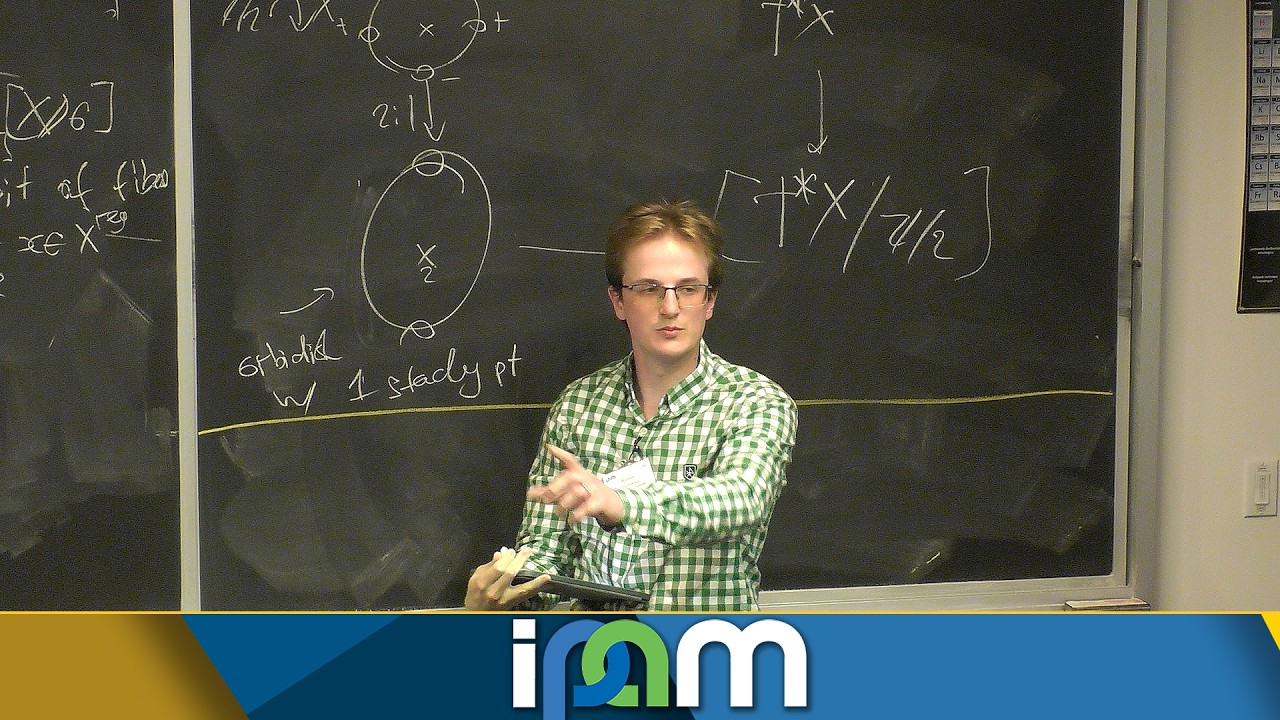
Roman Krutowski - Hecke algebras through the lens of orbifold Floer theory - IPAM at UCLA
Title history
- Roman Krutowski - Hecke algebras through the lens of orbifold Floer theory - IPAM at UCLA — observed on 20261101-0213 UTC (YouTube)
Keywords
Summary
149 words
Critical Evaluation
Value of the Information & Strength of the Argument
The talk provides a novel bridge between two areas: Hecke algebras, classical in representation theory, and Floer theory, central in symplectic topology. The argumentation is rigorous, with clear statement of theorems, motivations, and explicit examples, particularly the case of symmetric products of the sphere. The speaker carefully defines orbifold Hecke algebras and explains how they unify known examples. The evidence for the derived version is presented, though some open questions remain. The presentation is logically structured, leading from general results to specific computations.
Scientific Rigor, Source Quality, Title Accuracy
The scientific rigor is high: the content is based on joint work with published preprints, presented at an academic workshop. The only source explicitly cited is the IPAM workshop page, but the talk itself refers to several known works (by Abouzaid, Etgü, and others) without providing URLs. The title accurately reflects the content, which is essential for a specialized audience. No comments were available to analyze community perception.
166 words
Title / Content Match
The title precisely reflects the content: the speaker presents a connection between Hecke algebras and orbifold Floer theory.
Quality & Reliability
9/10
Presentation of original research at a specialized workshop, with clear theorems and proofs, though highly technical. The speaker is an MIT researcher and the context is a leading institute.
Key Moments
Markers derived by PSI from the transcript: the creator did not define chapters.
- Introduction and main theorem statement
- Motivation from symmetric products and braid skein algebras
- Definition of orbifold Hecke algebras and examples
- Generalized Hecke relations for Z/m actions
- Review of known Hecke algebras (Cherednik, affine, double affine)
- Extension to complex reflection groups and crystallographic groups
- Example: elliptic curve orbifold and its resolution
- Fukaya categories of orbifold cotangent bundles and morphisms
- A∞ operations and computation for symmetric products of S^2
- Open questions and future directions
Cited Sources
- IPAM Workshop II: Contact Geometry, Cluster Algebras and Skein Theory — Workshop page where the talk was recorded and additional information and related abstracts are available.
Contribution & Novelties
The original contribution is the establishment of a direct link between orbifold Hecke algebras (a generalization of Hecke algebras to orbifolds) and the Fukaya category of cotangent bundles of global quotient orbifolds. This extends previous results by Abouzaid for smooth manifolds to the orbifold setting, providing a degree-zero cohomology isomorphism under assumptions on π₂. The talk also gives explicit computations for symmetric products of the sphere, yielding a braid skein algebra with derived structure.
Pour aller plus loin :
- Hecke algebra — Classical context and definitions.
- Orbifold — Basic notion of orbifolds and their role in geometry.
- Fukaya category — Central object in symplectic topology and mirror symmetry.
- Skein algebra — Related algebraic structures on surfaces.
- Floer homology — Foundation of Floer-theoretic invariants.
123 words
Radar Profile
The profile shows very high technical level and quality, with slightly lower quantity due to the focused nature of the talk. The fiability is excellent, based on a rigorous academic presentation.