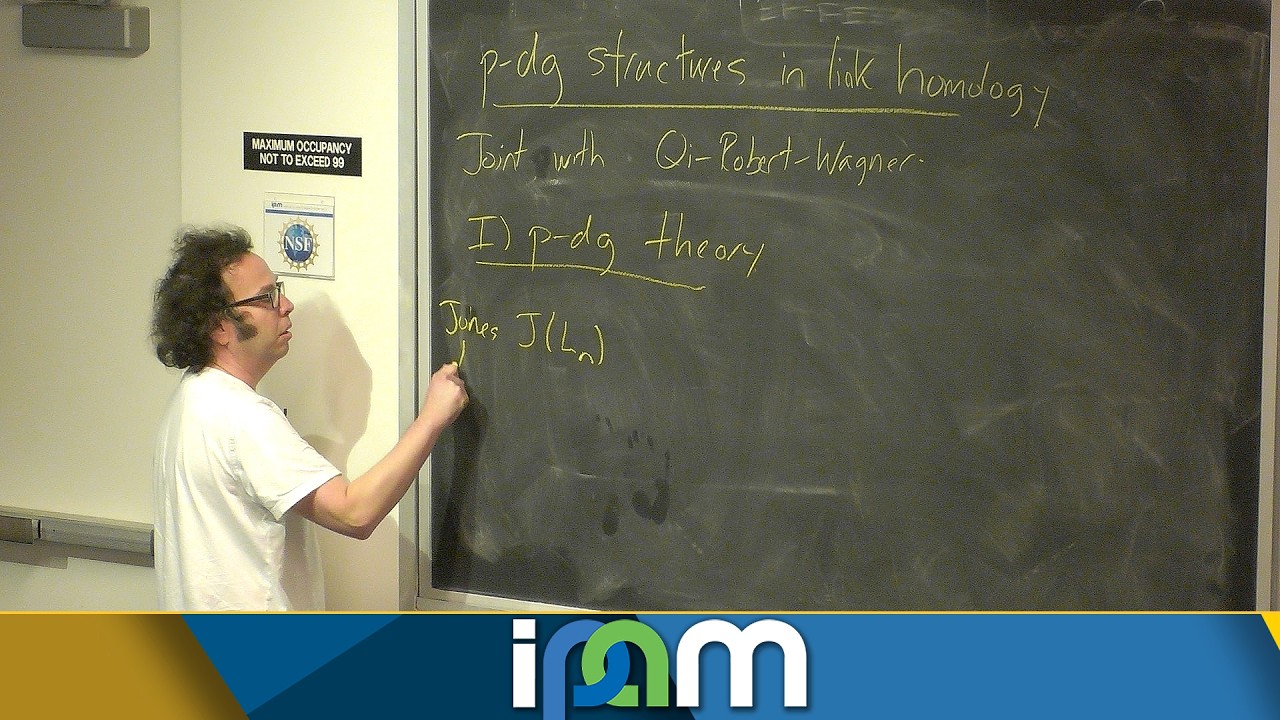
Joshua Sussan - p-DG structures on link homology - IPAM at UCLA
Title history
- Joshua Sussan - p-DG structures on link homology - IPAM at UCLA — observed on 20261118-0144 UTC (YouTube)
Keywords
Summary
243 words
Critical Evaluation
Value of the Information & Strength of the Argument
The talk provides substantial value by introducing a novel algebraic structure—p-DG structures—into link homology, directly addressing the long-standing question of categorifying root-of-unity evaluations of quantum link invariants. The argumentation is well-structured: it begins with a clear motivation (Crane-Frenkel dream), proceeds step-by-step through algebraic and topological constructions, and culminates in a precise theorem. The speaker carefully justifies choices (e.g., the parameter C, the twisting of the D action) and handles audience questions with concrete details. The reasoning relies on established theorems (Rickard’s equivalence, Robert-Wagner evaluation) and coherently builds a new framework, though the ultimate Hodge-theoretic interpretation and the conjecture about WRT homology remain open. The presentation is logically solid and demonstrates deep insight, though the technical complexity requires specialized background.
Scientific Rigor, Source Quality, Title Accuracy
The rigor is high: the talk references and builds on known results from Khovanov, Robert-Wagner, and others, and explicitly states joint work with Y. Qi, L.H. Robert, and E. Wagner. The single link provided in the description points to the IPAM workshop page, which serves as contextual source. The title precisely matches the content, and the talk avoids overclaiming by clearly marking which statements are theorems and which are conjectural. The evidence is based on detailed algebraic constructions and examples, though no peer-reviewed publication is cited during the talk. Overall, the presentation adheres to professional mathematical standards.
231 words
Title / Content Match
The title exactly describes the content: the talk centers on p-DG structures in the context of link homology, as presented by Joshua Sussan.
Quality & Reliability
8/10
The talk presents original joint research, delivered at a professional workshop (IPAM). The mathematical construction is rigorous, built on established results (Robert-Wagner evaluation, Khovanov's p-DG theory, Rickard's equivalence). However, it is a seminar presentation without full proofs or peer-reviewed publication, so absolute verification is not possible.
Key Moments
Markers derived by PSI from the transcript: the creator did not define chapters.
- Introduction and motivation: Jones polynomial, WRT invariants, categorification program.
- Definition of the algebra H = K[D]/(D^p) and the stable category; Grothendieck ring computation.
- Review of webs and foams, Robert-Wagner evaluation, and the universal construction for state spaces.
- Construction of the H-module action on foams, including the twisting at crossings to ensure compatibility.
- Statement of the main invariance theorem and corollary for Jones polynomial at roots of unity.
- Examples: unknot trivial, Hopf link non-trivial, and discussion of implications.
Cited Sources
- IPAM Workshop III: Categorification in Quantum Topology — Official workshop page for the talk, providing context and program details.
Concurring Sources
- Khovanov homology (Wikipedia) — Background on Khovanov homology, which is the foundation of the link invariant discussed in the talk.
- Categorification (Wikipedia) — General framework for the categorification program that the talk aims to advance.
Contribution & Novelties
The talk presents a novel p-DG structure on link homology, extending Khovanov’s earlier ideas to equip the state space of a web with a compatible H-module action, and demonstrating that the resulting complex yields a categorification of the Jones polynomial at 2p-th roots of unity. The construction is original and opens a concrete pathway toward categorifying WRT invariants. The approach via the stable category and singular derived category is a fresh contribution to the field, and the examples (Hopf link) show non-trivial behavior.
Pour aller plus loin :
- Categorification — General concept of lifting invariants to categorical structures, central to the talk.
- Khovanov homology — The original link homology theory that the talk builds upon.
- Jones polynomial — The classical link invariant that is categorified at roots of unity.
- Reshetikhin–Turaev invariant — Related three-manifold invariant, motivating the goal of categorifying WRT invariants.
142 words
Radar Profile
The radar profile shows high technical level (9) and strong quality/quantity scores (8), with slightly lower but still solid reliability (8). This indicates a technically dense, well-presented original research talk that assumes a specialized audience. The balanced scores suggest a consistent and rigorous presentation, although the lack of peer-reviewed publication tempers the overall reliability.