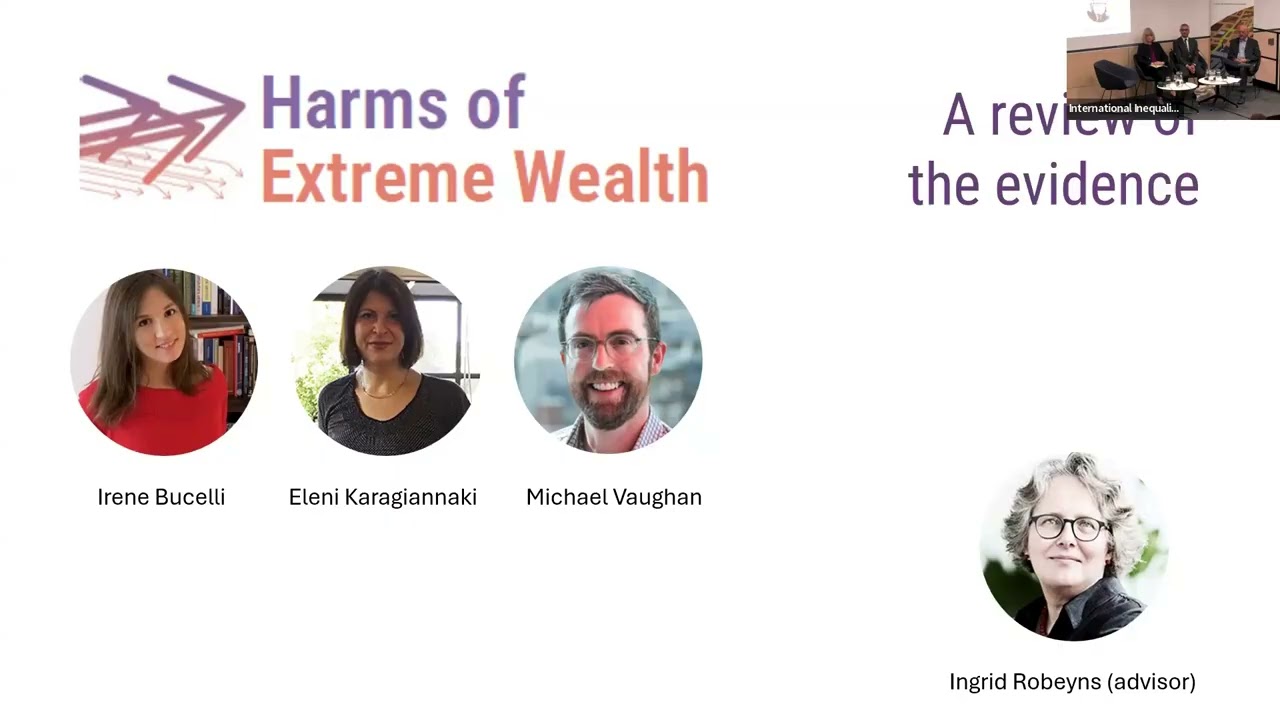
The Harms of Extreme Wealth: Launching the Evidence Review | LSE III Event
Title history
- The Harms of Extreme Wealth: Launching the Evidence Review | LSE III Event — observed on 20261111-1025 UTC (YouTube)
Keywords
Summary
130 words
Critical Evaluation
Value of the Information & Strength of the Argument
The presentation provides high-value information, synthesizing a wide range of academic studies into a coherent framework. The argumentation is solid: it systematically defines extreme wealth, presents evidence for each harm category, and discusses mechanisms. The use of visualizations (wealth distribution charts, Musk example) aids understanding. The speakers acknowledge limitations, such as lack of causal evidence and variation by context, which strengthens credibility. The proposal for an extreme wealth line is well-motivated by the evidence and positioned as a policy tool rather than a silver bullet.
Scientific Rigor, Source Quality, Title Accuracy
The scientific rigor is high: the review adopts evidential pluralism, drawing on multiple disciplines and study types. Sources mentioned include the World Inequality Report and The Spirit Level, both respected works. The presentation clearly distinguishes between correlation and causation, and highlights gaps in evidence. The title ‘The Harms of Extreme Wealth: Launching the Evidence Review’ accurately describes the event, which focuses on the launch and presentation of the review. No claims are made without referencing the underlying research, and the proposed extreme wealth line is presented as a starting point for further discussion.
193 words
Title / Content Match
The title accurately reflects the content: the event launches an evidence review on the harms of extreme wealth, presented by experts.
Quality & Reliability
8/10
The event is hosted by LSE, a leading academic institution. The speakers are professors and researchers, and the content is based on a systematic evidence review across disciplines. The presentation synthesizes multiple studies and provides a balanced overview of harms.
Key Moments
Markers derived by PSI from the transcript: the creator did not define chapters.
- Introduction of speakers and event purpose by Francisco Ferreira
- Tania Burchardt presents global wealth concentration charts
- Discussion of top 1% wealth share and UK distribution
- Illustration of Elon Musk's wealth to visualize scale
- Overview of four harm domains: political, economic, social, environmental
- Detailed evidence on political harms, including democratic erosion and campaign finance
- Economic harms: negative relation between wealth concentration and GDP growth
- Social harms: trust, social mobility, sticky ceilings
- Environmental harms: consumption and production channels
- Gaps in evidence and discussion of tipping points
- Proposal of the extreme wealth line and its rationale
- Kate Pickett's discussant remarks, comparing with The Spirit Level and current momentum
Cited Sources
- World Inequality Report — Used to show global concentration of wealth across regions.
- The Spirit Level — Referenced by Kate Pickett as prior work on inequality harms.
Contribution & Novelties
The evidence review synthesizes multidisciplinary research on the harms of extreme wealth, proposing a concrete ’extreme wealth line’ as a policy tool. Its novelty lies in systematically consolidating evidence across political, economic, social, and environmental domains, and in identifying gaps and potential tipping points. This moves beyond simple inequality to focus on the extreme end. The event highlights ongoing international efforts, including the UN roadmap and the proposed International Panel on Inequality.
Pour aller plus loin :
- Wealth inequality — Overview of wealth inequality concepts and measures.
- World Inequality Database — Data source behind the World Inequality Report.
- Democratic backsliding — Explains mechanisms of democratic erosion mentioned in the review.
110 words
Radar Profile
The radar profile shows high scores for information quantity and quality, a moderate technical level, and good reliability. This indicates a dense, well-sourced presentation that remains accessible, with critical evaluation by experts.