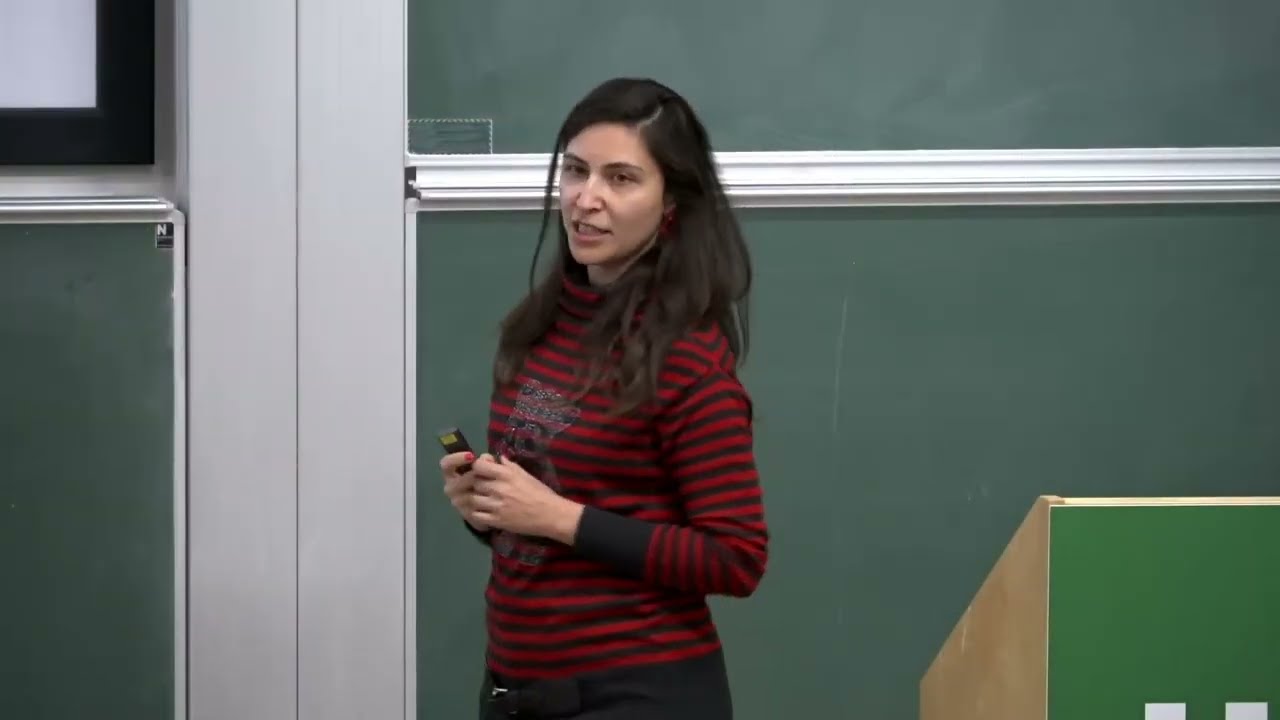
Dr. Raheleh Jalali | Formalizing the LLL algorithm in bounded arithmetic
Keywords
Summary
175 words
Critical Evaluation
Value of the Information & Strength of the Argument
The talk provides valuable insight into the formalization of a sophisticated algorithm within a weak arithmetic theory, demonstrating the feasibility of such a project and highlighting the subtle complexities involved. The argumentation is logical and well-structured: the speaker clearly explains the algorithm’s components and identifies the termination proof as the central challenge. The use of a concrete example to illustrate lattice reduction aids understanding. The discussion of the potential function for termination is rigorous, and the claims about the proof’s placement in PV1 are supported by references to existing work. The value lies in bridging computational complexity and proof theory, offering a concrete case study in bounded reverse mathematics.
Scientific Rigor, Source Quality, Title Accuracy
The scientific rigor is high; the presentation is based on the well-known LLL paper (Lenstra, Lenstra, Lovász, 1982) and builds on prior work on formalizing the AKS primality test in bounded arithmetic. The speaker is a domain expert from the University of Bath, and the venue (Isaac Newton Institute) is a prestigious research institution. The sources mentioned are appropriate and credible, though limited to the seminar page and the institute’s website in the description. The title matches the content precisely, with no discrepancy or exaggeration.
209 words
Title / Content Match
The title accurately reflects the content, which focuses on formalizing the LLL algorithm within bounded arithmetic.
Quality & Reliability
9/10
High-quality presentation by a domain expert at the Isaac Newton Institute, with rigorous technical content and clear reasoning.
Key Moments
Markers derived by PSI from the transcript: the creator did not define chapters.
- Introduction and joint work with U. Dalal.
- Problem statement: formalizing polynomial factorization in bounded arithmetic.
- Overview of the LLL algorithm steps and identification of lattice reduction as the challenging part.
- Introduction to PV1 theory and its relevance to polynomial-time reasoning.
- Explanation of termination proof using a determinant-based potential function.
- Current state of the project and future steps.
Cited Sources
- INI Seminar page — Event page for the talk, with additional details.
- Isaac Newton Institute for Mathematical Sciences — Institution hosting the seminar.
Contribution & Novelties
The main contribution is a formalization of the LLL algorithm in a weak arithmetic theory, specifically PV1, which is a significant step towards understanding the proof-theoretic strength required for lattice basis reduction. This work extends earlier efforts on the AKS primality test and demonstrates the feasibility of formalizing complex algorithms in bounded arithmetic. The termination proof, often intricate, is handled with a careful potential function.
Pour aller plus loin :
- Lenstra–Lenstra–Lovász lattice basis reduction algorithm — Provides background on the LLL algorithm and its applications.
- Bounded arithmetic — Introduces the theories of bounded arithmetic, including PV1 and related systems.
- Proof theory — Context for formalization efforts in logic and mathematics.
- PV1 theory — While not a direct article, the Cook–Reckhow theorem is relevant to complexity and proof systems; more precise sources may be found via the bounded arithmetic entry.
139 words
Radar Profile
The radar profile shows maximum technical depth and high reliability, while the quantity of information is moderate due to the concise nature of the talk. This reflects a focused, expert-level presentation with rigorous content.