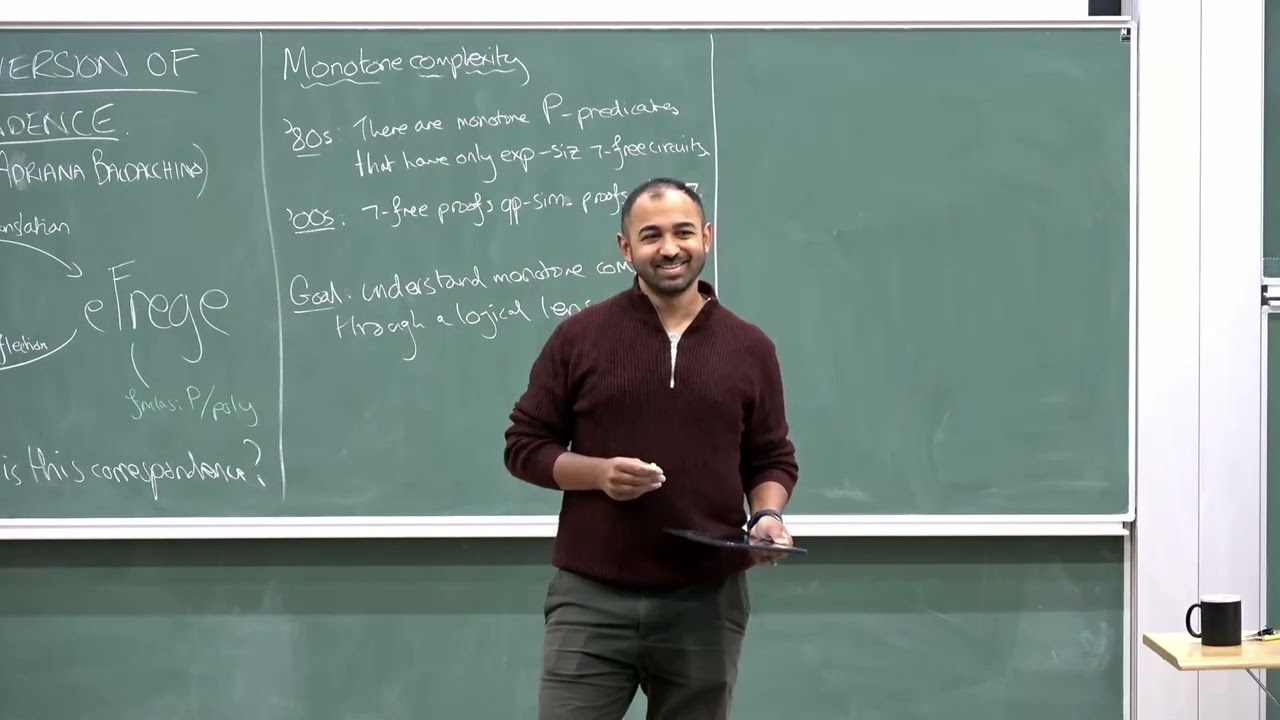
Prof. Anupam Das | A monotone version of Cook's correspondence
Keywords
Summary
118 words
Critical Evaluation
Value of the Information & Strength of the Argument
The talk provides valuable insights by extending classical Cook’s correspondence to the monotone setting, a domain where conventional intuitions about computational complexity break down. The argumentation is solid, systematically addressing obstacles such as the non-closure under Boolean combinations and the need for new coding techniques. The speaker motivates each design choice, making the technical developments comprehensible despite the high level of abstraction.
Scientific Rigor, Source Quality, Title Accuracy
The talk relies on established results from classical proof complexity and circuit complexity (e.g., Razborov’s lower bounds, L mesterman’s characterizations) and is presented at a high scientific standard. The source links provided in the description are the official INI seminar page and general institute page. The title accurately captures the essence of the work, which is a faithful monotone analogue of Cook’s correspondence.
140 words
Title / Content Match
The title accurately reflects the content: the talk presents a monotone version of Cook's correspondence between a positive theory PV and negation-free extended Frege systems.
Quality & Reliability
9/10
The talk is given by Prof. Anupam Das, an established researcher in proof complexity, at a recognized institution (INI). The content is technical, precise, and includes interaction with experts in the audience, indicating a high level of reliability and rigor.
Key Moments
Markers derived by PSI from the transcript: the creator did not define chapters.
- Introduction: background on Cook's correspondence between PV and extended Frege.
- Motivation for studying monotone computation and its divergence between circuit and proof complexity.
- Definition of monotone computation: negation-free circuits and positive polynomial-time functions.
- Design of positive PV: inequalities, induction on inequalities, and axioms for monotonicity.
- Theorem: positive PV proves inequalities with polynomial-size proofs in negation-free extended Frege.
- Length obliviousness of monotone functions and its use in coding and interpreting linear space equational theory.
- Reflection principle and conclusion.
Cited Sources
- Isaac Newton Institute — General institute website, context for the seminar.
- Seminar page: A monotone version of Cook's correspondence — Official seminar page providing event details and possibly additional materials.
Contribution & Novelties
The talk introduces a novel logical framework that extends Cook’s correspondence to the monotone world, overcoming significant technical hurdles related to the absence of case analysis and coding difficulties. This provides a new perspective on uniform monotone complexity and opens avenues for further research.
Pour aller plus loin :
- Proof complexity — Overview of the field, including key systems like Frege and extended Frege.
- Monotone circuit — Definition and importance of monotone circuits in circuit complexity.
- Cook–Reckhow theorem — Relates proof systems to computational complexity, foundational to Cook’s correspondence.
- PV theory — The equational theory for polynomial-time functions, central to the talk.
102 words
Radar Profile
The radar profile shows very high scores in technical level and quality of information, with slightly lower but still high scores in quantity and reliability. This indicates a highly specialized and rigorous presentation, best suited for an expert audience in mathematical logic.