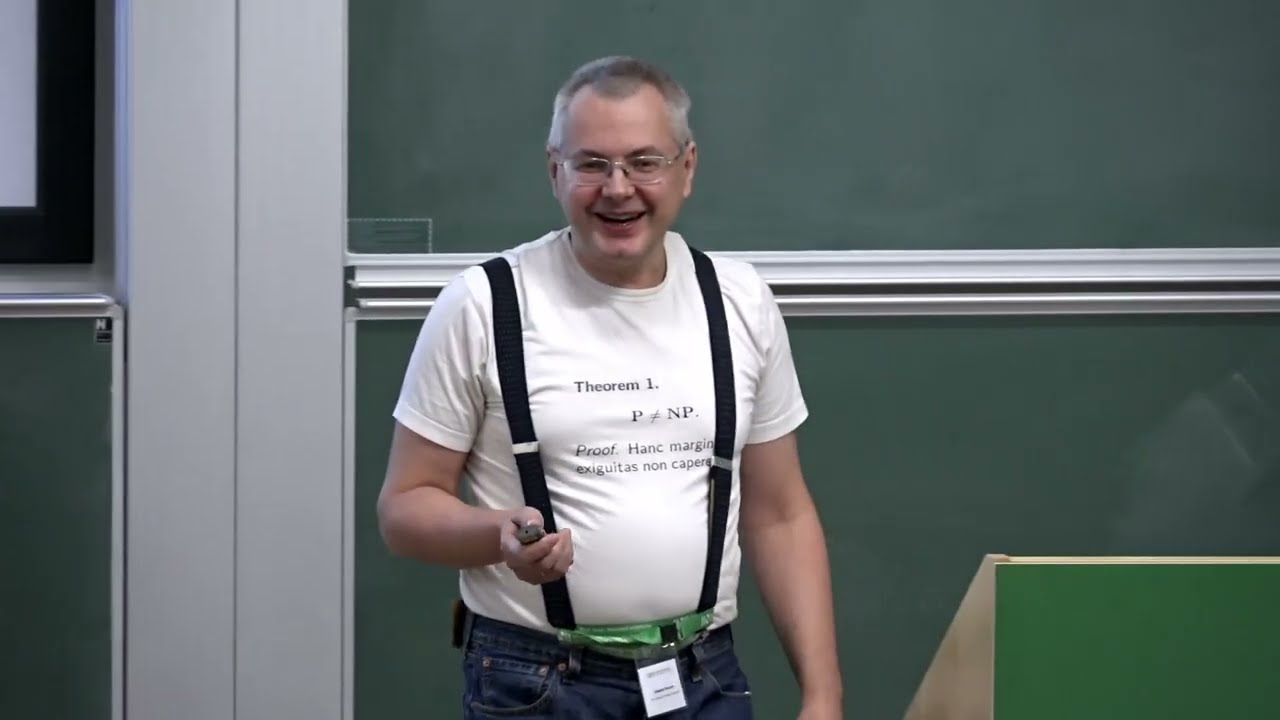
Prof. Edward Hirsch | Input-oblivious complexity classes in the second level of the Polynomial H...
Keywords
Summary
132 words
Critical Evaluation
Value of the Information & Strength of the Argument
The talk provides substantial value by introducing new complexity classes and establishing relationships that sharpen our understanding of the polynomial hierarchy and lower bounds. The argumentation is rigorous, built on clear definitions and logical deductions, with references to prior work that are appropriately contextualized. The use of examples and analogies (e.g., the map of classes) helps convey the significance of the results. The speaker also candidly discusses limitations and open problems, which strengthens the credibility of the presentation.
Scientific Rigor, Source Quality, Title Accuracy
The scientific rigor is high: the talk is hosted at a leading mathematical institute, the speaker is a recognized researcher, and the content appears technically sound. Sources are not explicitly cited with URLs, but the speaker references prior work (e.g., by Chakravarthy and Roy, Goldreich et al., Oliver and Tony) which is standard practice in research seminars. The title perfectly matches the content, as the entire talk is devoted to input-oblivious classes in the second level of the polynomial hierarchy. There is no stray from the main topic, and no public comments are available for analysis.
189 words
Title / Content Match
The title accurately describes the content: the talk focuses on input-oblivious complexity classes within the second level of the polynomial hierarchy.
Quality & Reliability
8/10
The talk is given by a professor at a renowned institute, presenting original research with clear definitions and proofs. The content appears technically rigorous, though verification requires reading the underlying paper.
Key Moments
Markers derived by PSI from the transcript: the creator did not define chapters.
- Introduction and motivation: input-oblivious classes and the use of AI in research.
- Definition of promise problems and their semantic nature in oblivious settings.
- Introduction of input-oblivious classes and historical context (Chakravarthy & Roy, etc.).
- Definition of Omin and its relation to OL2 and range avoidance.
- Properties: closure under Turing reductions, hard functions, and connections to ML and PRGs.
- Introduction of SOUP, its equivalence conjectures, and placement of other classes.
- Open questions, recent developments, and final remarks.
Cited Sources
- Isaac Newton Institute for Mathematical Sciences — Main website of the institute hosting the seminar.
- Seminar page — Details about the seminar event, part of the LFCW02 programme.
Contribution & Novelties
The talk introduces new complexity classes (Omin, SOUP) and establishes their relationships, offering unified frameworks for various known classes. It also improves upper bounds (e.g., MA placement) and provides new characterizations (e.g., OMA = BP-promise-OMP). These contributions advance our understanding of input-oblivious computations and their role in the polynomial hierarchy.
Pour aller plus loin :
- Polynomial hierarchy — Essential background on the hierarchy structure referenced throughout.
- Promise problem — Foundational concept for the semantic classes discussed.
- Circuit complexity — Relevant to the fixed-polynomial lower bounds and hard function constructions.
89 words
Radar Profile
The profile shows very high technical depth and information quality, with somewhat lower but still solid scores in quantity and global reliability. This reflects a dense, specialized seminar aimed at experts, with rigorous but limited breadth.