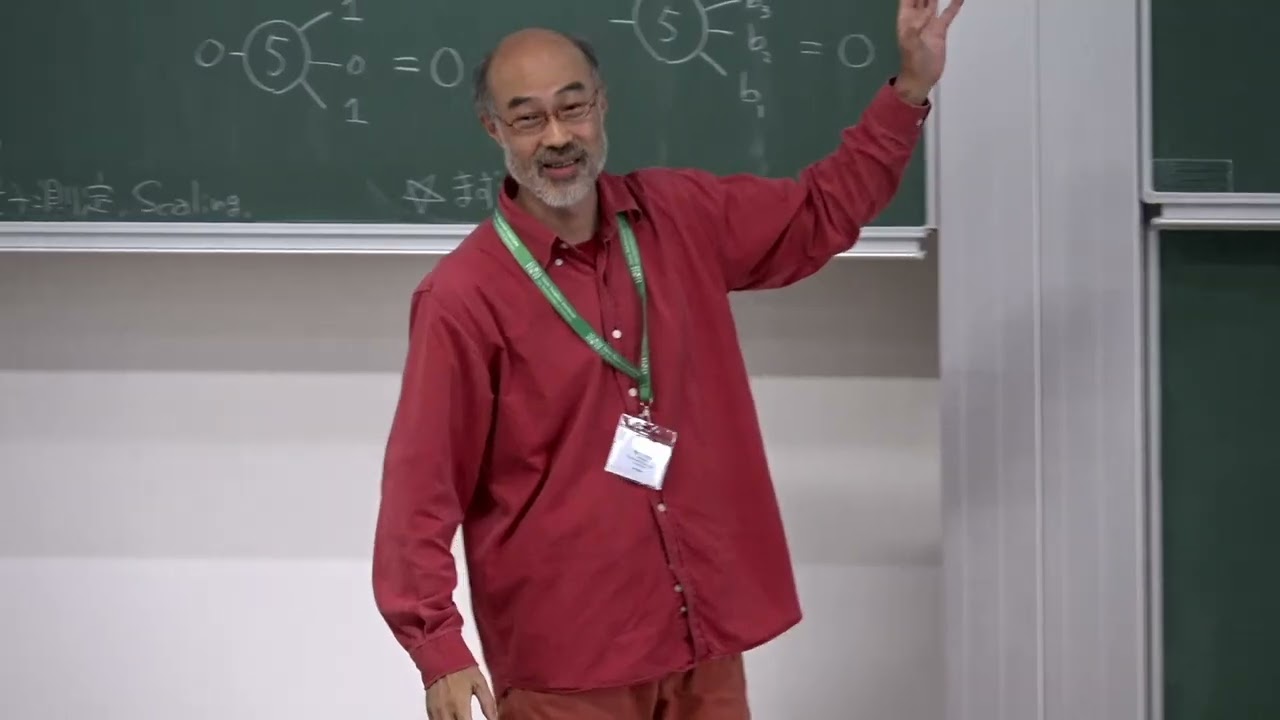
Prof. Tomotoshi Nishino | Tensor networks for statistical mechanical problems
Title history
- Prof. Tomotoshi Nishino | Tensor networks for statistical mechanical problems — observed on 20261030-1054 UTC (YouTube)
- Prof. Tomotoshi Nishino | Tensor networks for statistical mechanical problems Part I — observed on 20261028-1550 UTC (YouTube)
Keywords
Summary
167 words
Critical Evaluation
Value of the Information & Strength of the Argument
The talk provides valuable historical insights and a clear exposition of how tensor networks emerge naturally in statistical mechanics. Nishino skillfully connects seemingly distinct topics, such as crystal surfaces and quantum spin chains, through tensor network formalisms. The argumentation is solid, relying on established literature and original demonstrations. The use of binary addition to illustrate tensor network contraction is effective pedagogically. The speaker also encourages students to document their own ideas, underscoring the generative nature of the field. The discussion of AI-generated slides and personal anecdotes adds a personal touch but does not detract from the technical substance.
Scientific Rigor, Source Quality, Title Accuracy
The seminar adheres to high scholarly standards, referencing key papers in the field and providing historical context. The speaker explicitly mentions works by Baxter, Nightingale, and others, and credits the DMRG homepage as a resource. The description provides links to the Isaac Newton Institute and the specific seminar page, which serve as authoritative sources. The title is accurate, although it omits the historical and pedagogical aspects covered. The talk could have included more detailed citations with URLs, but given the format, the context is sufficiently rigorous. No external sources were directly cited with URLs in the talk itself, but the institutional links are reliable.
217 words
Title / Content Match
The title accurately reflects the content, which focuses on tensor network methods for statistical mechanical systems, as delivered by Professor Nishino.
Quality & Reliability
8/10
The talk is given by a leading expert in tensor networks, Professor Tomotoshi Nishino, at the Isaac Newton Institute. The content is historically grounded, references key papers, and presents original insights. Technical depth is high, and the speaker's authority is established. Minor caveats: some slides were not clearly visible, and the talk had occasional digressions.
Key Moments
Markers derived by PSI from the transcript: the creator did not define chapters.
- Introduction of Professor Nishino and his DMRG homepage.
- Discussion on the disordered flat phase in crystal surfaces and its relation to quantum spin chains.
- Historical overview of early tensor network works, including Baxter, Nightingale, and Britain.
- Illustration of tensor networks using integer representation and binary addition.
- Mapping of the Ising model to tensor networks via chessboard and SVD decomposition.
- Discussion of Fisher transformation and the eight-leg tensor representation.
Cited Sources
- Isaac Newton Institute for Mathematical Sciences — Official website of the host institution, providing context for the seminar.
- Seminar page: (MMBW02) European tensor networks school — Specific seminar page detailing the event and speaker.
Contribution & Novelties
The seminar offers a unique perspective by tracing the conceptual evolution of tensor networks in statistical mechanics, highlighting early contributions often overlooked. The speaker’s personal historical notes and the connection between classical statistical models and quantum tensor networks enrich the audience’s understanding. The emphasis on viewing basic operations (like binary addition) as tensor contractions provides a fresh pedagogical angle.
Pour aller plus loin :
- Matrix product state — A foundational concept in tensor networks, directly related to the MPS discussed in the seminar.
- Density matrix renormalisation group — The algorithm developed by White and closely connected to Nishino’s work.
- Tensor network — General overview of tensor networks, providing broader context.
- Ising model — The central statistical model discussed in the mapping examples.
122 words
Radar Profile
The radar profile shows a strong technical level (niveau_technique 9) and balanced scores for information quantity and quality (both 8). The reliability is slightly lower (8) due to the informal aspects of the talk. The speaker's expertise and institutional setting support the high technical and quality scores.