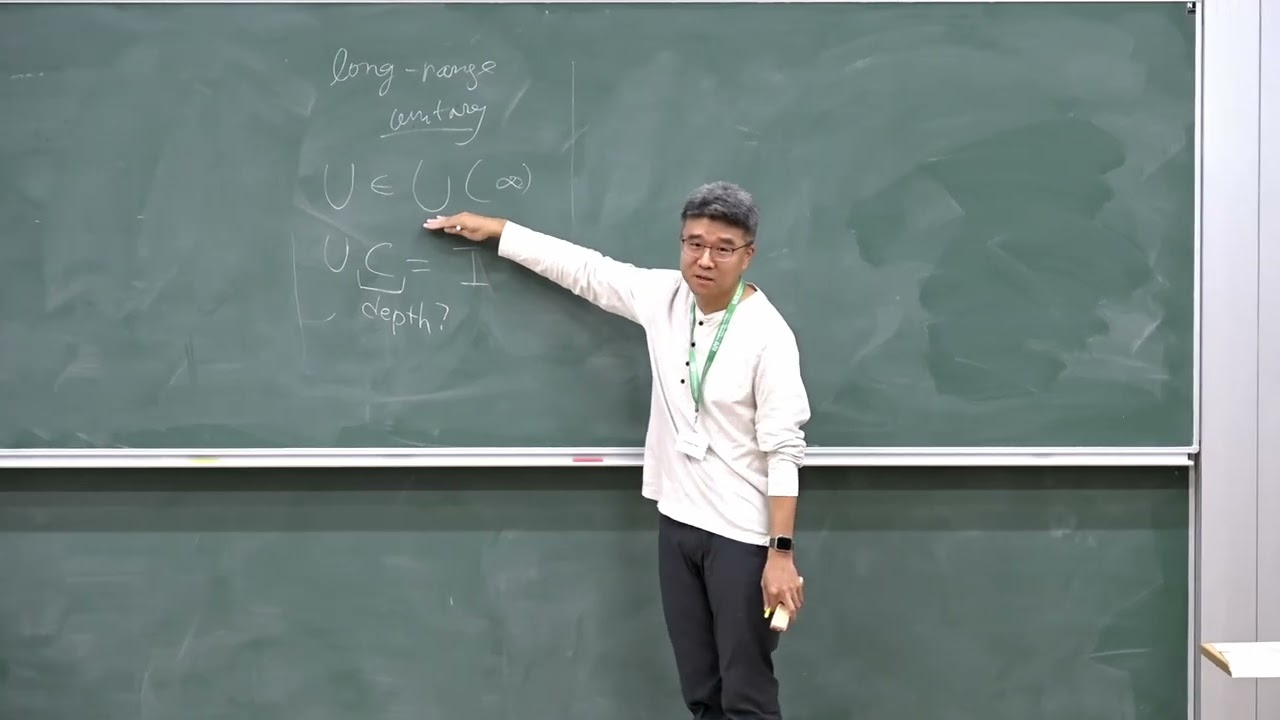
Dr. Jeongwan Haah | Long-range entangled unitaries and algebras
Title history
- Dr. Jeongwan Haah | Long-range entangled unitaries and algebras — observed on 20261104-1023 UTC (YouTube)
Keywords
Summary
151 words
Critical Evaluation
Value of the Information & Strength of the Argument
The talk provides a clear conceptual unification of long-range entanglement for states, unitaries, and algebras, which is a novel perspective. The argumentation is logically structured, starting from basic definitions and building up to a nontrivial example and proof sketch. The speaker carefully explains technical conditions such as bounded spread and the role of quantum circuits, making the reasoning accessible to a specialized audience. The connection between unitaries and algebras via dimensional reduction is insightful and supported by the QCA classification in one dimension. However, some parts of the proof are only sketched, and the key nontriviality result is not yet fully published, which tempers the completeness but does not undermine the overall value.
Scientific Rigor, Source Quality, Title Accuracy
The presentation adheres to rigorous mathematics and physics, with careful definitions and explicit constructions. The speaker references known results, such as the QCA classification by Gross, Nesme, Vogts, and Werner, and acknowledges a counterexample by Michael Levin, though these are not formally cited in the description. The title precisely matches the content, focusing on long-range entangled unitaries and algebras. The seminar is organized by the Isaac Newton Institute, a reputable venue. The use of sources is limited to the described links and internal citations, but the talk is primarily original research presented by an expert.
223 words
Title / Content Match
The title accurately reflects the content, which focuses on long-range entanglement in units (unitaries) and algebraic structures.
Quality & Reliability
8/10
The talk presents original research by an established expert in quantum many-body physics. The technical content is rigorous, but some results are still unpublished, which slightly affects reliability.
Key Moments
Markers derived by PSI from the transcript: the creator did not define chapters.
- Introduction: review of long-range entanglement for states and quantum circuit deformations.
- Generalization to unitaries and algebras: definitions using conjugation by quantum circuits.
- Example: two copies of toric code decomposed into three-fermion theories, generating a long-range entangled algebra.
- Connection to quantum cellular automata (QCA) and classification in 1D, leading to a dimensional correspondence.
- Proof sketch: nontriviality of the three-fermion algebra and the role of hopping operators.
- Discussion of gapped boundaries, commuting Hamiltonians, and a counterexample to folklore about chiral edge modes.
Cited Sources
- Isaac Newton Institute for Mathematical Sciences — The seminar is hosted by the Institute; general information about the organization.
- Seminar page: Structure of entanglement — Official event page providing details about the talk and related programme.
Contribution & Novelties
The talk contributes a novel framework for classifying long-range entanglement in unitaries and algebras, linking it to quantum cellular automata. The concrete construction using two copies of toric code reveals a nontrivial entangled algebra, with a proof of nontriviality outlined. This opens new directions in studying entanglement beyond states and may impact the understanding of topological phases and gapped boundaries.
Pour aller plus loin :
- Toric code — Fundamental model of topological order, central to the example presented.
- Quantum cellular automaton — Related concept used to characterize bounded-spread unitaries.
- Topological order — The broader context of long-range entanglement and phase classification.
101 words
Radar Profile
The radar shows a very high level of technicality (10) and a solid quantity of information (8), with quality and reliability slightly lower due to sketchy proof and unpublished results. This suggests a technically dense seminar that is valuable for experts but may be less accessibly balanced.