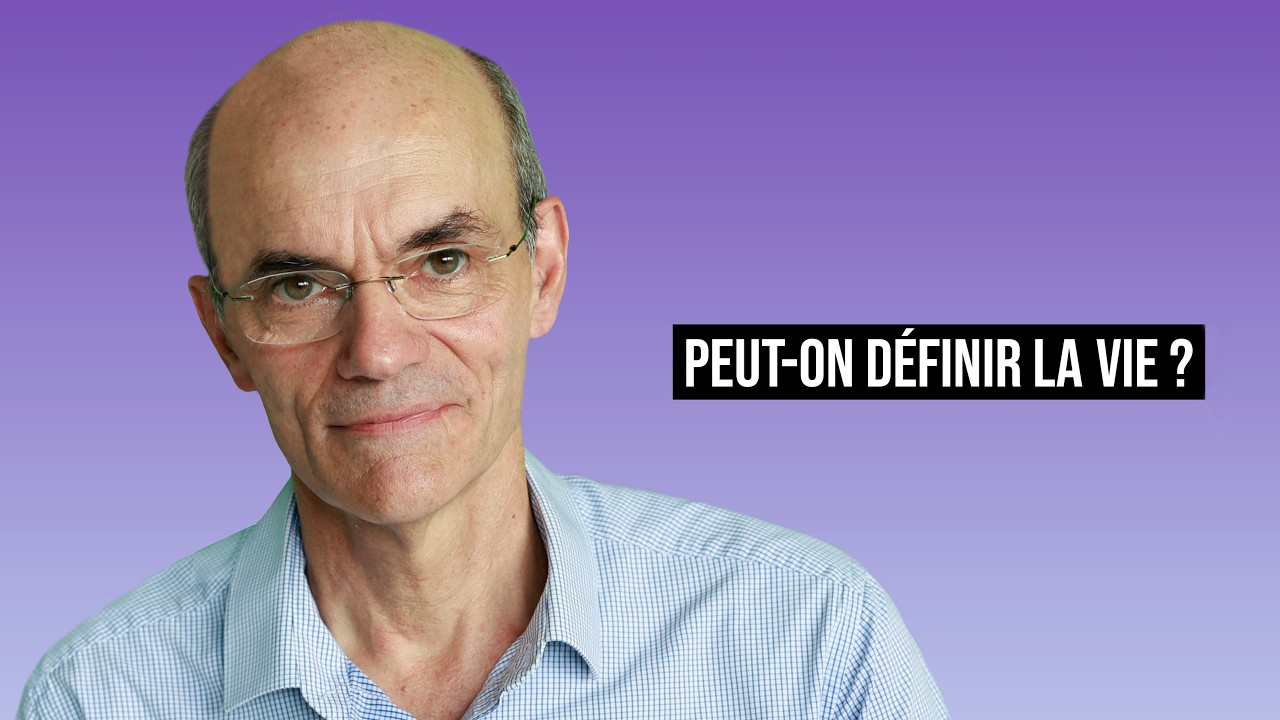
PEUT-ON DÉFINIR LA VIE ?
CAN LIFE BE DEFINED?
Keywords
Summary
156 words
Critical Evaluation
Value of the Information & Strength of the Argument
The video provides a valuable historical and conceptual overview, effectively illustrating how definitions of life have evolved and why they matter. The argumentation is solid: each definition is presented with its context and its implications, particularly the operational need in exobiology. The speaker balances historical accuracy with philosophical insight, and the logical flow is clear. However, the video does not engage deeply with cutting-edge debates (e.g., synthetic cells, artificial life), and some contemporary perspectives could have been more thoroughly explored.
Scientific Rigor, Source Quality, Title Accuracy
The scientific rigor is high: the speaker references well-known historical figures and properly attributes modern proposals (de Duve, Joyce, etc.). The sources mentioned in the description (AstrobioEducation, Ideas in Science) are relevant and institutional. The title accurately reflects the content, and the video’s scope is appropriate. The inclusion of the book ‘Comment définir la vie ?’ as a suggestion is useful for further reading. Overall, the presentation is rigorous and trustworthy.
166 words
Title / Content Match
The title directly matches the content: the video explores whether life can be defined and examines several historical and contemporary definition proposals.
Quality & Reliability
8/10
The speaker is a recognized historian of science, the historical definitions are accurately presented, and the discussion is logically coherent. The content is well-structured and references key scientific works, though it does not engage deeply with the most recent debates (e.g., synthetic biology).
Key Moments
Markers derived by PSI from the transcript: the creator did not define chapters.
- Introduction: everyday discrimination between living and non-living, and the difficulty of explicit criteria.
- Bichat's definition: 'life is the set of functions that resist death' and its vitalist context.
- Lamarck's transformist definition based on physical causes (calorique) and its implications.
- Claude Bernard's dual dynamics: phenomena of creation (synthesis) and destruction (organic decomposition).
- Modern definitions: Christian de Duve's empirical and biochimical criteria, excluding viruses.
- Autopoiesis and the definition by Damaglio and Luisi, connecting biology and philosophy.
- Exobiology's need for a discriminative definition; NASA's adopted definition by Gerald Joyce (1992).
- Michel Morange's perspective on the coupling of characteristics; conclusion that no definitive definition exists.
Cited Sources
- AstrobioEducation — The series AstrobioEducation, from which this video is part, and which focuses on astrobiology education.
- Ideas in Science — The channel's platform housing over 3000 scientific lectures.
- Ideas in Science – Donation page — Support for the channel's free science video library.
- Astrophysics playlist — A playlist of related science lectures on the channel.
Contribution & Novelties
This video contributes a concise historical synthesis of definitions of life, highlighting the pragmatic necessity of such definitions in exobiology. While it does not present original research, it effectively bridges historical perspectives with current scientific requirements, making the topic accessible without oversimplification.
Pour aller plus loin :
- Definition of Life (Wikipedia) — Overview of various definitions and debates.
- Autopoiesis (Wikipedia) — Deepens the concept by Maturana and Varela, essential for understanding Damaglio/Luisi.
- Exobiology (Wikipedia) — Contextualizes the need for a working definition in space exploration.
- Vitalism (Wikipedia) — Historical background to Bichat’s view and its decline.
96 words
Radar Profile
The radar profile shows moderate-to-high scores overall, with lower technical level reflecting the accessible nature of the presentation. The quantity and quality of information are well balanced, and reliability is high due to the expert speaker and institutional backing.