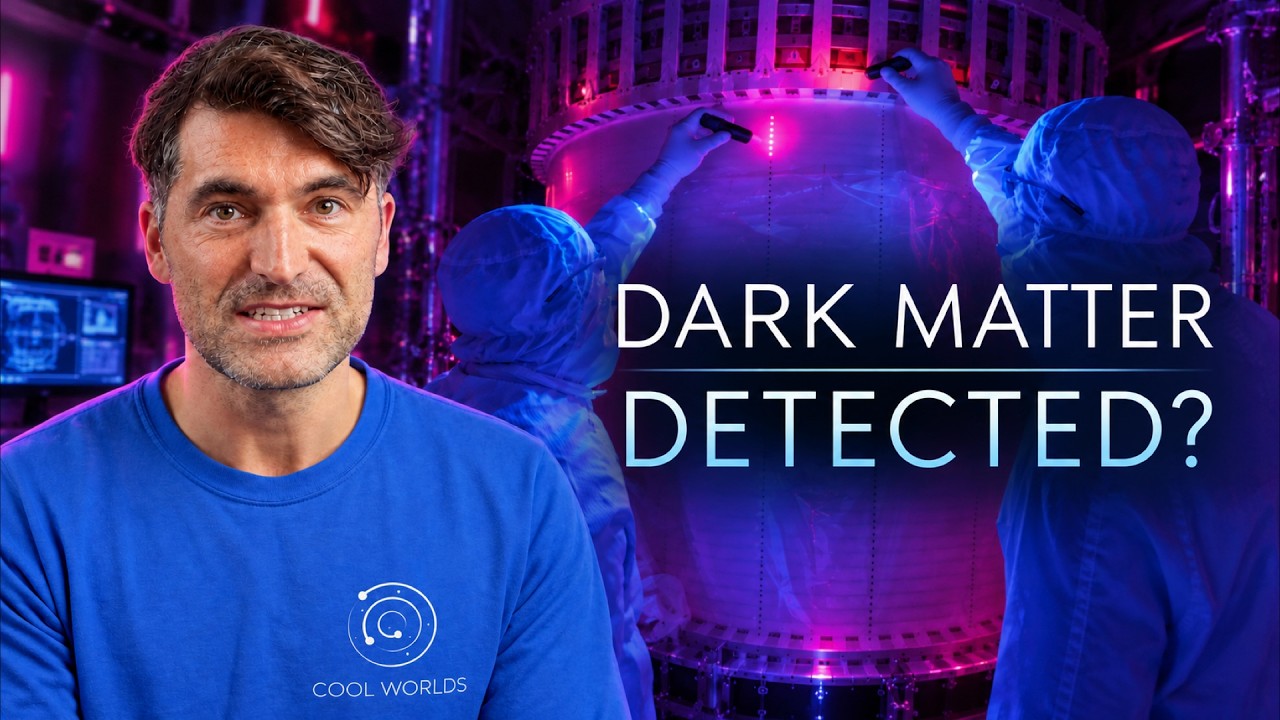
Did We Finally Detect Dark Matter Directly?
Keywords
Summary
219 words
Critical Evaluation
Value of the Information & Strength of the Argument
The video provides strong value by comprehensively explaining the context, the experimental setup, and the statistical interpretation of the LZ result. It successfully balances excitement with caution: the presenter explicitly notes that 2.6 sigma is not a detection and that the robustness test has limitations. The argumentation is solid, as it walks viewers through the physics of detection, the background reduction strategies, and the compatibility with earlier limits. The inclusion of a commissioned fact-check by a particle physicist adds credibility. However, the video does not cite specific publications or provide direct references to the LZ papers or other sources, which would enhance verifiability. The logical flow is coherent, and the presenter clearly distinguishes between observed evidence and theoretical interpretation.
Scientific Rigor, Source Quality, Title Accuracy
The scientific rigor is high: the presenter relies on established concepts like the WIMP miracle and the standard model of cosmology, and transparently explains the limitations of the reported signal. The use of salting is correctly described, and the potential issue with the energy level of the candidate event is acknowledged. The title is appropriately phrased as a question, reflecting the uncertainty, and the video thoroughly addresses the question. The description provides links to the channel’s support page, merchandise, podcast, and music credits, but no direct scientific references are given in the description. The video mentions collaborations with a cosmologist (Colin Hill) but does not provide a direct link. Overall, the content is well-grounded in scientific knowledge, though direct citations to the LZ collaboration papers or other specific research would be desirable for a fully rigorous presentation.
271 words
Title / Content Match
The title poses a question that the video directly addresses, explaining the evidence, the experimental details, and the appropriate interpretation. It matches the content accurately.
Quality & Reliability
8/10
The video is produced by an established astrophysicist, David Kipping, who explicitly states that a particle physicist (Kaliroe Pappas from Columbia University) was commissioned to fact-check the script. The content aligns with current scientific consensus and appropriately caveats the statistical significance of the claim. The presentation is clear, well-structured, and avoids overhype, though the lack of direct citations to specific papers reduces the verifiability to some extent.
Chapters
Cited Sources
- Cool Worlds Lab Support — Support link for the channel and research
- Cool Worlds Merch — Merchandise store
- Cool Worlds Podcast — Podcast channel referenced in the description
- Creative Commons Attribution License — Music licensing reference
- Cool Worlds Music Playlist — Playlist of background music used in videos
External References
Contribution & Novelties
The video offers a clear and balanced explanation of a recent scientific claim, contextualizing it within the broader search for dark matter. It breaks down the technical aspects of the LZ experiment in an accessible way while honestly addressing the statistical limitations. The inclusion of ‘salting’ and the ’neutrino fog’ concepts provides valuable nuance often missing in popular coverage. The video also discusses alternative dark matter candidates, encouraging a broader perspective.
Pour aller plus loin :
- Dark matter (Wikipedia) — Provides a comprehensive overview of dark matter evidence and candidates.
- LZ experiment (Wikipedia) — Details the LUX-ZEPLIN detector, its design, and results.
- Weakly interacting massive particle (Wikipedia) — Explains the WIMP hypothesis and searches.
- Supersymmetry (Wikipedia) — The theoretical framework predicting neutralinos.
- Neutrino fog (blog post or article?) — Discussion of the neutrino fog barrier. (Note: URL is uncertain, but concept can be searched.)
144 words
Radar Profile
The radar chart would show balanced scores across information quality, technical depth, and reliability, with a slightly lower quantity of information due to the video's moderate length but high density. The overall profile suggests a high-quality, informative science communication piece.
💬 Très positif. Sur les 30 commentaires analysés, les viewers expriment une grande appréciation pour la clarté des explications, l'enthousiasme du présentateur, et la rigueur scientifique, plusieurs mentionnant que c'est la meilleure analyse de cette découverte potentielle vue à ce jour.