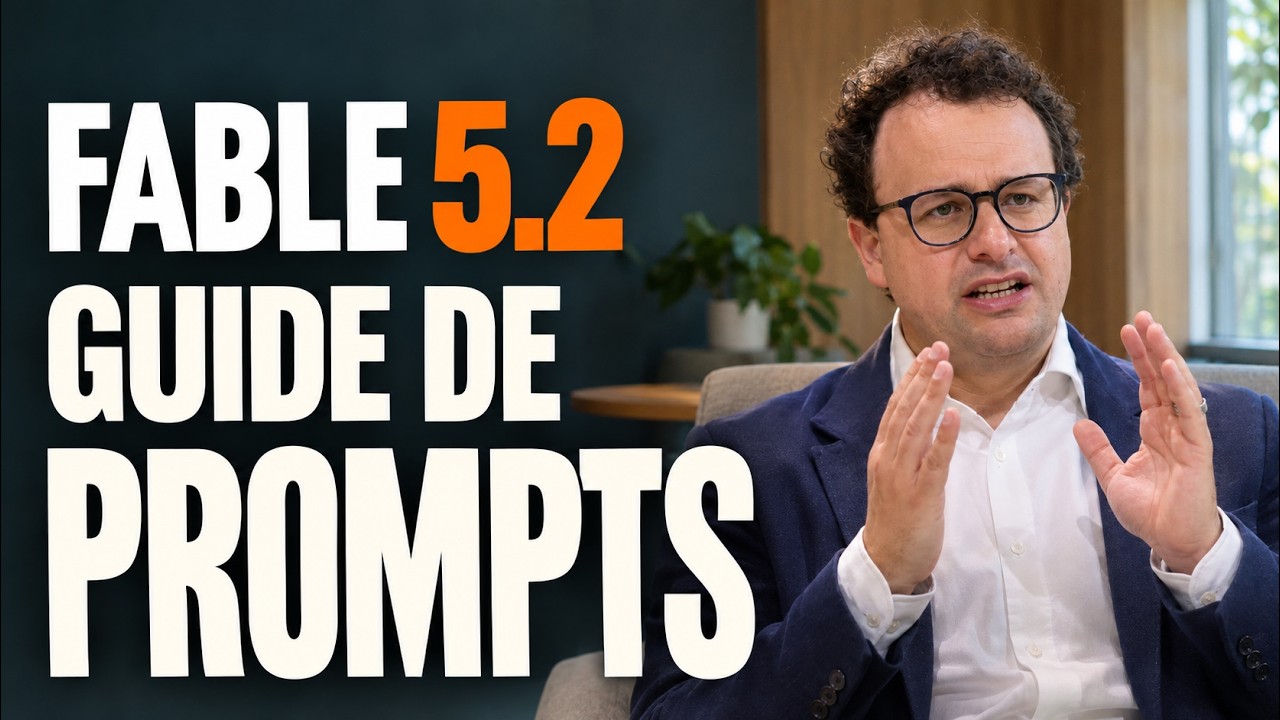
Anthropic révèle enfin comment prompter Fable 5.2 !
Anthropic finally reveals how to prompt Fable 5!
Title history
- Anthropic révèle enfin comment prompter Fable 5.2 ! — observed on 20261112-0839 UTC (YouTube)
Keywords
Summary
199 words
Critical Evaluation
Value of the Information & Strength of the Argument
The video provides valuable and concrete information about Anthropic’s official guidelines for model selection and prompt engineering, including specific cost-performance trade-offs. The creator supports his arguments with examples from the guide and personal experience, making the technical advice practical. However, the argumentation is sometimes weakened by emotional digressions and unverified claims about job market statistics. The core technical content is solid, but the presentation mixes expertise with personal motivation, which may distract from the main topic.
Scientific Rigor, Source Quality, Title Accuracy
The video is based on a guide published by Anthropic, written by Adi Osman, but no direct URL is provided in the description; only a link to a paid training course appears. The creator repeatedly references ‘Anthropic’s guide’ without citing a verifiable source, reducing traceability. The title is accurate, and the content aligns with the promise of explaining how to prompt Fable 5.2. However, the lack of independently verifiable sources and the inclusion of promotional content (training course) lower the overall rigor.
173 words
Title / Content Match
The title accurately reflects the core content: the video explains how to prompt the new Fable 5.2 model based on Anthropic's official guidance. Some extra personal commentary is included, but the main focus matches.
Quality & Reliability
7/10
The video relies heavily on the official Anthropic guide and provides concrete cost-performance data, but it also includes personal anecdotes and strong opinions that reduce objectivity. The lack of direct references to external sources (beyond the guide mentioned) limits verifiability.
Chapters
Cited Sources
- Formation IA & Business — Lien mentionné dans la description comme formation recommandée, non lié au contenu technique principal.
Contribution & Novelties
The video offers a practical synthesis of Anthropic’s official guidance on the Fable 5.2 model, emphasising cost optimization and a shift from simple prompting to agent-systems architecture. It provides concrete figures for cost implications and introduces concepts like sub-agent configuration and prompt caching. While the basic ideas are not novel, the video succeeds in translating them into actionable advice for practitioners.
Pour aller plus loin :
- Prompt engineering — Relevant for understanding the evolution of prompting techniques.
- AI agent — Background on autonomous software agents and their applications.
- SWE-bench — Benchmark used to evaluate code generation and repair abilities of LLMs, cited in the video.
105 words
Radar Profile
The profile shows strong scores in quantity and technical level, with moderate scores in quality and reliability. This indicates the video is rich in technical details but lacks rigorous sourcing and independent verification, making it valuable for practitioners but not fully reliable for scientific depth.