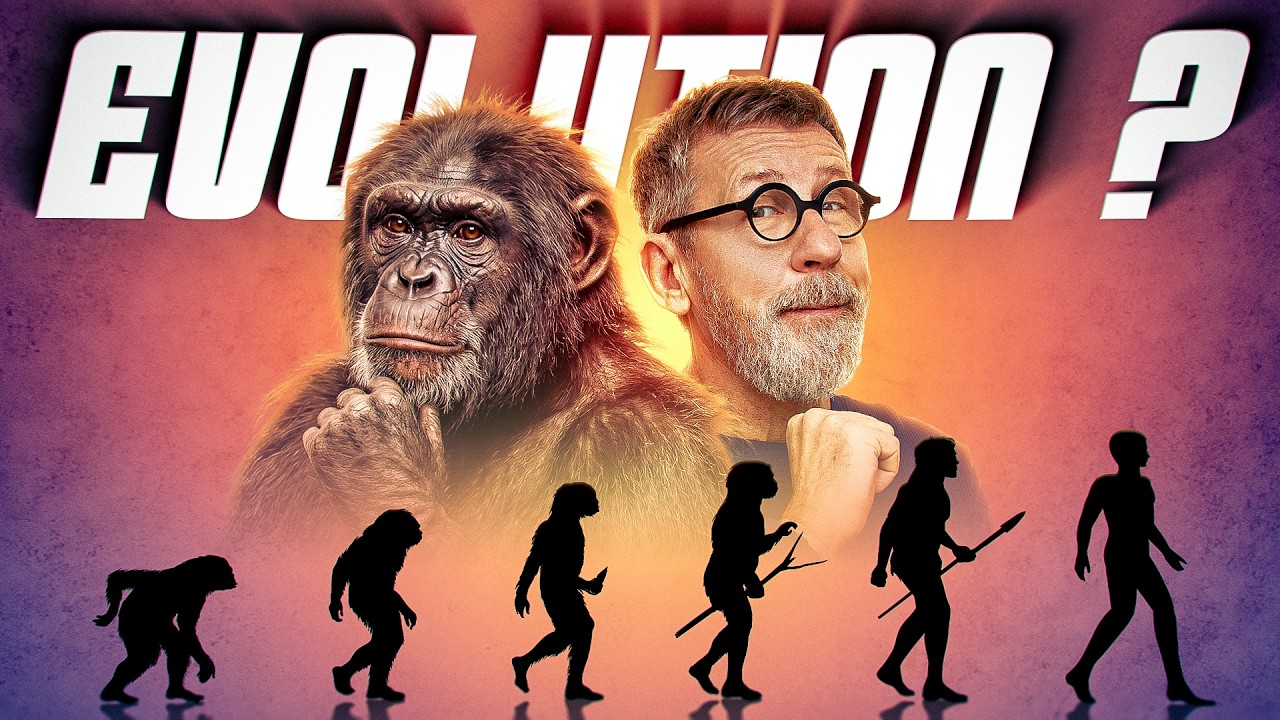
L'Homme descend-il vraiment du singe ?
Do Humans Really Come from Apes?
Keywords
Summary
320 words
Critical Evaluation
Value of the Information & Strength of the Argument
The informational value of this video lies mainly in its choice of entry point. Rather than listing facts about human evolution, it begins with a documented scientific fraud and shows how that fraud, far from being a mere curiosity, actively sustained a false mental model for decades. This gives the correction that follows real narrative force: the viewer is not simply told that the ’ladder’ model is wrong, they are shown how the ladder model was able to survive. The second strength is the clarity of the conceptual vocabulary introduced: the distinction between a descendant lineage and a shared node, the term DAC (last common ancestor), the notion of a bushy rather than linear radiation. The video repeatedly applies the same reasoning pattern, proposing a fossil as a candidate for the DAC and then eliminating it on chronological grounds, which teaches the viewer a criterion rather than a conclusion. The density is high for a 14-minute format, with roughly a dozen named fossils, four historical animal-language experiments and two field research programmes packed into the runtime, and the transitions are always justified by a question rather than an arbitrary cut. The argumentation is weakest where it accelerates. The leap from encephalisation to cumulative culture is presented as the decisive human singularity without any supporting evidence beyond a single nut-cracking example, and the claim that cumulative knowledge is what took humans to the Moon closes the reasoning with a rhetorical flourish rather than an argument. The repeated ‘99% of DNA’ figure is used as a narrative pivot twice without any indication of what is being compared, a point that matters because the rhetorical weight of the whole last third rests on it. The comparison between human achievement and chimpanzee life is also framed in a slightly evaluative register (‘our cousin is having an easy time of it’), which is entertaining but implicitly hierarchical in a way that sits awkwardly with the message that humans are simply one ape among others. Overall the reasoning is well constructed and internally consistent, but it relies more on well-chosen examples than on explicit evidential chains.
Scientific Rigor, Source Quality, Title Accuracy
On scientific rigour, the historical section is the most solid part. The Piltdown sequence is reported accurately: discovery in 1912 by Charles Dawson, examination by British Museum experts, presentation to the Geological Society of London, worldwide diffusion, doubts, then the 1953 re-analysis showing that the cranium and the mandible came from different periods and different species, and finally the 2016 study attributing the fabrication to Dawson. The fossil chronology is also broadly correct, with the divergence between the human and Pan lineages placed between 6 and 10 million years ago, Toumaï at around 7 million years, Orrorin slightly later, Australopithecus between 3 and 4 million years, Homo erectus around 2 million years and Homo sapiens around 300,000 years. The anatomy presented, notably the high larynx and small pharynx of chimpanzees and the revision of that explanation in favour of neural wiring, reflects the current state of the debate rather than an obsolete version of it. On source quality, however, the video is essentially undocumented. Two named professors from the Muséum national d’Histoire naturelle are interviewed and provide direct testimony, which constitutes real institutional authority, but no study, article, book or dataset is cited for any of the factual claims, and the description contains only a subscription link and social media accounts. The viewer therefore has no way to verify a date, a percentage or an attribution. The treatment of the animal-language experiments is honest in this respect: the Koko figure of 1,000 signs is explicitly flagged as difficult to verify scientifically, and the failure of the speech experiments is reported as failure. The Kanzi lexigram work, by contrast, is presented without the standard caveat that receptive comprehension and spontaneous productive grammar are different things. On title/content fit, the title’s question is answered directly and early, and the rest of the video serves as justification; the fit is exact, with the only mismatch being that the title promises less than the video delivers, since language and primate pharmacology occupy nearly a third of the runtime.
699 words
Title / Content Match
The title asks a direct question and the video answers it explicitly and early ('we are not descended from apes, we are apes'), then spends the rest of the runtime justifying that answer. The match is complete, although the title is narrower than the actual content, which also covers language and primate self-medication.
Quality & Reliability
8/10
The factual content is accurate and up to date: the Piltdown hoax chronology (1912 discovery, 1953 re-analysis, 2016 attribution to Dawson), the arborescent rather than linear model of evolution, the placement of humans within the hominids, the 6–10 million year divergence window for the human/chimpanzee last common ancestor, and the fossil series (Teilhardina, Proconsul, Lluc, Toumaï, Orrorin, Lucy, Homo erectus, Homo sapiens) are all correctly presented. Two researchers from the Muséum national d'Histoire naturelle are interviewed on camera, which gives the content institutional authority. The reserve is documentary rather than factual: no bibliographic reference, DOI or study title is given for any claim, and the description contains no scientific link, so nothing can be traced or checked by the viewer. The repeatedly stated 99% DNA figure is a rounded approximation presented without methodological nuance.
Chapters
- 0:30 - Intro
- 2:23 - L'homme de Piltdown et la théorie que l'Homme descend du singe selon Dawson
- 3:29 Nous sommes nous même des singes !
- 7:02 Notre ancêtre commun : Le DAC
- 7:40 Quels traits communs-partageons nous avec notre plus proche cousin le chimpanzé ?
- 8:20 Quelles différences avons nous ?
- 9:45 Quelles évolutions chez l'homme au fil des millénaires ?
- 11:40 Pourquoi pouvons nous parler ?
- 12:22 Le langage chez les singes
- 14:36Les primates ont la connaissance des médicaments !
- 14:51 Outro
Cited Sources
- Évelyne Heyer, professor of genetic anthropology, Muséum national d'Histoire naturelle (interview) — Interviewed on screen to describe the branching of the human and chimpanzee/bonobo lineages and the probable arboreal, partly bipedal nature of the last common ancestor.
- Sabrina Krief, professor of ecology, Muséum national d'Histoire naturelle (interview) — Interviewed on her long-term observations of chimpanzees in Kibale National Park, Uganda: use of antiseptic leaves, bark for coughs, rough leaves as a purge, geophagy, and the overlap with plants used by local healers.
- Study attributing the Piltdown forgery to Charles Dawson (2016) — Mentioned without title or authors as the study that identified Dawson himself as the perpetrator of the hoax.
- 1953 re-analysis of the Piltdown remains — Presented as the battery of new tests that established the human cranium and orangutan mandible belonged to different periods and species.
- Alban Lemasson, ethologist, work on Campbell's mona call sequences — Cited for the finding that Campbell's monas combine calls following syntactic rules, with distinct call sequences for leopard and eagle predators.
- Kanzi, bonobo trained on a lexigram keyboard (1980s) — Presented as having mastered around 350 symbols representing objects and abstract concepts such as good and bad.
- Koko, gorilla taught sign language (1980s) — Reported as having learned around 1,000 signs according to her trainers, with the figure explicitly described as difficult to verify scientifically.
- Gua (1930s) and Viki (1950s) speech-training experiments — Cited as the historical attempts to teach chimpanzees spoken language, ending in failure or in the production of four words only.
Concurring Sources
- Piltdown Man — Wikipedia — Confirms the 1912 discovery, the 1953 exposure of the hoax, the human cranium combined with an orangutan mandible, and the later attribution to Charles Dawson.
- Sahelanthropus (Toumaï) — Wikipedia — Supports the dating of Toumaï at approximately 7 million years and the debate over its bipedal status and position relative to the human lineage.
- Orrorin — Wikipedia — Corroborates the age of Orrorin and the use of femoral anatomy to argue for bipedalism.
- Australopithecus afarensis — Wikipedia — Supports the description of Lucy as a habitual but not exclusive biped with long arms indicating partial arboreal life.
- Hominidae — Wikipedia — Confirms the classification of humans within the great apes (Hominidae), which underpins the video's central claim that humans are themselves apes.
- Kanzi — Wikipedia — Corroborates the lexigram keyboard work and the vocabulary of several hundred symbols, while also documenting the scientific debate over what such performance demonstrates.
Dissenting Sources
- Estimates of human–chimpanzee genetic distance — The video states twice that humans share 'about 99%' of their DNA with chimpanzees. The figure depends entirely on what is compared and how: single-base substitutions in aligned regions, inclusion or exclusion of insertions and deletions, and protein-coding versus non-coding sequence give values that spread across roughly 98.5% to 99.5%. Stating a single rounded number without indicating the method overstates the precision and, in this video, carries considerable argumentative weight.
- Interpretation of syntactic structure in primate alarm-call sequences — The presentation of Campbell's mona call combinations as evidence of 'grammar and syntax' is more assertive than the underlying literature, where the crucial question is whether the ordering reflects compositional meaning or simpler statistical and contextual regularities. The video moves from 'call sequences follow rules' to 'language is not the prerogative of man' in a single step, which some primatologists would consider premature.
External References
Radar Profile
The profile is that of a well-informed popularisation piece: high on information quantity and quality, moderate on technical depth, and strong on reliability. The low technical score reflects the deliberate absence of methodological detail, genetics and cladistics being mentioned by name rather than explained. The gap between information quality and technical level is exactly what one expects from an expert-interview format aimed at correcting a misconception rather than training a specialist.