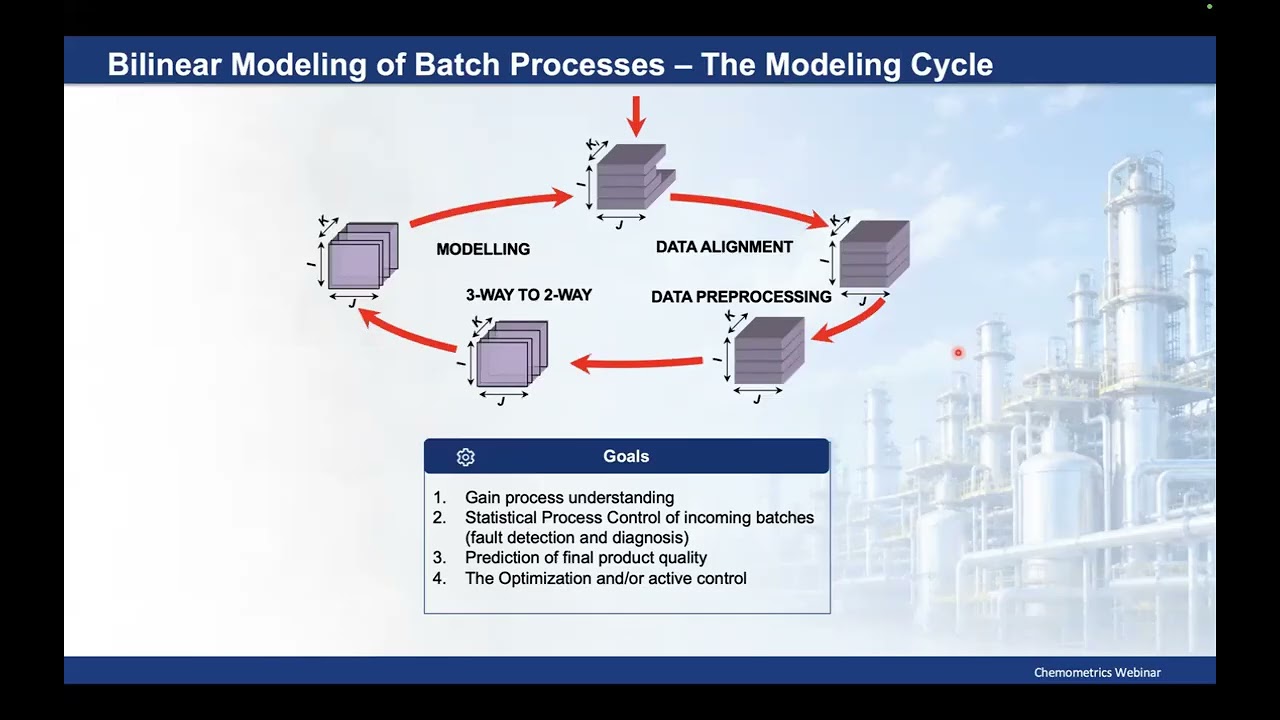
A Walk Through the Bilinear Modeling Cycle for Batch Processes
Title history
- A Walk Through the Bilinear Modeling Cycle for Batch Processes — observed on 20261028-1006 UTC (YouTube)
Keywords
Summary
162 words
Critical Evaluation
Value of the Information & Strength of the Argument
The value of the information lies in the clear structuring of a complex modeling workflow, making it accessible to practitioners. The argued advantages of missing-data imputation over simple interpolation are demonstrated with a concrete example, strengthening the credibility. The speaker supports claims by referencing his own book and toolbox, and provides intuitive explanations of methods like dynamic time warping without heavy mathematics. However, the argumentation sometimes relies on assertions rather than extensive scientific evidence; for instance, the statement that preprocessing is orthogonal to three-way transformation is stated without formal proof, though it is a known principle in chemometrics. Overall, the webinar serves as a solid educational resource rather than a presentation of new research.
Scientific Rigor, Source Quality, Title Accuracy
The content is scientifically rigorous, grounded in established chemometric methods (PCA, PLS, DTW) and the presenter’s extensive experience. The sources cited are mainly internal (the book and the associated MV Batch Toolbox), with no external references provided in the description. The title is accurate: the presentation indeed walks through the entire bilinear modeling cycle. Adequation is high, with no significant mismatch between title and content. No public comments were provided to analyze for additional insights.
204 words
Title / Content Match
The title accurately reflects the content: the webinar provides a step-by-step walkthrough of the bilinear modeling cycle, from data alignment to monitoring.
Quality & Reliability
8/10
The presenter is a co-author of a well-regarded book on batch processes and the webinar presents established methodologies (PCA, PLS, DTW) with concrete demonstrations. The technical depth is consistent and the presentation appears rigorous, though it lacks external citations beyond the book and associated toolbox.
Key Moments
Markers derived by PSI from the transcript: the creator did not define chapters.
- Introduction and motivation for PAT and batch process modeling.
- Discussion of challenges: high-dimensional, collinear, misaligned data in batch processes.
- Data equalization: demonstration of solving differing sampling rates using interpolation vs. regression-based imputation.
- Data synchronization: introduction to dynamic time warping and its application in aligning batch trajectories.
- Data preprocessing: variable vs. trajectory centering and scaling, and the importance of preprocessing independence.
- Overview of modeling for monitoring, fault detection, prediction, and optimization, and concluding remarks on the book's toolbox.
Cited Sources
- LinkedIn profile of José María González Martínez — LinkedIn profile of the presenter and co-author of the book 'Data Science for Batch Processes'.
Contribution & Novelties
The webinar provides a clear, integrated walkthrough of the bilinear modeling cycle, bringing together data alignment, synchronization, preprocessing, and modeling in a single framework accessible to practitioners. The demonstrations with the MV Batch Toolbox offer practical, replicable examples that bridge theory and application. The novel aspect is the emphasis on the order and interdependence of steps, and the provision of open-source tools for the community.
Pour aller plus loin :
- Dynamic time warping — Core synchronization method used for aligning batch trajectories.
- Principal component analysis — Latent variable method underlying much of the modeling discussed.
- Partial least squares — Another key method for predictive modeling of batch quality.
- Process analytical technology — Regulatory context and framework driving the adoption of these techniques.
122 words
Radar Profile
The radar chart shows high scores in quality and quantity of information, with slightly lower technical level and reliability scores due to reliance on internal sources and limited external verification. This profile indicates a well-structured educational webinar that is trustworthy in its content but would benefit from broader citation of independent sources.