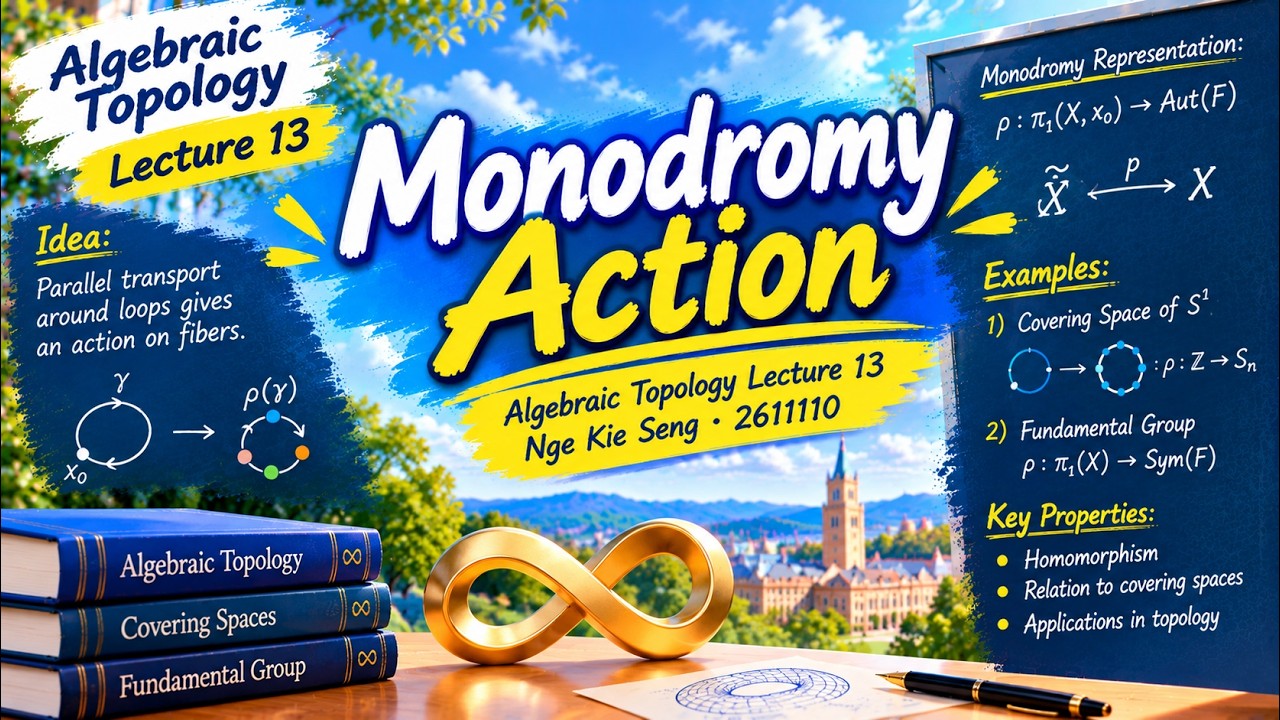
Monodromy Actions | Algebraic Topology Lecture 13 | Nge Kie Seng 2611110
Title history
- Monodromy Actions | Algebraic Topology Lecture 13 | Nge Kie Seng 2611110 — observed on 20261113-2156 UTC (YouTube)
Keywords
Summary
164 words
Critical Evaluation
Value of the Information & Strength of the Argument
The lecture provides a conceptual overview of one of the most elegant correspondences in topology: the bijection between connected covering spaces and conjugacy classes of subgroups of the fundamental group. The instructor’s explanations, while informal, effectively convey the intuition behind the construction and why the correspondence holds. He argues from known theorems like the lifting criterion and the existence of universal covers, and he clarifies how different basepoints lead to conjugate subgroups, reinforcing the robustness of the classification. The use of a wedge of circles and permutation representations nicely concretizes the abstract ideas. The argumentation is generally sound, though some key proofs are skipped or left as exercises, which is typical for a lecture setting. Overall, the value lies in synthesizing several difficult concepts into a coherent narrative, making it an excellent study aid for advanced undergraduate or graduate students.
Scientific Rigor, Source Quality, Title Accuracy
The lecture is a self-contained presentation by an academic, but no external sources are cited in the description or during the talk. The mathematical rigor is acceptable as it follows standard textbook material (e.g., Hatcher’s ‘Algebraic Topology’), though the lack of explicit references limits verifiability. The title accurately reflects the content, which indeed centers on monodromy actions and Galois correspondence in covering spaces. The informal digressions and administrative discussions do not detract from the core scientific value, but they do lower the perceived precision. No public comments are available, so the reception cannot be assessed.
250 words
Title / Content Match
The title emphasizes monodromy actions, which are central to the Galois correspondence in covering spaces discussed in the lecture. The content aligns with this title, focusing on covering spaces, fundamental groups, and the correspondence with subgroups.
Quality & Reliability
7/10
The lecture is delivered by an academic mathematician and presents standard results in algebraic topology, but the informal style and lack of formal citation reduce reliability. The mathematical content is well-established, though the presentation includes digressions and unverified statements.
Key Moments
Markers derived by PSI from the transcript: the creator did not define chapters.
- Opening remarks and administrative announcements, followed by a brief discussion of the lifting criterion.
- Explanation of the existence of simply connected covering spaces and their construction via homotopy classes of paths.
- Introduction of the Galois correspondence: defining the equivalence relation on the universal cover and demonstrating that subgroups correspond to covering spaces.
- Examples of three-fold covering spaces of a wedge of circles, using permutations of fibers to distinguish different covers.
- Discussion of the universal cover as the largest covering space and the ordering relation between subgroups and covering spaces.
Contribution & Novelties
The lecture contributes a pedagogical synthesis of covering space theory and the Galois correspondence, emphasizing the analogy with field theory. It clarifies how the fundamental group acts as a global invariant to classify covering spaces, and it provides a concrete construction using quotient spaces. The discussion of conjugation and basepoint dependence is particularly useful.
Pour aller plus loin :
- Covering space - Wikipedia — A comprehensive reference on covering spaces, including the Galois correspondence and universal covers.
- Fundamental group - Wikipedia — Background on the algebraic invariant central to the classification.
- Galois connection - Wikipedia — The abstract concept generalizing the correspondence presented here.
- Hatcher’s Algebraic Topology (free PDF) — Standard textbook covering these topics in depth.
117 words
Radar Profile
The radar profile shows high scores in technical level and information quantity, indicating a dense and advanced lecture. Quality and reliability are slightly lower, reflecting the informal style and lack of explicit citations, but the overall shape suggests a solid academic presentation.