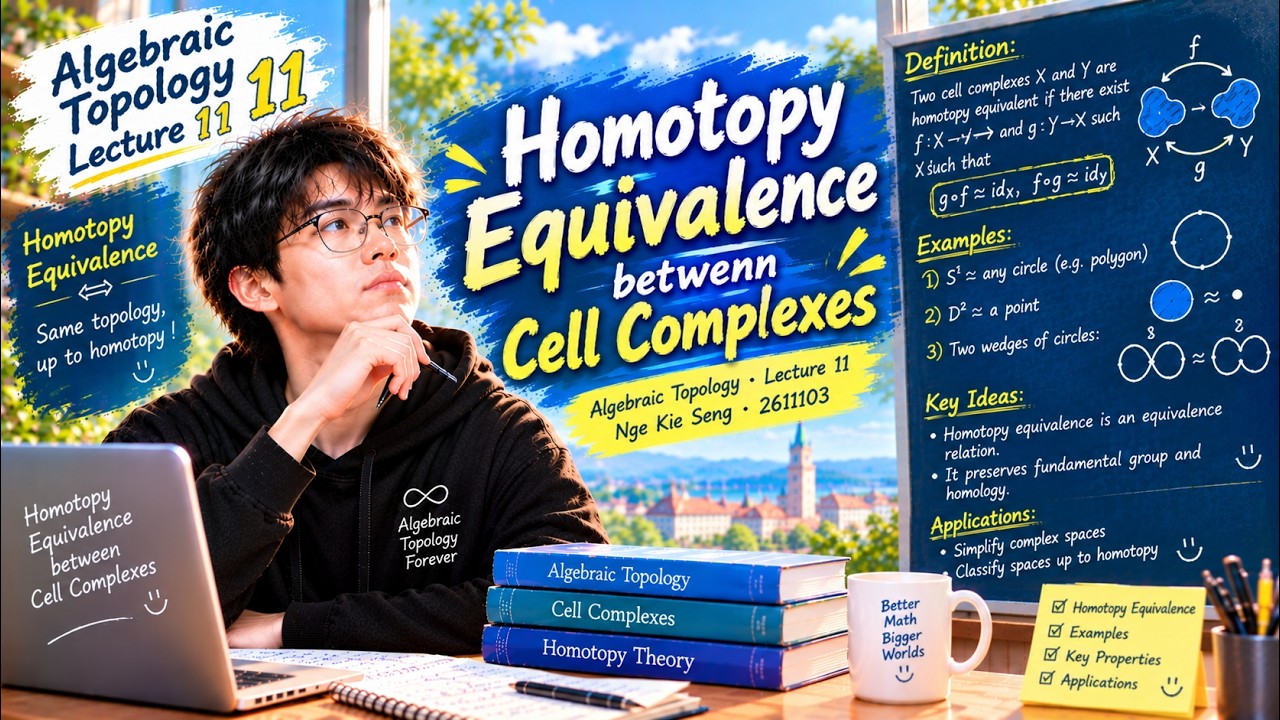
Homotopy Equivalence betwenn Cell Complexes | Algebraic Topology Lecture 11 | Nge Kie Seng 2611103
Title history
- Homotopy Equivalence betwenn Cell Complexes | Algebraic Topology Lecture 11 | Nge Kie Seng 2611103 — observed on 20261103-2359 UTC (YouTube)
Keywords
Summary
138 words
Critical Evaluation
Value of the Information & Strength of the Argument
The lecture provides a solid pedagogical value by presenting two fundamental techniques for constructing homotopy equivalences: collapsing subspaces and attaching spaces. The argumentation is largely intuitive, relying on examples and visual reasoning, which is appropriate for an introductory course. The instructor carefully explains the role of the homotopy extension property and its necessity for the validity of the claims, though the proof is deferred to tutorials. The discussion of homotopies between attaching maps is detailed, with an emphasis on ensuring continuity during deformation. While the reasoning is generally sound, some steps are left for students to verify, which encourages active learning. The lecturing style is interactive, with multiple student interventions, which may aid comprehension but also introduces occasional digressions that obscure the overall flow.
Scientific Rigor, Source Quality, Title Accuracy
The scientific rigor is high, as the content aligns with standard algebraic topology topics and the instructor demonstrates deep familiarity with the subject. No explicit external sources are cited in the description, but the material is consistent with established textbooks on algebraic topology. The title accurately reflects the content, though it contains a minor typo (‘betwenn’ instead of ‘between’ in the original). The lack of provided sources means that the reliability depends on the lecturer’s expertise, which appears credible. The absence of a formal structure (e.g., chapters) reduces navigability, but the lecture is coherent within its scope. Overall, the title is appropriate and the content is scientifically sound.
247 words
Title / Content Match
The title accurately describes the lecture content about homotopy equivalence of cell complexes.
Quality & Reliability
7/10
The lecture is delivered by an expert in algebraic topology, but the technical content is dense and the transcription contains many interruptions, which may reduce clarity. The content is consistent with standard material.
Key Moments
Markers derived by PSI from the transcript: the creator did not define chapters.
- Introduction and review of homotopy equivalence
- Statement of first claim about collapsing subspaces and HEP
- Example of sphere and wedge, collapsing subspaces
- Discussion of graphs and homotopy equivalence
- Second claim about attaching spaces and homotopy of attaching maps
- Discussion of homotopy between attaching maps and student questions
- Further discussion and conclusion
Contribution & Novelties
The lecture provides a clear pedagogical exposition of two classical construction techniques for homotopy equivalences, emphasizing the role of the homotopy extension property. It contributes to the understanding of how collapsing and attaching operations preserve homotopy type, with concrete examples that illustrate the underlying mechanisms. The interactive engagement with students helps to clarify subtleties, such as the continuity of homotopies during deformation.
Pour aller plus loin :
- Homotopy extension property — Directly relates to the HEP condition discussed in the lecture.
- Mapping cylinder — A construction that appears when gluing spaces along attaching maps.
- Fundamental group — Used in the lecture to analyze the effect of homotopy equivalences on loop spaces.
111 words
Radar Profile
The radar profile shows high technical level and good information quality, but moderate quantities of information and reliability. This reflects a dense, expert-level lecture that is not fully polished in presentation but offers substantial content.