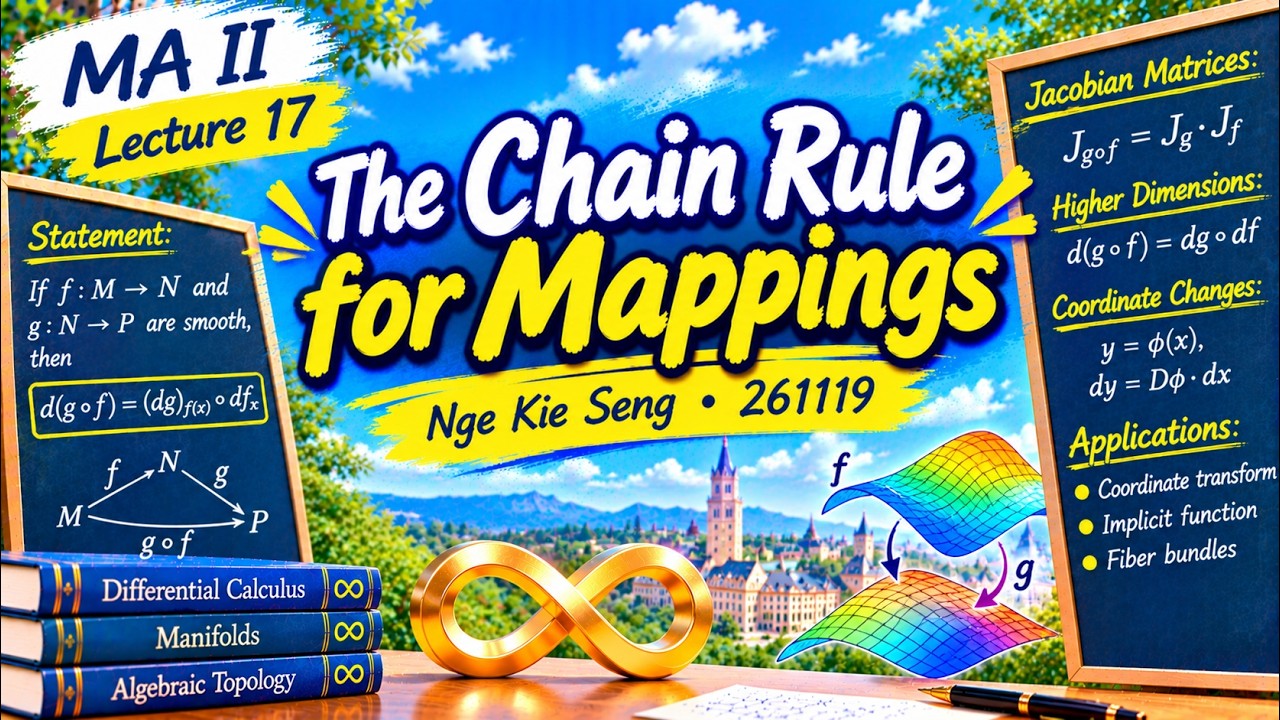
The Chain Rule for Mappings | MA II Lecture 17 | Nge Kie Seng 261119
Title history
- The Chain Rule for Mappings | MA II Lecture 17 | Nge Kie Seng 261119 — observed on 20261121-1609 UTC (YouTube)
Keywords
Summary
176 words
Critical Evaluation
Value of the Information & Strength of the Argument
The lecture provides high educational value by offering a complete, self-contained derivation of the chain rule and its generalizations, demonstrating both the underlying ideas and the technical details. The argumentation is rigorous: the lecturer carefully reviews the size of matrices, invokes known theorems (mean value theorem, first-order approximation), and proves auxiliary lemmas (stability of invertible matrices) before using them. The step-by-step proof is clear, and the example helps solidify understanding. The exposition is mathematically sound and builds intuition by relating the gradient to the derivative matrix and then to general Jacobians.
Scientific Rigor, Source Quality, Title Accuracy
The lecture does not cite external sources but relies on standard mathematical analysis concepts, which are presented with full derivations. The rigor is high: definitions are precise, proofs are complete, and the lecturer explicitly verifies dimensions and domain conditions. The title is perfectly aligned with the content: the lecture indeed focuses on the chain rule for mappings, as indicated. The instructor also mentions using an AI to write a poem for the midterm, but that is not relevant to the mathematical content. There is no evidence of any commercially sponsored segment.
197 words
Title / Content Match
The title accurately reflects the lecture's content, which focuses on the chain rule for mappings, as part of a university-level mathematical analysis course.
Quality & Reliability
9/10
The lecture presents rigorous mathematical proofs, uses precise notation, and demonstrates a complete derivation of the chain rule and related theorems. The presentation is scholarly and technically sound.
Key Moments
Markers derived by PSI from the transcript: the creator did not define chapters.
- Introduction of derivative matrix notation and gradient as special case.
- Statement and proof of the chain rule for scalar-valued functions of vector variables.
- Generalization to arbitrary mappings using derivative matrices.
- Worked example of the chain rule for a map from R to R³.
- Beginning of the inverse function theorem discussion, including a linear algebra lemma on invertible matrices.
- Definition of stable mappings and the nonlinear stability theorem.
Concurring Sources
- Chain rule - Wikipedia — Standard mathematical result that the video derives for mappings.
- Inverse function theorem - Wikipedia — Video introduces this theorem after chain rule, relying on stability conditions.
Contribution & Novelties
This lecture offers a clear and thorough pedagogical presentation of the chain rule for mappings, bridging the gap between scalar calculus and multivariable generalisations. It emphasizes the conceptual unity through derivative matrices and the importance of verifying dimensions. The proof strategy via mean value theorem and first-order approximations is a valuable learning tool.
Pour aller plus loin :
- Chain rule — Foundational concept, generalisation to multiple variables.
- Jacobian matrix and determinant — Directly related to derivative matrices used in the lecture.
- Inverse function theorem — The theorem that follows the chain rule in this lecture series, with these lemmas as prerequisites.
101 words
Radar Profile
The radar chart reveals a very high quantitative content and technical depth, with slightly lower but still strong marks in information quality and reliability. This profile is typical of a rigorous university lecture: dense, precise, and trustworthy, though it may be less accessible to non-specialists.