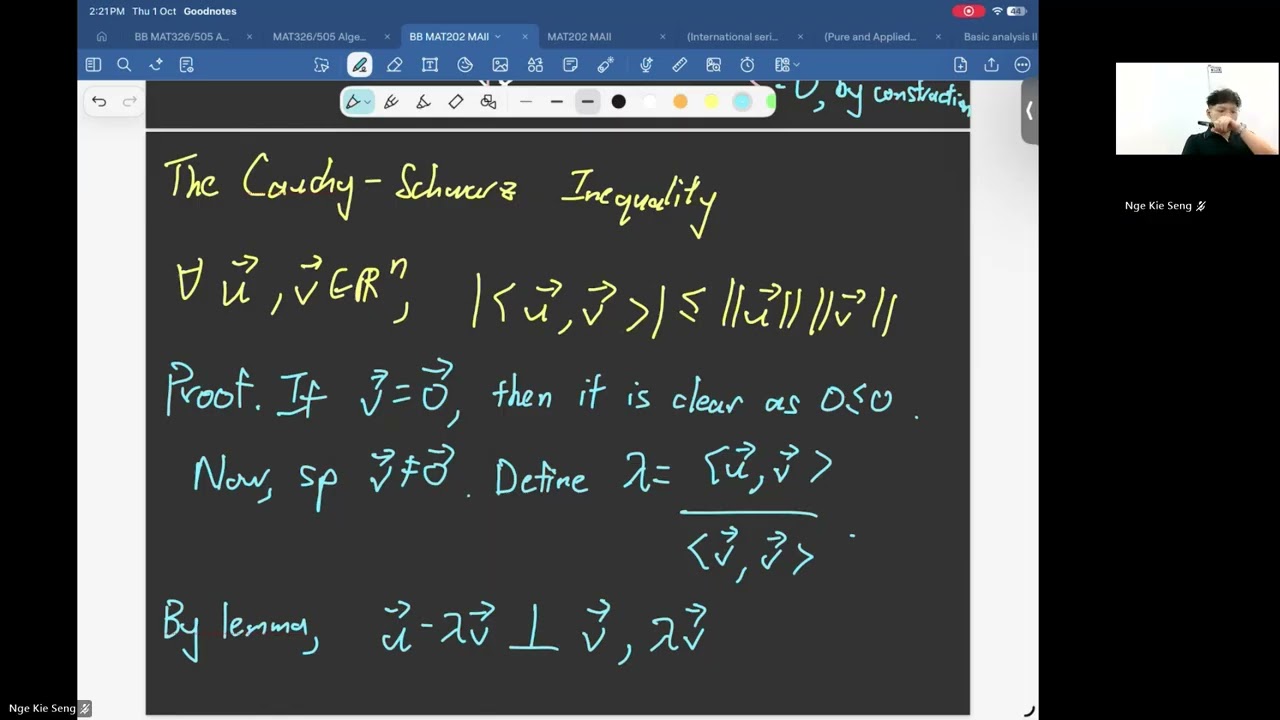
The Cauchy-Schwarz Inequality | MA II Lecture 2 | Nge Kie Seng 261001
Keywords
Summary
135 words
Critical Evaluation
Value of the Information & Strength of the Argument
The value lies in the clear, step-by-step derivation of Cauchy-Schwarz from elementary principles, which is essential for advanced analysis. The argumentation is logically sound: the instructor demonstrates that the inner product of a vector with itself is non-negative, then rearranges to obtain the inequality. The subsequent application to the triangle inequality is properly motivated, showing how Cauchy-Schwarz provides the necessary bound. However, some steps are rushed, and the instructor occasionally relies on intuitive statements rather than rigorous epsilon-delta proofs, especially in the convergence discussion. The connections to broader mathematical fields (algebraic geometry, topology) add value by providing context, though they are only mentioned briefly.
Scientific Rigor, Source Quality, Title Accuracy
No external sources are cited, which is typical for a lecture, but the mathematical content adheres to standard proofs found in any analysis textbook. The rigor is acceptable for an introductory undergraduate course, but the oral style lacks the precision of a written exposition. The title accurately highlights the main topic, but the lecture covers more than just Cauchy-Schwarz, including distance and sequence convergence, which is not reflected in the title. Overall, the content is reliable, but it would benefit from a more structured presentation. No comments were available for analysis.
210 words
Title / Content Match
The title focuses on the Cauchy-Schwarz inequality, which is the central topic, but the lecture also covers triangle inequality, distance, and sequences. This slight mismatch does not diminish the usefulness.
Quality & Reliability
7/10
The lecture presents canonical mathematical results (Cauchy-Schwarz, triangle inequality, metric properties) with accurate reasoning. However, the oral delivery is informal, proofs are sketched rather than fully formalized, and no external references are provided. The content is reliable for a standard university course but lacks the rigor of a formal written source.
Key Moments
Markers derived by PSI from the transcript: the creator did not define chapters.
- Introduction and course logistics, links to MA1 and broader mathematical fields
- Recall of inner product and norm definitions
- Proof of Cauchy-Schwarz inequality using projection method
- Application to prove triangle inequality for norms
- Definition of distance and generalization to metrics
- Sequences in R^n and convergence definition using norm
- Discussion of the triangle inequality for distance and reverse triangle inequality
- Proof idea for uniqueness of limits and assignment for next session
Contribution & Novelties
The lecture offers a didactic approach to a classical inequality, emphasizing the connection between algebraic structures and topological properties. Its contribution is in the pedagogical flow, showing how Cauchy-Schwarz underpins the triangle inequality and how this extends to metric spaces. The mention of pseudometrics in Einstein’s gravity is a nice motivational aside.
Pour aller plus loin :
- Cauchy-Schwarz inequality — Direct link to the main topic, with multiple proofs and historical context.
- Inner product space — The general setting where the inequality holds, including infinite-dimensional spaces.
- Metric space — Generalizes the distance concept discussed, explaining the axioms of symmetry and triangle inequality.
- Triangle inequality — Foundational inequality with applications across mathematics.
111 words
Radar Profile
The radar profile shows a strong technical level (8/10) against moderate quantity (7) and reliability (7), and lower quality of information (6). This indicates a content-rich but informally presented lecture, appropriate for an intermediate audience but not a reference source.